
Pain Management for Tattoo Artists: 2026 Relief Guide

Medically reviewed by
Dr. Saurabh Dang, MD, MBA
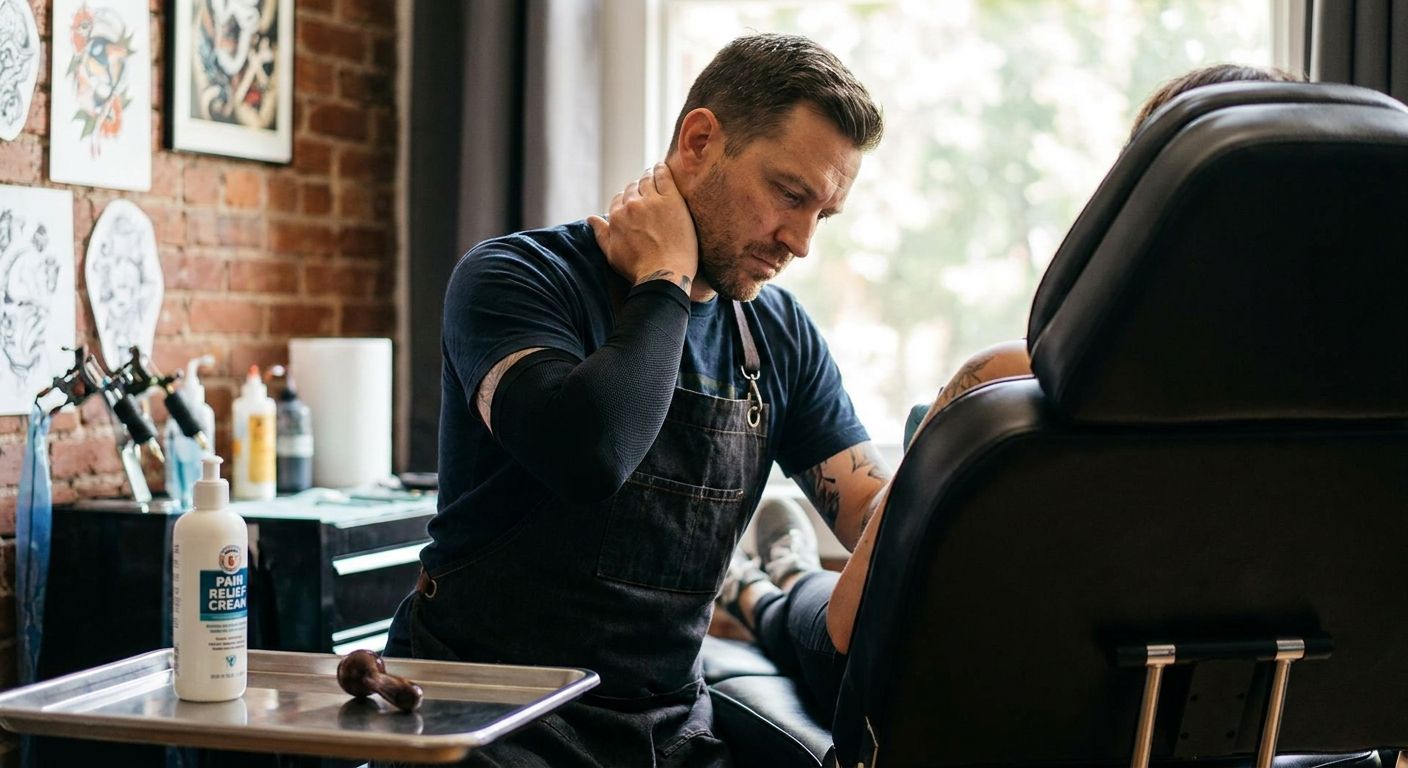
Tattoo artists spend entire shifts hunched over a table, wrist pinned in one position, neck craned forward for hours at a stretch — and by year five or six, that posture starts sending bills due. Pain management for tattoo artists means treating chronic neck and back strain caused by repetitive, static positioning, not a single injury.
TL;DR
- Trigger point injections give tattoo artists targeted relief for shoulder and upper back knots in 2026 without downtime — Recommended.
- Cervical facet joint pain from forward head posture responds well to radiofrequency ablation, with relief often lasting 6-12 months.
- Skip generic OTC pain patches as a long-term fix — they mask strain instead of addressing the posture pattern causing it.
- A same-week evaluation with a board-certified pain specialist beats guessing at home remedies once pain interferes with holding a machine steady.
Why this matters
A tattooist’s job is a posture problem disguised as an art form. Leaning over a client for 3, 4, sometimes 6 hours at a time loads the cervical spine, the trapezius, and the lower back in ways a desk job never does — and unlike an office worker, you can’t just stand up and stretch mid-session without breaking your line.
Over years, that repeated static load leads to cervical facet joint irritation, chronic trapezius trigger points, and disc-level strain in the lower back. Ignore it long enough and steady-hand work — the entire basis of the craft — starts to suffer. Getting ahead of pain management for tattoo artists before it becomes a career-limiting issue is the difference between adjusting your setup now and needing a procedure later.
Who this is for
This guide is for working tattoo artists — shop owners, apprentices, and freelancers alike — who spend most of a shift leaning forward over a table or chair, holding a machine with a pinch grip, and turning their head to one side repeatedly during a session. If you’re finishing shifts with a stiff neck that won’t loosen, a burning ache between the shoulder blades, or lower back pain that gets worse the longer the appointment runs, this is your pain profile.
What to look for in pain management for tattoo artists
A specialist who understands repetitive occupational strain
General practitioners often default to rest and ibuprofen, which doesn’t touch the mechanical cause of pain built from years of forward-leaning posture. You want a provider who asks about your setup — chair height, table angle, hours per session — before recommending a treatment plan.
Diagnostic precision before treatment
Neck and back pain in tattoo artists can come from facet joints, disc irritation, or myofascial trigger points, and each needs a different approach. A specialist who confirms the pain generator with exam findings or imaging before treating avoids months of guesswork.
Treatments that don’t sideline you for weeks
You can’t book clients if you’re out of commission. Interventional options like trigger point injections and nerve blocks typically involve minimal downtime compared to surgery, which matters when your income depends on being at the table.
A plan that addresses ergonomics, not just symptoms
A single injection wears off if the setup that caused the pain doesn’t change. Look for guidance on chair height, magnifying lamp positioning, and break intervals alongside any procedure.
Insurance and scheduling that fit a non-9-to-5 income
Many tattoo artists work as independent contractors or 1099 shop renters without employer-sponsored insurance. A practice that walks through coverage options and appointment timing around your booking calendar removes a real barrier to getting treated.
Top picks: treatments that fit a tattoo artist’s schedule and strain pattern
Trigger point injections — the fast, low-downtime fix
The hook: this is the pick for artists whose main complaint is a knotted, burning spot between the shoulder blades or at the base of the neck. Trigger point injections target the exact muscle band causing referred pain, and most patients tolerate the procedure with only a few minutes of discomfort.
Relief is often felt within days, and the appointment itself typically takes well under an hour — workable between bookings. Verdict: Recommended for artists with focal muscle knots rather than diffuse pain.
Cervical facet joint treatment — for the forward-head crowd
The hook: this is the pick for artists whose pain is specifically in the neck and worsens with looking down for long stretches. Chronic forward head posture during close detail work irritates the small facet joints in the cervical spine, and diagnostic facet joint pain in the neck evaluation can confirm the source before committing to a longer-term fix.
When facet joints are confirmed as the pain generator, radiofrequency ablation can interrupt the pain signal for 6-12 months at a time, based on how long it takes the treated nerve to regenerate. Verdict: Recommended once conservative care and diagnostic blocks confirm the joint is the source.
Cervicogenic headache treatment — the overlooked companion issue
The hook: this is the pick for artists who assume their headaches are unrelated to their neck strain. Hours of static neck flexion frequently produce cervicogenic headaches that get misdiagnosed as tension headaches or eye strain from close work.
Treating the underlying neck dysfunction, rather than just the headache symptom, tends to reduce both problems together. Verdict: Consider if headaches show up alongside your neck pain rather than in isolation.
At-home ergonomic changes alone — the wildcard that isn’t enough on its own
The hook: adjustable chairs, anti-fatigue mats, and posture reminders genuinely help, but they don’t undo years of accumulated joint or muscle damage by themselves. They’re a useful complement to treatment, not a replacement for it once pain is already established. Verdict: Consider as an add-on, not a standalone fix.
Ignoring it and pushing through appointments — the pick to avoid
The hook: this is the default plan for most artists, and it’s the one that turns manageable strain into chronic pain that limits how many hours you can book. Verdict: Skip.
Get your neck and back pain evaluated
Board-certified pain specialists in Englewood, Woodland Park, and Edison, NJ.
What to avoid
- Chiropractic-only plans with no diagnostic workup. Manual adjustments can feel good short-term but don’t identify whether the pain is coming from a facet joint, a disc, or a muscle, so relief is inconsistent.
- Long-term reliance on muscle relaxants. They mute the symptom during a shift but don’t change the posture pattern causing repeated strain, and daytime sedation is a real problem when you’re holding a needle.
- Generic “desk worker” ergonomic advice. Standard office ergonomics assume a keyboard and monitor setup, not a tattoo chair, magnifying lamp, and machine grip — the angles and durations are different enough that the advice doesn’t transfer cleanly.
Verdict comparison
| Option | Downtime | Best for | Verdict |
|---|---|---|---|
| Trigger point injections | Minimal, same-day return to work | Focal muscle knots in shoulders/upper back | Recommended |
| Radiofrequency ablation | Days, confirmed by diagnostic block first | Confirmed cervical facet joint pain | Recommended |
| Cervicogenic headache treatment | Minimal | Neck-driven headaches during long sessions | Consider |
| Ergonomic setup changes alone | None | Prevention alongside treatment | Consider as add-on |
| Pushing through without treatment | None now, more later | No one | Skip |
FAQ
What is the best pain management for tattoo artists with chronic neck pain?
Trigger point injections and, when facet joints are confirmed as the source, radiofrequency ablation are the most targeted options for tattoo artists in 2026. Both address the specific muscle or joint causing pain rather than masking it with medication.
Is back pain from tattooing permanent if left untreated?
Untreated occupational strain from years of forward-leaning posture can become chronic, but it isn’t automatically permanent. Early evaluation and targeted treatment, combined with ergonomic changes, prevent most cases from progressing to lasting damage.
How much does an interventional pain procedure cost without insurance?
Costs vary by procedure and location, and many independent tattoo artists carry no employer-sponsored coverage. A detailed breakdown of typical out-of-pocket ranges is covered in the guide on paying for pain procedures without insurance.
Can I keep working while getting treated for neck or back strain?
Most interventional treatments like trigger point injections involve minimal downtime, and many patients return to work the same day or within 48 hours. Recovery time depends on the specific procedure and should be confirmed with your provider.
Are cervicogenic headaches common among tattoo artists?
Yes, hours of static neck flexion during close detail work is a known trigger for cervicogenic headaches. They’re frequently mistaken for tension headaches or eye strain instead of being traced back to the neck.
Does insurance cover pain management procedures for occupational strain?
Coverage depends on your specific plan and whether conservative treatment has been tried first. Checking with a pain specialist’s office ahead of your visit clarifies what your plan will approve.
When should a tattoo artist see a pain specialist instead of a general doctor?
See a specialist once pain interferes with holding a steady line, lasts more than a few weeks, or keeps returning after rest. A general doctor can rule out other causes, but a pain specialist diagnoses the specific joint or muscle involved and treats it directly.
Is radiofrequency ablation a permanent fix for neck pain?
No, radiofrequency ablation typically provides relief for 6-12 months because the treated nerve eventually regenerates. Many patients repeat the procedure on that cycle as part of ongoing pain management.
One last thing
The detail most artists miss: it’s not the tattooing itself that does the most damage, it’s the between-appointment habits — scrolling on a phone with the neck bent forward, or sitting the same hunched way during consultations and paperwork. Fixing the setup only during sessions and ignoring the other six hours a day spent in the same posture is why pain keeps coming back even after treatment.
Related guides
- Pain management for hairstylists and barbers
- Pain management for dental hygienists with neck and shoulder pain
- Common causes and treatment options for upper back pain
- How to budget for pain procedures without insurance
About the Medical Reviewer
Dr. Saurabh Dang is a double board-certified interventional pain management specialist serving Central and Northern New Jersey. He combines clinical expertise with a patient-centered approach to help patients find lasting relief from chronic pain conditions.
Read Full Bio →Seeking Treatment for Nerve Block Injections?
Dr. Dang and the team at Hudson Pain and Spine offer specialized care and advanced interventional treatments.
Ready to Find Relief from Pain?
Schedule your consultation with Dr. Saurabh Dang at our Englewood office.
Serving patients across Central and Northern New Jersey — Bergen, Passaic, and Middlesex counties.