What Is Multimodal Pain Treatment? A Clear Guide

Medically reviewed by
Dr. Saurabh Dang, MD, MBA
What Is Multimodal Pain Treatment? A Clear Guide
Multimodal pain treatment is defined as the simultaneous use of two or more therapy types, combining at least two classes of non-opioid medications with non-pharmacological interventions, to control pain more effectively while reducing opioid dependence. The clinical term used in pain medicine is multimodal analgesia, and it targets three distinct pain mechanisms: nociceptive (tissue damage), neuropathic (nerve injury), and nociplastic (central sensitization). This approach is now the standard of care for both acute and chronic pain, backed by 2026 clinical guidelines that prioritize opioid-sparing strategies. If you are researching what multimodal pain treatment looks like in practice, this guide breaks it down clearly.
What is multimodal pain treatment and how does it work?
Multimodal analgesia works because different drugs and therapies act on different parts of the pain pathway. Combining NSAIDs, anticonvulsants, and physical therapy targets nociceptive, neuropathic, and nociplastic pain simultaneously, producing better control than any single agent alone. That synergy also means lower doses of each individual treatment, which reduces side effects across the board.

Think of it this way: a single medication is like turning off one light switch in a fully lit room. Multimodal treatment turns off the entire circuit. Each therapy addresses a different pain signal, so the combined effect is far greater than the sum of its parts.
| Pain type | Mechanism | Common treatment examples |
|---|---|---|
| Nociceptive | Tissue damage or inflammation | NSAIDs, acetaminophen, physical therapy |
| Neuropathic | Nerve injury or dysfunction | Anticonvulsants (gabapentin), nerve blocks, tricyclic antidepressants |
| Nociplastic | Central sensitization, amplified signals | Cognitive behavioral therapy, mindfulness, SNRIs |
| Mixed | Combination of above mechanisms | Multimodal regimen tailored to individual profile |
The table above shows why no single drug can address all pain types. Nociceptive pain responds well to anti-inflammatory medications. Neuropathic pain requires agents that calm overactive nerve signals. Nociplastic pain, which involves the brain amplifying pain signals, responds best to brain-based therapies like cognitive behavioral therapy.
Key drug classes used in multimodal plans include:
- NSAIDs (ibuprofen, naproxen): reduce inflammation at the injury site
- Acetaminophen: acts centrally to raise the pain threshold
- Anticonvulsants (gabapentin, pregabalin): calm nerve signal overactivity
- SNRIs (duloxetine): modulate descending pain pathways in the brain
- Muscle relaxants: address spasm-driven nociceptive pain
What are the typical components of a multimodal pain management plan?
A well-designed multimodal pain management plan combines medications, physical interventions, and psychological support under one coordinated care team. Patients benefit from a multidisciplinary team that includes primary care physicians, pain specialists, physical therapists, and psychologists, with annual reviews to adjust the plan as your condition evolves. No single provider can manage all the dimensions of chronic pain alone.
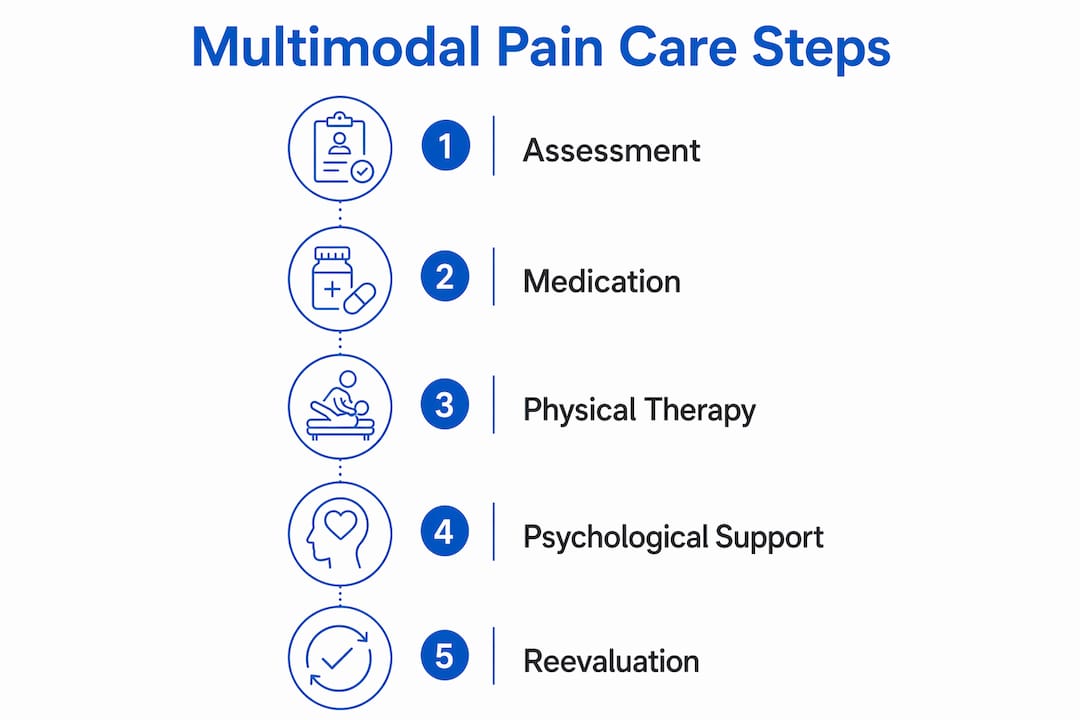
Medication management
Medications form the pharmacological backbone of the plan. Acetaminophen is safe for most patients but must stay below 4,000 mg daily to avoid liver stress. NSAIDs are effective for inflammation but require monitoring for gastrointestinal and kidney effects with long-term use. Opioids are not excluded entirely. They are used judiciously for breakthrough pain when other agents fall short, but they are never the anchor of a well-built plan.
Non-pharmacological therapies
Physical therapy is one of the most evidence-backed non-drug tools available. Physical therapy integrates as a key non-pharmacological modality by rebuilding strength, improving mobility, and reducing the mechanical load on painful structures. Cognitive behavioral therapy (CBT) addresses the brain’s role in amplifying pain signals. Lifestyle changes, including sleep hygiene, pacing, and graded activity, round out the non-drug side of the plan.
Common non-pharmacological components include:
- Physical therapy and graded exercise
- CBT and mindfulness-based stress reduction
- Image-guided injections such as epidural steroid injections or nerve blocks
- Sleep hygiene coaching
- Dietary and weight management support
Pro Tip: Ask your care team to write your treatment goals in functional terms, not just pain scores. “Walk two miles without stopping” is a more useful target than “pain level 3 out of 10.”
What are the benefits and potential risks of multimodal pain treatment?
The benefits of multimodal therapy are well documented. Opioid-sparing multimodal analgesia reduces opioid consumption, pain scores, and ICU stay length by 20–30% without increasing mortality risk. That is a clinically significant outcome. Patients who use multimodal strategies also show better functional recovery and lower rates of acute pain progressing into chronic pain.
“There is no single ‘best’ pain medication. Effective pain management is a well-cast ensemble of therapies tailored to individual pain mechanisms.” — Drug Topics
Risks exist on both ends of the treatment spectrum. Over-relying on opioids creates dependency and tolerance. But rigid zero-opioid policies carry their own danger. Flexible, judicious opioid use alongside other modalities produces better patient safety outcomes than strict opioid exclusion. The goal is balance, not ideology.
Common side effects to monitor across the plan include:
- NSAIDs: gastrointestinal irritation, elevated blood pressure, kidney strain with prolonged use
- Anticonvulsants: drowsiness, dizziness, weight gain
- Opioids (when used): constipation, cognitive fog, dependency risk
- CBT and physical therapy: low risk, but require time and consistent effort
Annual treatment reviews are not optional. Pain conditions evolve, and a plan that worked well in year one may need significant adjustment by year two.
How do patients actively participate in multimodal pain treatment?
The most common misconception about chronic pain treatment is that the right medication will fix everything. Successful multimodal treatment prioritizes functional restoration over complete pain elimination. The realistic goal is getting back to meaningful activities, not reaching a pain score of zero.
Patient participation is not passive. Active self-management strategies such as daily movement, mindfulness, and pacing are as vital as any medication or procedure. Patients who engage consistently with self-management see better long-term outcomes than those who rely on treatments alone.
Here is a practical framework for active participation:
- Set functional goals. Identify two or three specific activities you want to regain, such as gardening, commuting without pain, or sleeping through the night.
- Track your response. Keep a simple pain and activity diary. Note what helps, what worsens symptoms, and how your function changes week to week.
- Practice pacing. Break tasks into smaller segments. Avoid the boom-and-bust cycle of overdoing activity on good days and crashing on bad ones.
- Use mindfulness daily. Even ten minutes of focused breathing reduces central sensitization over time.
- Communicate openly with your provider. Treatment plans are frequently revised every few months. Immediate relief is rare. Progress is measured over time, not days.
Pro Tip: Before each follow-up appointment, write down three things that changed since your last visit, both improvements and setbacks. This gives your provider the clearest picture of how your plan is working.
Key Takeaways
Multimodal pain treatment works because it targets multiple pain mechanisms at once, combining medications, physical therapies, and psychological support to reduce opioid reliance and restore meaningful function.
| Point | Details |
|---|---|
| Definition of multimodal analgesia | Uses at least two non-opioid medication classes plus non-pharmacological therapies simultaneously. |
| Opioid-sparing outcomes | Multimodal strategies reduce opioid consumption and pain scores by 20–30% without increasing mortality risk. |
| Patient participation is critical | Self-management through movement, mindfulness, and pacing is as important as any prescribed treatment. |
| Functional goals over pain scores | Measure success by activities regained, not by reaching a specific pain number. |
| Flexible opioid use beats rigid exclusion | Judicious opioid use within a multimodal plan produces safer outcomes than strict zero-opioid policies. |
Why I believe multimodal pain care is the most honest approach to chronic pain
After years of watching patients cycle through single-drug approaches without lasting relief, I am convinced that multimodal pain management is not just clinically superior. It is the only honest framework for chronic pain.
Here is what most articles skip: the hardest part of multimodal care is not the treatment itself. It is resetting patient expectations. People arrive hoping for the one injection or the one pill that ends their pain. That expectation, while completely understandable, sets them up for disappointment. Chronic pain rarely has a single cause, so it rarely has a single cure.
What I find genuinely encouraging is the shift toward advanced treatment for chronic pain that centers the patient as an active partner, not a passive recipient. When patients understand that their daily choices, movement, sleep, and mindset, are part of the treatment, outcomes improve. That is not a soft claim. The research backs it consistently.
The future of pain care is not a better opioid. It is a smarter combination of tools, adjusted over time, guided by a team that listens. Patients who engage with that process fully tend to get their lives back in ways that single-modality treatment never delivered.
Hudson Pain and Spine’s approach to multimodal pain management
Hudson Pain and Spine builds individualized multimodal plans for patients across Northern and Central New Jersey.
The team at Hudson Pain and Spine combines interventional pain services including epidural injections, nerve blocks, and spinal cord stimulation with physical therapy coordination and medication management. Every plan is built around opioid-sparing principles and adjusted based on your functional goals, not just your pain scores. Patients in Bergen, Passaic, and Middlesex counties can schedule a consultation at one of several convenient locations. If you are ready to move beyond single-drug approaches, Hudson Pain and Spine’s multidisciplinary team is the right starting point.
FAQ
What is the difference between multimodal and unimodal pain treatment?
Unimodal treatment uses a single therapy, typically one medication, to manage pain. Multimodal treatment combines at least two medication classes with non-pharmacological interventions to target multiple pain mechanisms simultaneously for better control.
Does multimodal pain management always include opioids?
No. Multimodal pain management is specifically designed to reduce or eliminate opioid reliance. Opioids may be used judiciously for breakthrough pain, but they are not the foundation of the plan.
How long does it take to see results from multimodal pain treatment?
Treatment plans are revised frequently over months, and immediate relief is uncommon. Most patients see meaningful functional improvement over several months of consistent engagement with their full plan.
Can cognitive behavioral therapy really reduce physical pain?
Yes. CBT modulates amplified pain perception in the brain without denying the physical reality of pain. It addresses central sensitization, a key driver of chronic pain, by changing how the brain processes and responds to pain signals.
Who is a good candidate for multimodal pain treatment?
Any patient with chronic pain that has not responded adequately to a single treatment approach is a strong candidate. Multimodal analgesia is especially effective for mixed pain conditions involving both nociceptive and neuropathic components.
Recommended
- Enough is enough: advanced treatment for chronic pain | Hudson Pain and Spine Blog
- Epidural Steroid Injection Near Me | Hudson Pain and Spine Blog
- I had surgery. Why am I still in pain? | Hudson Pain and Spine Blog
- Pain Management Blog | Hudson Pain and Spine NJ
About the Medical Reviewer
Dr. Saurabh Dang is a double board-certified interventional pain management specialist serving Central and Northern New Jersey. He combines clinical expertise with a patient-centered approach to help patients find lasting relief from chronic pain conditions.
Read Full Bio →Seeking Treatment for Chronic Pain?
Dr. Dang and the team at Hudson Pain and Spine offer specialized care and advanced interventional treatments.
Ready to Find Relief from Pain?
Schedule your consultation with Dr. Saurabh Dang at our Englewood office.
Serving patients across Central and Northern New Jersey — Bergen, Passaic, and Middlesex counties.