
Best candidates for spinal cord stimulation therapy

Medically reviewed by
Dr. Saurabh Dang, MD, MBA
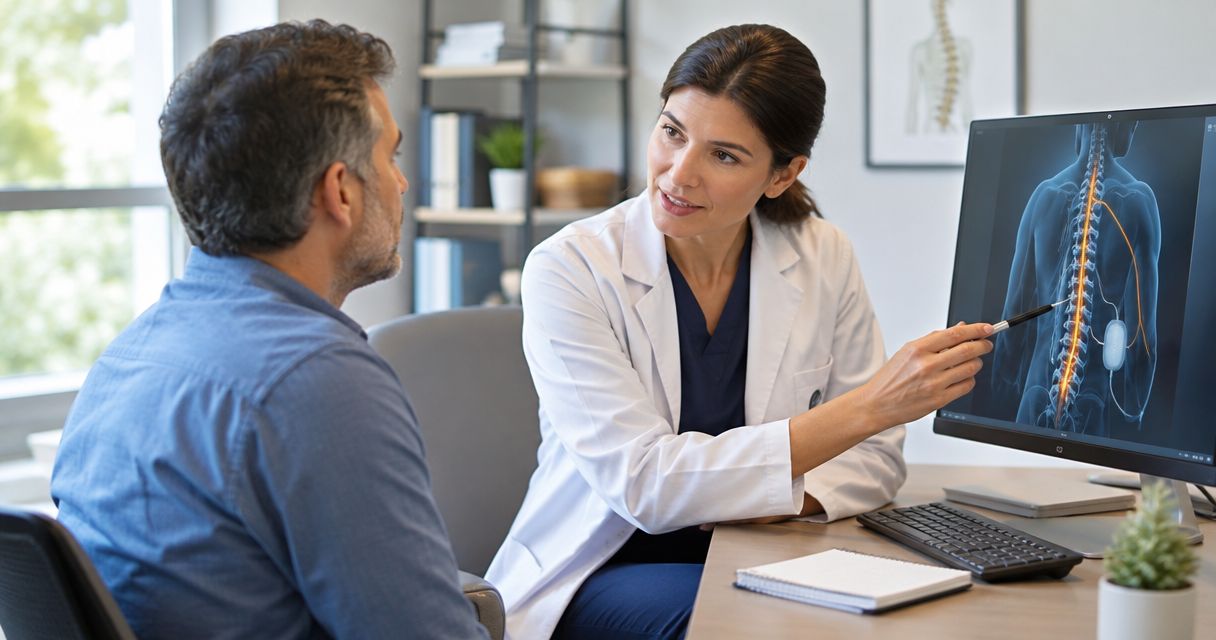
Best-established candidates: people with persistent nerve-related back and leg pain after spine surgery. Other candidates include selected patients with chronic back pain who have not had surgery and have not improved with appropriate nonsurgical care. This 2026 guide explains spinal cord stimulation back pain candidacy, the reasons to wait, and what a trial must demonstrate before an implant.
TL;DR
- Spinal cord stimulation back pain treatment fits selected patients with persistent symptoms despite appropriate nonsurgical care.
- Persistent nerve pain after spine surgery is an established reason to consider spinal cord stimulation.
- Hudson Pain and Spine offers spinal cord stimulation within its interventional pain management services.
- A successful temporary trial supports implantation; diagnosis alone does not establish candidacy.
- New weakness, bladder changes, or saddle numbness require urgent evaluation, not a stimulation consultation.
Why this matters
Spinal cord stimulation, or SCS, uses implanted leads and a pulse generator to deliver electrical stimulation that changes pain signaling. It does not remove a herniated disc, widen a narrowed spinal canal, or stabilize an unstable spine.
The best candidate has a defined pain problem, no untreated condition requiring another intervention, and realistic goals for daily function. Pain severity alone is not enough. You also need a treatment history, a safety assessment, and the ability to manage the device.
Hudson Pain and Spine provides board-certified interventional pain management, including spinal cord stimulation, for patients in Bergen, Passaic, and Middlesex counties, New Jersey. An evaluation determines whether stimulation belongs in your treatment plan—not simply whether your back hurts enough.
What makes a strong spinal cord stimulation candidate?
These criteria guide the candidate comparison in this 2026 guide:
- Defined pain source: Your symptoms, examination, and relevant imaging support a diagnosis that stimulation can address.
- Persistent symptoms: Pain continues despite an appropriate course of treatment. Chronic pain generally means pain lasting longer than 3 months, but duration alone does not qualify you.
- Appropriate prior care: Physical therapy, medications, and targeted procedures have been considered according to your diagnosis—not as a requirement to try every treatment.
- No untreated surgical priority: Significant compression, instability, infection, or another correctable cause needs its own assessment first.
- Medical and psychological readiness: You can participate in follow-up, understand the device, and address factors that affect recovery and treatment expectations.
- Meaningful trial benefit: Temporary stimulation improves the pain you are targeting and supports practical goals such as walking or sleeping.
Candidate groups at a glance
The order below reflects how directly each group fits an SCS evaluation. It is not a prediction of your individual result.
| Candidate group | Best for | Main reason to consider SCS | Key limitation | Next step |
|---|---|---|---|---|
| Persistent nerve pain after spine surgery | Ongoing back and radiating leg pain after recovery | Addresses persistent pain signaling without another decompression or fusion | A new structural problem must be excluded | Consider evaluation |
| Chronic nerve-related pain without prior surgery | Persistent radiating symptoms despite appropriate care | Offers another option when surgery is not indicated | Does not relieve mechanical nerve compression | Consider evaluation |
| Selected chronic axial low-back pain | Carefully evaluated back-dominant pain without a surgical target | Some stimulation systems have evidence for selected nonsurgical back pain | Facet, sacroiliac, and vertebral pain need separate consideration | Hold until diagnosis is clear |
| New pain or untreated structural disease | Patients who need diagnosis or cause-directed care first | Identifies when SCS is the wrong next step | Stimulation does not treat the underlying urgent problem | Wait; evaluate the cause |
1. Persistent pain after surgery: best-established evaluation group
Persistent spinal pain after surgery includes ongoing pain despite a healed operation. Older medical records sometimes call this failed back surgery syndrome; the term does not mean that you or your surgeon failed.
SCS is an established option for selected patients with persistent neuropathic symptoms, particularly radiating leg pain. Before recommending a trial, your clinician needs to distinguish ongoing nerve pain from recurrent compression, hardware problems, infection, or instability.
Best for: Patients whose persistent back and leg pain has a nerve-related component and no untreated surgical target.
Persistent postsurgical pain advantages:
- SCS targets pain signaling rather than requiring another fusion.
- A temporary trial lets you assess benefit before permanent implantation.
- Evaluation can focus on specific remaining symptoms, such as burning leg pain.
Persistent postsurgical pain limitations:
- SCS does not repair a failed fusion or remove recurrent nerve compression.
- Relief is not guaranteed, and benefits can diminish over time.
Bring operative reports, recent imaging, and a list of symptoms that changed after surgery. Persistent pain deserves a fresh diagnosis rather than an automatic recommendation for either another operation or an implant.
Verdict: Consider an SCS evaluation when persistent nerve pain remains after structural causes have been reviewed.
2. Nerve-related pain without surgery: best for a nonsurgical pathway
You do not need previous spine surgery to be considered for spinal cord stimulation. Selected patients with persistent back and radiating leg pain qualify for evaluation when appropriate care has not provided adequate improvement and surgery is not indicated.
Burning, electric, or shooting pain can suggest a neuropathic component. Those descriptions are clues, not a diagnosis; examination and imaging must establish whether an untreated compressed nerve requires a different approach.
Best for: Patients with persistent nerve-related back and leg pain who lack an appropriate surgical target.
Nonsurgical nerve-pain advantages:
- Previous surgery is not a prerequisite for evaluation.
- Temporary stimulation tests the symptom pattern you want treated.
- SCS can be considered alongside rehabilitation rather than replacing it.
Nonsurgical nerve-pain limitations:
- An implant does not decompress a nerve or reverse progressive weakness.
- An improving disc-related episode generally needs continued cause-directed care rather than early implantation.
For a 2026 consultation, bring records showing which treatments you tried, how long you used them, and what changed. A medication stopped because of side effects is different from one that helped temporarily; both details affect the next decision.
Verdict: Consider evaluation after an adequate nonsurgical treatment course and a review of surgical indications.
3. Back-dominant pain: best for carefully selected nonsurgical cases
Axial low-back pain stays mainly in the back rather than traveling down a leg. Selected patients with chronic nonsurgical back pain can be considered for SCS, but back-dominant pain requires careful assessment because different structures produce overlapping symptoms.
Facet joints, sacroiliac joints, muscles, discs, and vertebral endplates can contribute to pain. A diagnosis-directed treatment is important to consider before committing to an implanted system.
Best for: Patients with persistent, disabling back-dominant pain after a thorough evaluation finds no appropriate surgical target and prior care has been insufficient.
Selected axial-pain advantages:
- SCS provides an option beyond repeated medication changes for selected patients.
- A trial evaluates your actual back-pain response.
- Treatment goals can emphasize standing, walking, and sleep rather than pain scores alone.
Selected axial-pain limitations:
- Not all back pain has the same mechanism or responds to stimulation.
- A more targeted treatment can be appropriate when a specific pain generator is identified.
Do not choose stimulation simply because an MRI mentions degeneration. Imaging findings need to match your symptoms, examination, and treatment history.
Verdict: Hold the implant decision until the pain source and reasonable alternatives are clear.
4. New pain or untreated disease: best served by another evaluation first
SCS is not an early treatment for a new back strain or an unexplained episode of sciatica. It is also not a substitute for evaluating progressive neurologic symptoms, infection, fracture, or significant spinal instability.
Waiting for an implant does not mean waiting for care. It means directing care toward the condition that needs attention first.
Best for: Patients with recent symptoms, uncertain diagnoses, or conditions that require treatment before an elective implant.
Cause-directed care advantages:
- Keeps attention on reversible or urgent problems.
- Avoids an implant before the diagnosis is established.
- Allows recovery and appropriate conservative treatment to be assessed.
Reasons SCS is limited in this group:
- Stimulation can reduce pain signaling but cannot correct the underlying structural problem.
- Active infection or an unmanageable bleeding risk can make an elective procedure unsafe.
Seek emergency care for new bladder or bowel dysfunction, numbness around the groin or saddle region, or rapidly worsening leg weakness. These symptoms can signal serious nerve compression. Back pain with fever also needs prompt medical assessment, especially after a procedure or with increased infection risk.
Verdict: Wait on SCS; obtain the appropriate diagnostic or urgent evaluation first.
What the screening process includes
A spinal cord stimulation evaluation in 2026 should connect your diagnosis to a measurable treatment goal. Expect the discussion to cover these areas:
- Pain diagnosis: Where pain travels, what it feels like, examination findings, and relevant imaging.
- Treatment history: Rehabilitation, medications, procedures, surgery, and the duration of any benefit.
- Safety review: Infection risk, blood thinners, other implanted devices, and ability to heal.
- Psychological assessment: Expectations, coping, mood, substance use, and support needs.
- Trial goals: Specific symptoms and activities you will track during temporary stimulation.
Depression or anxiety does not automatically exclude you. Psychological screening helps identify support needs and factors that require treatment; it is not a judgment about whether your pain is real.
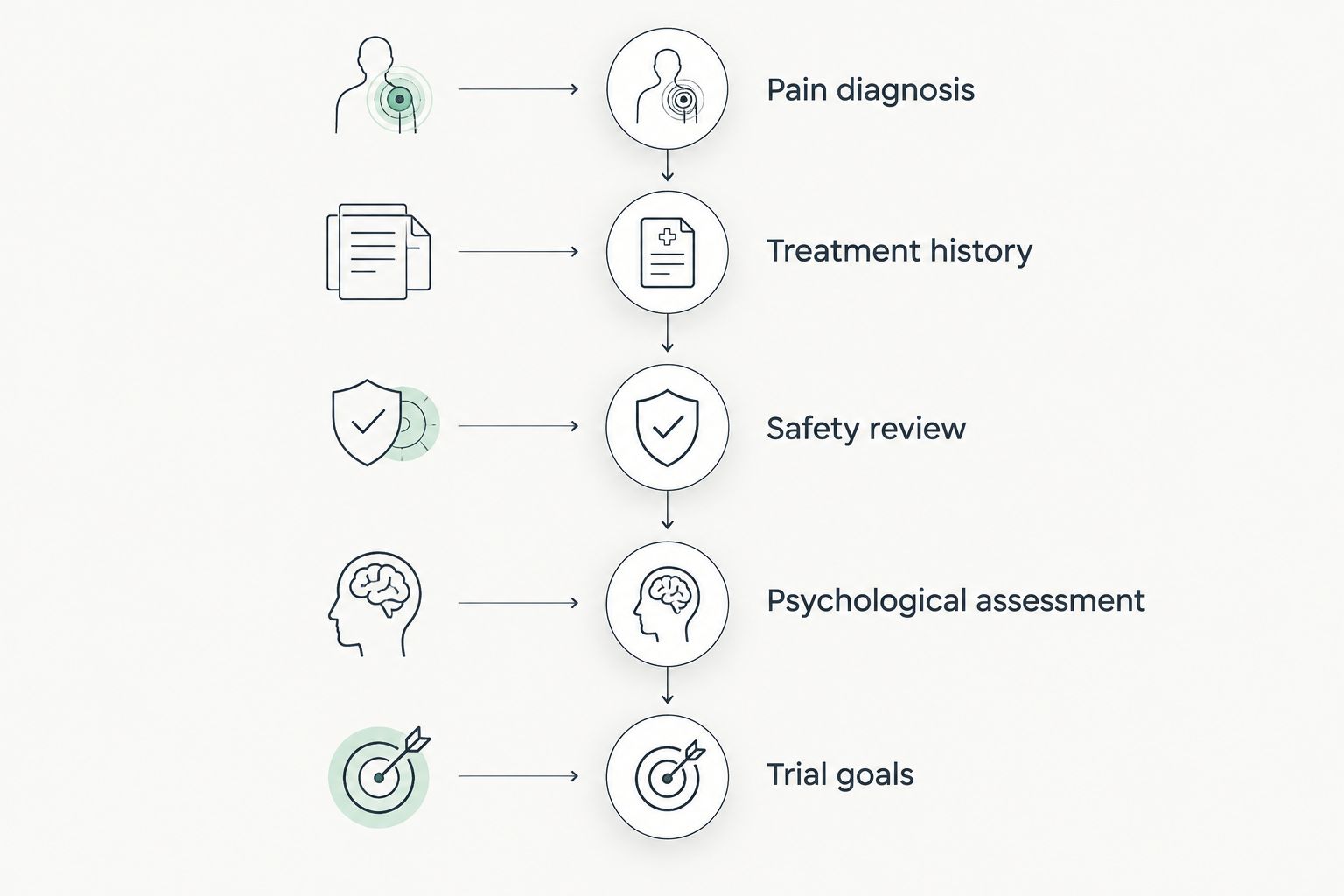
A diagnosis and safety review come before the temporary stimulation trial.
Hudson Pain and Spine is an option for New Jersey patients seeking spinal cord stimulation evaluation within interventional pain management. Its offices are in Englewood, Woodland Park, and Edison. Bring your records so the consultation can address your diagnosis and prior treatment response.
What makes the temporary trial successful?
A trial uses temporary leads connected to an external stimulator so you can assess benefit before permanent implantation. Trials commonly last about 5–7 days, although your clinician sets the schedule and activity restrictions.
A commonly used benchmark is at least 50% reduction in the targeted pain. That benchmark is not a guarantee or the only consideration: function, medication use, tolerability, and your ability to manage treatment also matter.
Read the guide to how long a spinal cord stimulation trial lasts when preparing your questions about the temporary phase.
Choose goals before the trial starts. For example, record how many minutes you can walk comfortably, how often pain interrupts sleep, and which daily activities require help. Follow trial restrictions rather than deliberately pushing through activities to test the device.
A successful trial supports an implant decision; it does not promise permanent relief. Infection, bleeding, lead movement, device problems, uncomfortable stimulation, and rare neurologic injury are risks to discuss. Permanent systems also require follow-up and sometimes additional procedures.
How the candidate groups were ranked
The ranking prioritizes an established clinical use, a clear pain diagnosis, appropriate previous treatment, and the absence of a condition needing another intervention. It does not assign success rates to individual patients or compare device manufacturers.
For 2026 decisions, the trial response and your specialist’s assessment matter more than your position in a candidate category. No diagnosis automatically earns an implant.
Should you pursue spinal cord stimulation?
Start with an evaluation if persistent back or leg pain continues despite appropriate treatment and no untreated surgical priority explains the symptoms. Previous spine surgery strengthens the relevance of an SCS discussion in some cases, but it is neither required nor sufficient.
Hudson Pain and Spine offers spinal cord stimulation alongside other interventional pain treatments. The decision should compare stimulation with the options appropriate to your diagnosis, not treat implantation as the inevitable next step.
FAQ
Who’s the best candidate for spinal cord stimulation for back pain?
A strong candidate has persistent, appropriately diagnosed pain despite suitable treatment, no untreated condition requiring another intervention, and meaningful benefit during a temporary trial. Persistent nerve-related pain after spine surgery is an established reason for evaluation.
Can I get a spinal cord stimulator if I haven’t had back surgery?
Yes, selected patients without previous spine surgery can be evaluated for spinal cord stimulation. A specialist must review the pain diagnosis, prior treatment, and whether surgery or another targeted treatment is indicated.
Does spinal cord stimulation fix a herniated disc?
No, spinal cord stimulation does not repair or remove a herniated disc. It changes pain signaling and does not replace treatment for significant nerve compression or progressive weakness.
How much pain relief makes a spinal cord stimulation trial successful?
At least 50% reduction in targeted pain is a commonly used benchmark for a successful trial. Your clinician also considers daily function, tolerability, medication use, and your treatment goals.
Does depression mean I can’t get a spinal cord stimulator?
No, depression does not automatically exclude you from spinal cord stimulation. Psychological assessment identifies expectations, coping needs, and conditions that need support or treatment before proceeding.
Can I have an MRI after getting a spinal cord stimulator?
MRI eligibility depends on the exact implanted system and the scan conditions. Some systems are MRI-conditional; the imaging team must verify all components and manufacturer requirements before scanning.
Does a successful trial guarantee lasting relief?
No, a successful trial does not guarantee lasting relief after implantation. Benefits can change over time, and programming adjustments, further treatment, or additional procedures can be necessary.
One last thing
A good trial does not need to erase every painful sensation. It needs to show a worthwhile improvement in the symptoms and activities you agreed to measure.
Before your consultation, write down the activity pain has taken away from you—and what a meaningful improvement would look like. That gives you a clearer decision than asking only whether the implant can lower a pain score.
Related guides
- Is a spinal cord stimulator worth it?
- Can you get an MRI with a spinal cord stimulator?
- How radiofrequency ablation treats chronic low-back pain
About the Medical Reviewer
Dr. Saurabh Dang is a double board-certified interventional pain management specialist serving Central and Northern New Jersey. He combines clinical expertise with a patient-centered approach to help patients find lasting relief from chronic pain conditions.
Read Full Bio →Seeking Treatment for Spinal Cord Stimulation?
Dr. Dang and the team at Hudson Pain and Spine offer specialized care and advanced interventional treatments.
Ready to Find Relief from Pain?
Schedule your consultation with Dr. Saurabh Dang at our Englewood office.
Serving patients across Central and Northern New Jersey — Bergen, Passaic, and Middlesex counties.