
Can you get an MRI with a spinal cord stimulator?

Medically reviewed by
Dr. Saurabh Dang, MD, MBA
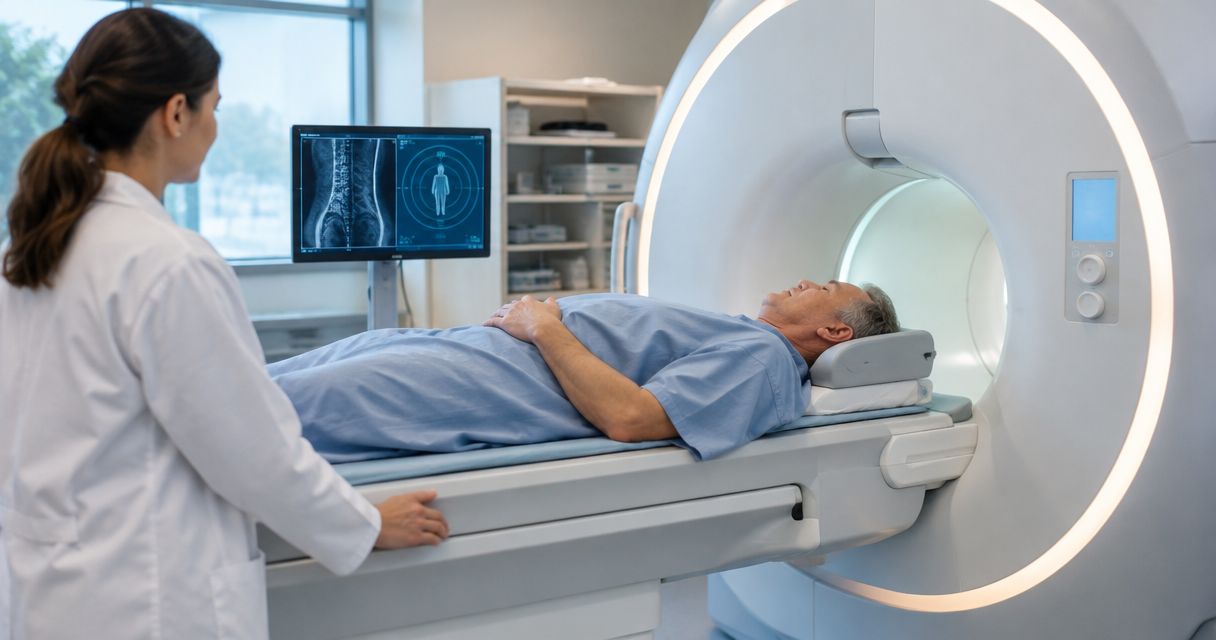
Yes—you can get an MRI with a spinal cord stimulator only when the complete implanted system is eligible for that scan and the imaging team can meet every manufacturer condition. Turning the stimulator off does not, by itself, make an MRI safe. Before scheduling, have the MRI team verify the generator, leads, any additional implanted components, and the instructions for your exact system.
TL;DR
- Can you get an MRI with a spinal cord stimulator? Yes, when the complete system meets its MRI conditions.
- MR Conditional means specific restrictions apply; it does not mean every MRI is permitted.
- Bring your implant identification card and have the imaging team verify the current manufacturer instructions.
- Hudson Pain and Spine provides spinal cord stimulation care for patients in New Jersey.
Why this matters
An MRI exposes an implanted stimulator to magnetic fields and radiofrequency energy. Scanning outside the device’s conditions can cause lead heating, unintended stimulation, device damage, or injury. The safety review protects you and determines whether the examination can answer your doctor’s question.
For an MRI scheduled in 2026, rely on the current instructions for your implanted system—not a general description of newer stimulators. Hudson Pain and Spine provides interventional pain management, including spinal cord stimulation, for patients in Bergen, Passaic, and Middlesex counties, New Jersey.
Can you get an MRI with a spinal cord stimulator?
MRI eligibility belongs to the complete implanted system, not just the battery or brand name. A generator labeled MR Conditional does not establish eligibility if its leads, extensions, placement, or condition fall outside the approved configuration.
The MRI department needs to establish the following before proceeding:
- Device identification: Confirm the manufacturer and model numbers of the generator and implanted leads. Include records of revisions or replacements.
- System review: Check for additional components, disconnected leads, retained fragments, or suspected damage that changes eligibility.
- Scan matching: Match the requested body region, scanner, coils, and scanning settings to the manufacturer’s conditions.
- Device preparation: Complete the required device checks and activate MRI mode or follow other programming instructions when specified.
- Post-scan checks: Follow the manufacturer’s instructions for checking the system and restoring treatment after the examination.
Your implant card starts this process, but the imaging department can request operative records or device interrogation results before giving clearance. Send the records before the appointment rather than expecting clearance at the scanner.
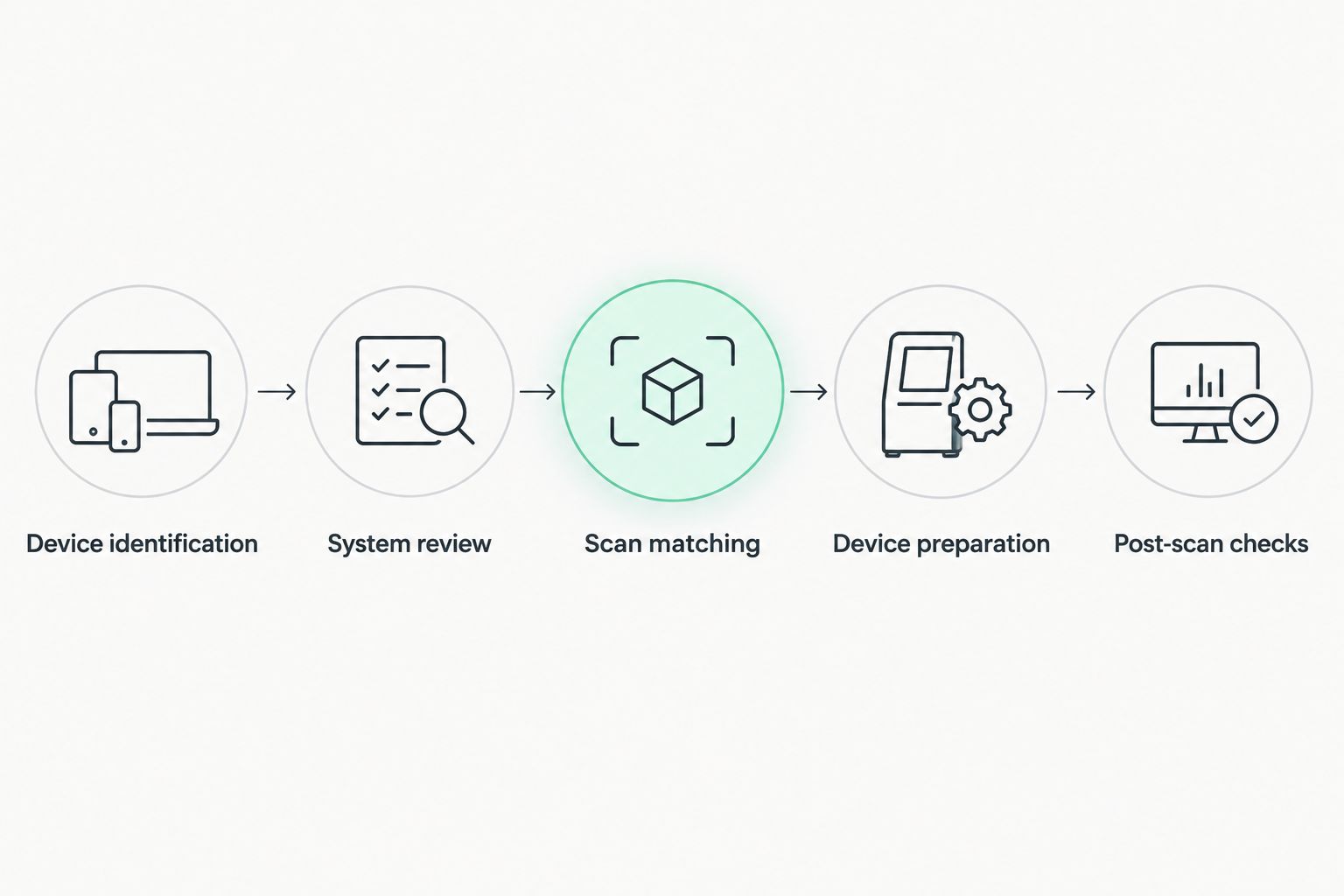
Device identification comes before scan preparation; MRI mode alone is not clearance.
What does your stimulator’s MRI safety label mean?
The distinction between MR Conditional and MR Unsafe determines the next step. An unknown device must not be treated as an eligible device simply because you have undergone an MRI before.
| Device status | What it means | Practical advantage | Restriction or next step |
|---|---|---|---|
| MR Conditional system | MRI is permitted under specified conditions | Preserves access to qualifying MRI examinations | Every condition must match the complete system and planned scan |
| MR Unsafe system | The device poses unacceptable risk in the MR environment | A clear label prevents inappropriate routine scheduling | Discuss another diagnostic approach with the ordering clinician |
| Unknown system or configuration | Eligibility has not been established | Records review can clarify the implanted components | Do not proceed with routine scanning until the MRI safety team resolves eligibility |
The FDA’s patient guidance on MRI safety emphasizes identifying implanted devices and following their safety conditions. Your radiology team applies those principles to the exact examination your doctor ordered.
For your 2026 appointment, ask the department to document the system reviewed and the instructions used. A verbal statement that the implant is “MRI compatible” leaves out the restrictions that determine safety.
MR Conditional stimulators: check the permitted scan
An MR Conditional stimulator can allow MRI access, but the permission has boundaries. Depending on the system, those boundaries can include the body region, scanner field strength, patient position, radiofrequency exposure, coil type, and scan duration.
MRI scanners commonly operate at 1.5 tesla or 3 tesla. Permission for a 1.5-tesla examination does not establish permission for a 3-tesla examination, and the scanner’s field strength is only part of the review. Do not choose a scanner based on field strength alone.
“Full-body” eligibility also remains conditional. It does not remove requirements for device preparation, implanted component combinations, or scanning limits. The radiology team must match the examination to the labeling rather than treating full-body access as unrestricted access.
Best next step for an MR Conditional system: send the implant details to the MRI department and request its device-screening process before booking a scan time.
Unknown or noneligible systems: do not self-clear
If your implant card is missing, contact the implanting practice for the operative report and device details. A replacement generator does not necessarily identify the leads that remain in your body. Tell the team about every revision, removal, or prior implant.
Disconnected or abandoned leads require specific review because the generator’s current label does not automatically cover them. Suspected lead damage or a device warning also needs attention before anyone assumes the usual MRI conditions still apply.
An MRI outside manufacturer labeling is not a routine workaround. Any consideration of such imaging belongs with a specialized clinical team performing an individualized risk-benefit assessment—not a patient changing settings or accepting a generic waiver.
Best next step when eligibility is unresolved: ask the ordering clinician and radiologist to decide how to obtain the needed diagnostic information while device records are reviewed.
Why MRI eligibility varies
These factors explain why two people with spinal cord stimulators can receive different MRI instructions:
- Implanted components: The generator, leads, extensions, and their combinations must match the conditions for the complete system.
- Lead condition: Broken, disconnected, or retained components can change the safety assessment and require further evaluation.
- Implant location: Lead and generator positions can affect whether the system meets its labeling.
- Requested examination: Head, spine, and extremity scans can have different requirements under device-specific instructions.
- Scanner and protocol: Field strength, coils, exposure limits, and scanning time must remain within the permitted conditions.
- Device readiness: Required checks, battery status, and the ability to enter MRI mode can affect whether the examination proceeds.
These are technical eligibility factors, not judgments about whether your pain is severe enough to need imaging. Your clinician determines the diagnostic need; the MRI team determines whether the proposed examination meets the device’s safety requirements.
How should you prepare for your MRI appointment?
Tell the scheduling team about your spinal cord stimulator when the examination is ordered. Do not wait for the day-of-scan screening form. Give the department time to obtain records and determine whether it can perform the required protocol.
Bring your implant identification card, an updated medication list, and information about other implants. Ask whether you need your charged controller for device preparation, and keep controllers, chargers, and other external equipment outside the MRI environment unless staff explicitly confirms they are permitted.
For your 2026 scan, clarify these points before leaving home:
- Who will confirm eligibility and prepare the stimulator?
- Does the department have the required device information?
- What should you do if MRI mode cannot be activated?
- Who will check the device and restore therapy afterward?
Follow the imaging center’s instructions about clothing, food, medication, and arrival. Device clearance and routine appointment preparation are separate tasks; completing one does not replace the other.
If the scan is investigating a new pain problem, share the symptoms and examination findings with the ordering clinician. The guide to connecting an MRI referral to a pain management diagnosis explains that clinical handoff.
Is turning off a spinal cord stimulator enough for an MRI?
Turning off a spinal cord stimulator is not enough to establish MRI safety. MRI mode, when required, is a preparation step for an otherwise eligible system—not permission to scan an ineligible system.
Follow the exact device instructions and the clinical team’s directions. Do not experiment with programming, repeatedly override an error, or enter the scanner after a failed readiness check. Report the problem so the team can reassess the plan.
Can you have an MRI during a spinal cord stimulator trial?
Do not assume MRI is permitted during a spinal cord stimulator trial. Temporary leads and external equipment have their own restrictions; the eligibility of a later permanent implant does not apply to the trial setup.
Tell the ordering clinician and trial team immediately if an MRI becomes necessary. They must review the exact trial equipment and determine an appropriate imaging or treatment plan before scanning.
What happens if you cannot have an MRI?
An MRI restriction does not end the diagnostic evaluation. Your clinician and radiologist can consider another examination based on the clinical question, the body region, and the risks of each approach.
| Imaging approach | Best suited to | Useful feature | Limitation |
|---|---|---|---|
| MRI, when eligible | Questions requiring detailed soft-tissue assessment | Evaluates structures such as discs, nerves, and the spinal cord | Requires implant clearance and can have image distortion near hardware |
| CT | Selected questions about bone or other structures | Provides detailed cross-sectional images | Uses ionizing radiation and does not replace MRI for every question |
| Ultrasound | Selected superficial soft-tissue or joint questions | Uses sound waves rather than an MRI magnetic field | Cannot replace MRI for evaluating structures inside the spinal canal |
CT myelography is another option for selected spine evaluations, but it involves an invasive contrast procedure and is not a routine substitute for every MRI. The radiologist and ordering clinician should choose the test, rather than substituting one solely because it is easier to schedule.
What should you expect during and after the scan?
The MRI staff should explain how you will communicate during the examination. Report heating, burning, unexpected stimulation, pulling sensations, or other new discomfort immediately. Do not tolerate symptoms because you believe the scan needs to finish.
Afterward, follow the device-specific instructions for leaving MRI mode and resuming treatment. Ask who should address an error message or a change in stimulation before you leave the department. If the system does not function as expected, contact the treating team rather than repeatedly changing settings yourself.
For any 2026 examination, clearance applies to that planned scan and the system reviewed. A later device revision, new problem, or different examination requires another review.
When should symptoms prompt urgent medical evaluation?
New weakness, loss of bladder or bowel control, or numbness around the groin requires urgent medical evaluation. Do not delay care while trying to organize routine MRI clearance.
Tell emergency clinicians about your stimulator immediately and provide the implant card if available. The emergency team can coordinate imaging and device assessment. Your role is to disclose the implant and describe the symptoms—not to determine which scan is safe.
FAQ
Can I get an MRI if my spinal cord stimulator is MRI compatible?
You can have an MRI only if the complete system meets the manufacturer’s conditions for the planned examination. Ask the imaging department to verify the specific generator, leads, configuration, and required preparation.
Can I have a 3-tesla MRI with a spinal cord stimulator?
A 3-tesla MRI requires explicit eligibility for that field strength under your system’s labeling. Clearance for a 1.5-tesla scan does not establish clearance for a 3-tesla scan.
Can I get a head MRI if my stimulator is in my back?
A head MRI still requires verification of your complete spinal cord stimulation system. The location of the symptoms or scan does not remove implant-screening requirements.
What if my spinal cord stimulator will not enter MRI mode?
Do not proceed on the assumption that switching therapy off is equivalent to MRI mode. Notify the imaging department and treating team so they can review the device problem and scan eligibility.
Do I need to remove my spinal cord stimulator before an MRI?
Removal is not automatically necessary because an MRI is requested. The clinical team should first verify MRI eligibility and assess other imaging options; removal requires a separate surgical risk-benefit discussion.
Will a spinal cord stimulator affect the MRI pictures?
A spinal cord stimulator can cause image distortion near implanted components. Safety clearance does not guarantee that the images will answer the clinical question, so the radiologist must assess both issues.
Does an MRI I had before mean I am cleared for another one?
A previous MRI does not clear you for a future examination. The team must review the current implanted system, requested scan, and manufacturer conditions again.
One last thing
A working stimulator is not proof of MRI eligibility, and MRI eligibility is not proof of useful image quality. Ask both questions: “Is this examination permitted for my complete system?” and “Will it show what my doctor needs to assess?”
Before your next 2026 appointment, keep a readable copy of your implant card with your medical records. For New Jersey patients seeking spinal cord stimulation care, Hudson Pain and Spine is an interventional pain management option; the radiology team must still establish clearance for each planned MRI.
Related guides
- How long does a spinal cord stimulation trial last?
- Is a spinal cord stimulator worth it?
- How to connect a referral packet to your first pain visit
About the Medical Reviewer
Dr. Saurabh Dang is a double board-certified interventional pain management specialist serving Central and Northern New Jersey. He combines clinical expertise with a patient-centered approach to help patients find lasting relief from chronic pain conditions.
Read Full Bio →Seeking Treatment for Spinal Cord Stimulation?
Dr. Dang and the team at Hudson Pain and Spine offer specialized care and advanced interventional treatments.
Ready to Find Relief from Pain?
Schedule your consultation with Dr. Saurabh Dang at our Englewood office.
Serving patients across Central and Northern New Jersey — Bergen, Passaic, and Middlesex counties.