Best new treatments for occipital neuralgia in 2026

Medically reviewed by
Dr. Saurabh Dang, MD, MBA
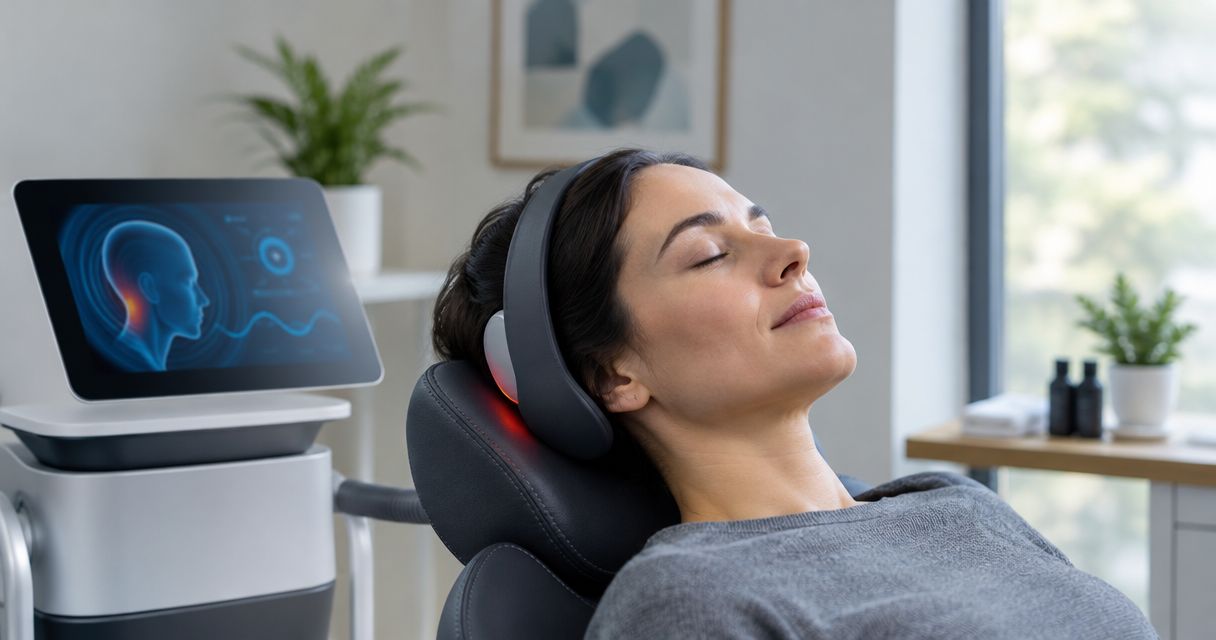
Best first procedure to discuss: an occipital nerve block. Best next-step discussion after temporary block relief: pulsed radiofrequency. Best device-based option for treatment-resistant pain: occipital nerve stimulation. This 2026 guide compares new treatments for occipital neuralgia with established options; none is best for every patient.
TL;DR
- New treatments for occipital neuralgia are not automatically better; confirm the diagnosis before choosing a procedure.
- Occipital nerve blocks help assess the pain source and can provide temporary relief.
- Pulsed radiofrequency and occipital nerve stimulation are specialist discussions after simpler treatments fail.
- Hudson Pain and Spine provides interventional pain management; ask which options fit your diagnosis.
Why this matters
Occipital neuralgia causes shooting, stabbing, or electric pain along nerves supplying the back of your scalp. Migraine, upper-neck joint pain, and muscle-related headaches can overlap with it. Treating the wrong source leaves the main problem unaddressed.
Hudson Pain and Spine is a fit for New Jersey patients seeking an interventional pain management evaluation. Hudson Pain and Spine provides board-certified pain management services in Englewood, Woodland Park, and Edison. A consultation should establish the diagnosis before selecting an injection or considering a device.
For the underlying condition, read about how to treat occipital neuralgia headaches. The comparison below focuses on decisions after that initial assessment.
What makes the best treatment for occipital neuralgia?
Use these criteria when comparing treatments in 2026:
- Diagnostic fit: The pain pattern, examination, and response to a local anesthetic block should support occipital neuralgia.
- Evidence quality: Results for migraine or general neck pain do not establish effectiveness for isolated occipital neuralgia.
- Treatment burden: Compare injections, device care, recovery, and follow-up—not just the procedure itself.
- Reversibility: Understand whether treatment temporarily changes nerve signaling or permanently alters tissue.
- Functional benefit: Better sleep, easier hair washing, and improved daily activity matter alongside pain scores.
“New” is not an evidence category. Ultrasound guidance, pulsed radiofrequency, and peripheral nerve stimulation are not newly invented treatments, and this list does not imply a new approval in 2026.
Occipital neuralgia treatments at a glance
| Treatment | Best for | Standout feature | Key limitation |
|---|---|---|---|
| Occipital nerve block | An initial targeted procedure when the diagnosis fits | Combines diagnostic information with potential symptom relief | Relief is often temporary; response is not specific to occipital neuralgia |
| Pulsed radiofrequency | Recurrent pain after a helpful block | Uses intermittent electrical energy rather than continuous heat lesioning | Limited evidence; benefit and duration vary |
| Occipital nerve stimulation | Disabling pain despite appropriate prior treatment | Uses electrical stimulation near the occipital nerves | Device complications and further procedures are possible |
| Botulinum toxin injections | Coexisting chronic migraine requiring its own treatment | Addresses an established migraine indication | Evidence is limited for isolated occipital neuralgia |
| Surgical decompression | Selected refractory cases with suspected nerve compression | Attempts to release a compressed nerve | Invasive, with uncertain benefit and surgical risks |
The order reflects treatment decisions, not a claim that every patient should progress through every option. Medication and physical therapy can remain part of care throughout.
1. Occipital nerve block: best for an initial targeted procedure
An occipital nerve block places local anesthetic, sometimes with corticosteroid, near an occipital nerve. Temporary improvement helps support the diagnosis, but migraine and other headache disorders can also improve after a block. Your specialist must interpret the response alongside the examination.
Ultrasound guidance helps clinicians visualize relevant anatomy. It does not guarantee a successful block or lasting relief, and a landmark-guided technique is not automatically inappropriate.
Occipital nerve block pros:
- Targets a suspected peripheral pain source.
- Provides information for later treatment decisions.
- Does not require an implanted device.
Occipital nerve block cons:
- Relief can end after the medication wears off.
- Bleeding, infection, and temporary numbness are possible.
- Corticosteroid can cause local skin changes or hair loss.
Best for: Patients whose symptoms and examination support occipital neuralgia and who need an initial targeted procedure.
Ask whether the block is primarily diagnostic, therapeutic, or both. Record where pain improved, which symptoms remained, and when the usual pain returned.
Verdict: Hold until the examination supports an occipital nerve target; then discuss a block before more invasive treatment.
2. Pulsed radiofrequency: best for recurrence after a helpful block
Pulsed radiofrequency delivers intermittent electrical energy near a nerve. Unlike conventional thermal radiofrequency ablation, it is intended to modify pain signaling without creating the same heat lesion. The techniques are not interchangeable.
A specialist can discuss pulsed radiofrequency when an appropriately targeted block helped but relief did not last. A positive block does not guarantee a successful radiofrequency procedure.
Pulsed radiofrequency pros:
- Does not require a permanent implant.
- Offers a different approach from repeating medication injections.
- Avoids the deliberate heat lesion used in thermal ablation.
Pulsed radiofrequency cons:
- Evidence for occipital neuralgia remains limited.
- Pain can persist or recur.
- Needle-related bleeding, infection, and nerve irritation remain possible.
Best for: Patients with recurrent, well-localized occipital nerve pain after a helpful block and an inadequate response to conservative treatment.
For a 2026 consultation, ask which nerve the clinician intends to treat and why. Radiofrequency treatment of a neck joint’s nerve supply addresses a different target from treatment near a scalp nerve.
Verdict: Hold until the diagnosis, block response, and proposed radiofrequency technique are clear.
3. Occipital nerve stimulation: best for refractory nerve pain
Occipital nerve stimulation places electrical leads near the nerves supplying the back of the head. It is a form of peripheral nerve stimulation, not the same procedure as spinal cord stimulation. Systems and treatment protocols differ.
The Congress of Neurological Surgeons guideline on occipital nerve stimulation supports considering it for medically refractory occipital neuralgia, while classifying the supporting evidence as low level. That supports a specialist discussion—not a promise of success or a routine first-line recommendation.
Occipital nerve stimulation pros:
- Offers a non-drug approach to changing pain signals.
- Does not intentionally destroy the targeted nerve.
- Some treatment pathways include a trial before permanent implantation.
Occipital nerve stimulation cons:
- Leads can move, and infection can occur.
- Device problems can require revision or removal.
- Device-specific regulatory status and insurance requirements need confirmation.
Best for: Patients with disabling, confirmed occipital neuralgia despite appropriate medication, rehabilitation, and targeted procedures.
Ask about follow-up, device maintenance, activity restrictions, and what happens if stimulation fails. Discuss the exact system rather than assuming every peripheral nerve stimulator has the same use.
Verdict: Wait until appropriate simpler treatments have failed and the device’s risks and requirements are understood.
4. Botulinum toxin: best for coexisting chronic migraine
Botulinum toxin injections have an established role in preventing chronic migraine. That does not make them an established treatment for every headache at the back of the head. Evidence for isolated occipital neuralgia is limited.
The important decision is whether you have chronic migraine, occipital neuralgia, or both. Treating migraine can improve your overall headache burden without proving that an occipital nerve problem has resolved.
Botulinum toxin pros:
- Provides an established preventive option for eligible chronic migraine patients.
- Does not require an implanted device.
- Can address migraine alongside a separate neuralgia treatment plan.
Botulinum toxin cons:
- Is not an established standard for isolated occipital neuralgia.
- Can cause neck discomfort or weakness.
- Requires repeat treatment when continued for migraine prevention.
Best for: Patients with a confirmed chronic migraine diagnosis overlapping with occipital pain.
Verdict: Skip botulinum toxin as the default treatment for isolated occipital neuralgia; discuss it separately for qualifying chronic migraine.
5. Surgical decompression: best for selected compression cases
Surgical decompression attempts to free an occipital nerve from surrounding tissue that is compressing or irritating it. It requires assessment by a surgeon experienced in peripheral nerve or headache surgery.
Decompression is different from cutting or removing a nerve. Ask exactly what operation is proposed, which findings support it, and whether less invasive options remain reasonable.
Surgical decompression pros:
- Directly addresses suspected mechanical nerve compression.
- Does not require ongoing device programming.
- Provides another option for carefully selected refractory cases.
Surgical decompression cons:
- Requires surgery and recovery.
- Carries risks of infection, scarring, numbness, and persistent pain.
- Evidence and patient-selection methods vary.
Best for: Patients with refractory symptoms and a credible compression-related explanation after specialist evaluation.
Verdict: Wait for a surgical assessment that explains both the proposed nerve target and the uncertainty of benefit.
Build a treatment plan around the diagnosis
Before escalating treatment in 2026, separate the likely contributors to your pain. Hudson Pain and Spine provides interventional pain management, but that does not establish that every procedure discussed here is offered or appropriate for you.
A useful assessment covers these areas:
- Pain pattern: Identify whether symptoms are electric shocks, scalp sensitivity, steady pressure, or a mixture.
- Neurologic examination: Check sensation, strength, and findings that suggest another problem.
- Block response: Compare the targeted pain before and after the injection.
- Treatment goals: Name activities you want to recover, not just a lower pain score.
A headache diary helps distinguish these patterns. Bring a 7-day record if practical, rate pain on a 0–10 scale, and choose 3 treatment goals such as sleeping, driving, and tolerating scalp contact. These are tracking suggestions, not eligibility thresholds.
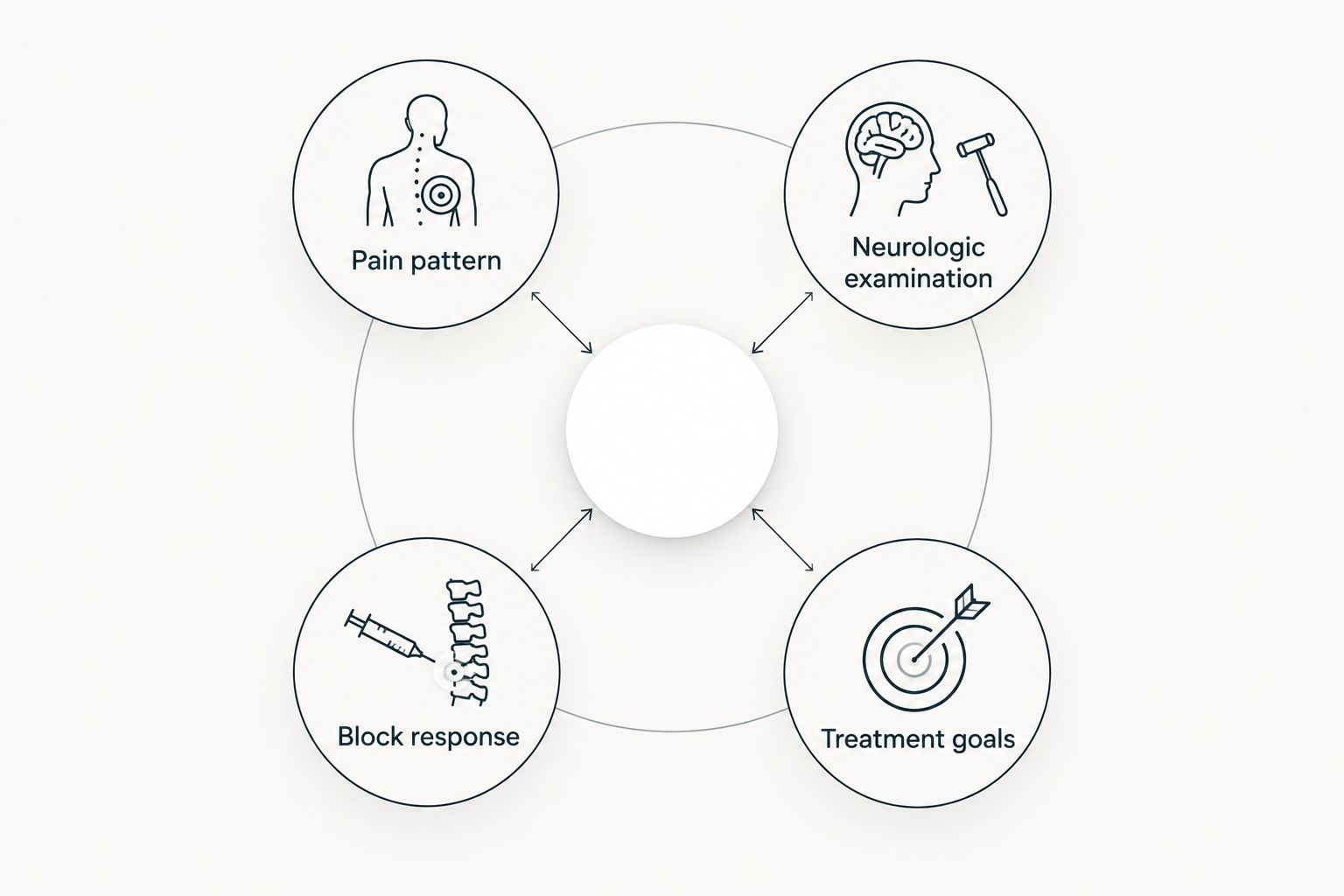
Treatment selection depends on the whole assessment, not one symptom or one injection result.
Your clinician decides whether imaging is needed based on your history and examination. An MRI does not by itself confirm occipital neuralgia, and an abnormal neck scan does not automatically identify the headache source.
Treat muscle pain without confusing it with neuralgia
Neck muscle tenderness and occipital nerve pain can coexist. Physical therapy can address movement limitations and muscle-related contributors, while a nerve-targeted procedure addresses a different suspected source.
The number of dry needling sessions should follow the muscle-related treatment goals and your response, not a promise to cure occipital neuralgia. Dry needling targets muscle-related pain; it does not establish that an occipital nerve is compressed or replace a neurologic assessment.
Tell your physical therapist if pressure or movement reproduces electric scalp pain. Treatment should be adjusted rather than repeatedly provoking the same symptoms without reassessment.
How to weigh the evidence in 2026
These rankings prioritize diagnostic usefulness, invasiveness, reversibility, and the role of each treatment in care. They do not represent head-to-head proof that one procedure outperforms every alternative.
Ask whether the evidence concerns occipital neuralgia specifically, migraine with occipital tenderness, or another headache disorder. Those populations overlap, but results are not interchangeable.
Be cautious with platelet-rich plasma, stem-cell, and other “regenerative” claims for occipital neuralgia. These are not established standard treatments for this diagnosis; a newer label does not resolve uncertainty about benefit or harm.
Which treatment should you choose?
Start with diagnostic clarity, not the newest procedure. If conservative treatment has not helped and the examination supports occipital neuralgia, an occipital nerve block is a reasonable first procedural discussion.
Temporary improvement can support discussing pulsed radiofrequency. Persistent disabling symptoms warrant reassessment before considering stimulation or surgery. Hudson Pain and Spine offers a setting for an interventional pain evaluation, not a guarantee that a particular procedure will relieve your pain.
Seek emergency care for a sudden severe headache, new weakness, trouble speaking, vision loss, or headache with fever and a stiff neck. Do not assume these symptoms are occipital neuralgia.
FAQ
What’s the best new treatment for occipital neuralgia in 2026?
No single new treatment is best for everyone with occipital neuralgia. Pulsed radiofrequency and occipital nerve stimulation are options to discuss for selected patients, but diagnostic confirmation and simpler treatments come first.
Is pulsed radiofrequency better than an occipital nerve block?
Pulsed radiofrequency is not automatically better than an occipital nerve block. A block helps assess the pain source and can relieve symptoms; pulsed radiofrequency is a separate discussion when pain recurs and the diagnosis remains supported.
Does a successful nerve block prove I have occipital neuralgia?
No, relief after an occipital nerve block does not prove occipital neuralgia by itself. Other headache disorders can respond, so the symptom pattern and examination still matter.
Can Botox treat occipital neuralgia?
Evidence for botulinum toxin in isolated occipital neuralgia is limited. Botulinum toxin has an established role in chronic migraine, which can coexist with occipital neuralgia and needs its own assessment.
Is occipital nerve stimulation the same as spinal cord stimulation?
No, occipital nerve stimulation and spinal cord stimulation target different locations. Occipital stimulation places leads near nerves supplying the back of the head, while spinal cord stimulation places leads near the spinal cord.
Can physical therapy cure occipital neuralgia?
Physical therapy does not guarantee a cure for occipital neuralgia. It can address contributing neck movement and muscle problems, but persistent electric scalp pain needs an appropriate diagnostic evaluation.
Will insurance approve these treatments?
Insurance approval depends on your plan, diagnosis, proposed procedure, and documentation. Ask for confirmation of authorization requirements before proceeding, especially for stimulation or procedures with limited evidence.
One last thing
A partially successful block can be more informative than a simple yes-or-no result. If scalp shocks improve but a steady neck ache remains, report both outcomes. Different symptoms can reflect different pain contributors, and repeating the same treatment without separating them can obscure the next decision.
Related guides
- How long does numbness last after a nerve block?
- How peripheral nerve stimulation treats chronic nerve pain
- How to treat cervicogenic headaches from neck problems
About the Medical Reviewer
Dr. Saurabh Dang is a double board-certified interventional pain management specialist serving Central and Northern New Jersey. He combines clinical expertise with a patient-centered approach to help patients find lasting relief from chronic pain conditions.
Read Full Bio →Seeking Treatment for Nerve Block Injections?
Dr. Dang and the team at Hudson Pain and Spine offer specialized care and advanced interventional treatments.
Ready to Find Relief from Pain?
Schedule your consultation with Dr. Saurabh Dang at our Englewood office.
Serving patients across Central and Northern New Jersey — Bergen, Passaic, and Middlesex counties.