
Best treatment options for a herniated disc in the neck

Medically reviewed by
Dr. Saurabh Dang, MD, MBA

Best starting treatment: physical therapy with activity modification for a cervical herniated disc without progressive weakness. Best for persistent radiating arm pain: a cervical epidural steroid injection after specialist evaluation. Best for worsening nerve or spinal cord compression: surgical assessment. This 2026 guide compares the options and explains when you need care rather than another home remedy.
TL;DR
- Treatment herniated disc in neck: physical therapy and activity modification are the usual starting options without neurological warning signs.
- Cervical epidural steroid injections target nerve inflammation; they do not repair the herniated disc.
- Progressive weakness, walking difficulty, or new bladder changes require urgent assessment, not routine rehabilitation.
- Hudson Pain and Spine provides interventional pain management for patients seeking nonsurgical neck pain care in New Jersey.
Why this matters
A cervical herniated disc occurs when disc material extends beyond its normal boundary. It can irritate a nerve root, causing pain that travels from your neck into your shoulder, arm, or hand. This pattern is called cervical radiculopathy.
Treatment depends on the examination, not just the MRI wording. A disc abnormality on imaging does not automatically explain your symptoms or mean you need surgery.
Hudson Pain and Spine is an option for New Jersey patients seeking interventional evaluation of persistent neck and arm pain. The practice provides board-certified pain management services in Englewood, Woodland Park, and Edison; explore Hudson Pain and Spine for practice information.
The central decision in 2026 is whether you have stable pain that supports conservative care or neurological changes that require faster evaluation.
When neck symptoms need urgent attention
Seek urgent medical assessment for new or worsening arm weakness, increasing hand clumsiness, or trouble walking. New loss of bladder or bowel control with neck or neurological symptoms warrants emergency assessment. Significant neck trauma, fever with severe neck pain, or rapidly worsening symptoms also require prompt evaluation.
Do not wait for a scheduled injection or finish an exercise program when these warning signs develop. Pain intensity alone does not measure nerve function.
What makes the best treatment for a herniated neck disc?
Use these criteria when comparing cervical herniated disc treatments in 2026:
- Correct symptom target: Neck stiffness, radiating arm pain, and spinal cord compression need different approaches.
- Neurological safety: Strength, reflexes, sensation, walking, and hand coordination guide urgency.
- Functional improvement: A useful treatment helps you sleep, work, move, or participate in rehabilitation.
- Risk fit: Medication effects, bleeding risk, other illnesses, and procedural risks affect selection.
- Clear reassessment: Your plan needs a review point and instructions for reporting deterioration.
No option wins every category. The least invasive appropriate treatment is the default—not an obligation to delay necessary surgery.
Treatment options at a glance
| Treatment | Best for | Standout role | Key limitation |
|---|---|---|---|
| Physical therapy | Stable symptoms requiring functional recovery | Builds movement tolerance and strength | Does not address progressive neurological loss |
| Activity modification and home care | Reducing everyday symptom triggers | Keeps you active while limiting aggravating tasks | Insufficient alone for severe or worsening symptoms |
| Clinician-guided medication | Short-term symptom control | Supports sleep, movement, and rehabilitation | Side effects and interactions limit use |
| Cervical epidural steroid injections | Persistent nerve-related arm pain | Delivers anti-inflammatory medicine near affected nerves | Relief varies; rare serious complications occur |
| Cervical surgery | Progressive deficits or persistent disabling compression | Directly relieves selected structural compression | Requires surgical risk assessment and recovery |
These options often work together. Medication can support physical therapy, while an injection can provide a period of symptom relief that makes rehabilitation more tolerable.
1. Physical therapy: best for restoring movement and function
Physical therapy uses an examination-based program to improve neck movement, muscle control, and tolerance for daily activity. Treatment can include cervical and shoulder-blade exercises, posture education, and selected manual techniques. Some patients also receive supervised traction when the therapist considers it appropriate.
Best for: Patients with stable cervical radiculopathy or neck pain who do not have progressive weakness or signs of spinal cord involvement.
Physical therapy pros
- Addresses movement limitations rather than relying only on pain suppression.
- Provides exercises matched to your symptoms and examination.
- Builds a home program for work, lifting, and daily activities.
Physical therapy cons
- Exercises need adjustment when symptoms worsen or spread farther down the arm.
- Participation takes effort, and severe pain can limit tolerance.
A therapist should know whether you have numbness, weakness, or imaging findings that affect exercise selection. Avoid treating online neck stretches as interchangeable with an individualized program.
Clinicians commonly reassess persistent cervical radicular symptoms after approximately 4–6 weeks of conservative care. This is a review window, not a requirement to wait when strength or coordination changes.
Verdict: Hold invasive treatment while an appropriate rehabilitation plan improves stable symptoms. Escalate evaluation if function deteriorates.
2. Activity modification: best for controlling daily triggers
Activity modification means changing aggravating tasks without becoming inactive. You might reduce heavy overhead lifting, break up prolonged desk work, or change a sleep position that repeatedly provokes arm pain.
Complete bed rest is not the goal. Continue tolerable walking and ordinary movement while avoiding activities that clearly intensify neurological symptoms.
Best for: Patients whose symptoms increase during identifiable tasks or sustained positions.
Activity modification pros
- Gives you practical ways to reduce repeated irritation.
- Supports continued participation in daily life.
- Works alongside physical therapy and other prescribed treatments.
Activity modification cons
- Cannot determine whether a disc is causing your symptoms.
- Does not replace assessment of persistent numbness or weakness.
Heat or cold can provide temporary comfort. Use a cloth barrier and brief sessions, commonly 15–20 minutes, while checking your skin; avoid temperature treatments over skin with reduced sensation unless your clinician approves.
Change one aggravating activity at a time so you can identify what helps. Stop any movement that produces new weakness or a clear increase in radiating symptoms.
Verdict: Hold prolonged bed rest; choose tolerable movement and targeted changes instead.
3. Clinician-guided medication: best for short-term symptom control
Medication can reduce symptoms while you begin rehabilitation or await further assessment. Depending on your health history, a clinician can consider anti-inflammatory medication, acetaminophen, or selected prescription medicines for nerve-related pain.
These medicines do not remove the herniation. The goal is enough symptom control to support useful activity without unacceptable side effects.
Best for: Patients whose pain disrupts sleep or prevents participation in conservative care.
Medication pros
- Offers a nonprocedural way to manage symptoms.
- Can support movement and participation in therapy.
- Allows treatment selection around your medical history.
Medication cons
- Anti-inflammatory medicines carry gastrointestinal, kidney, cardiovascular, and bleeding risks.
- Some prescription medicines cause sedation, dizziness, or impaired driving.
Bring a complete medication list to your appointment, including supplements and nonprescription products. Do not combine multiple anti-inflammatory medicines or change prescribed doses without guidance.
Opioids are not a routine first choice for cervical radiculopathy. A medication review should consider benefit, adverse effects, and whether the treatment still serves a clear purpose.
Verdict: Skip self-directed medication escalation; use a clinician-reviewed plan with a defined reassessment point.
4. Cervical epidural injections: best for persistent radiating arm pain
A cervical epidural steroid injection places anti-inflammatory medicine in the epidural space near irritated spinal nerves. It is considered for selected patients whose arm pain remains limiting despite appropriate nonsurgical care and whose examination and imaging support the diagnosis.
Best for: Persistent cervical radicular pain that interferes with sleep, work, or rehabilitation, without an untreated surgical emergency.
Cervical epidural injection pros
- Targets inflammation associated with irritated nerve roots.
- Offers a nonsurgical option for selected patients.
- Can make physical therapy and daily movement more tolerable when effective.
Cervical epidural injection cons
- Does not repair the disc or guarantee lasting relief.
- Carries risks including infection, bleeding, dural puncture, and rare serious neurological injury.
Image guidance, the injection approach, medication selection, and review of your MRI all matter. Tell the specialist about blood thinners, diabetes, allergies, recent infections, and previous reactions; never stop a prescribed blood thinner on your own.
The FDA warns that epidural corticosteroid injections can cause rare serious neurological events, and corticosteroids are not FDA-approved for epidural administration. Discuss this off-label use and the alternatives during informed consent.
Verdict: Hold an injection until a specialist confirms a suitable nerve-pain target and reviews the risks with you.
5. Cervical surgery: best for significant compression or neurological decline
Cervical surgery addresses selected structural problems that compress a nerve root or the spinal cord. Depending on the anatomy, surgical options include anterior cervical discectomy and fusion, artificial disc replacement, or posterior decompression.
These procedures are not interchangeable. A spine surgeon assesses the affected level, stability, alignment, and neurological findings before recommending an approach.
Best for: Progressive weakness, spinal cord compression with clinical signs, or persistent disabling radicular symptoms despite appropriate nonsurgical treatment.
Cervical surgery pros
- Directly addresses selected causes of nerve or spinal cord compression.
- Provides an option when conservative treatment has not restored acceptable function.
- Allows treatment planning around the specific anatomy.
Cervical surgery cons
- Carries risks including infection, swallowing problems with some approaches, nerve injury, and anesthesia complications.
- Requires recovery and does not guarantee complete reversal of numbness or weakness.
For stable symptoms without urgent neurological findings, surgical discussion often follows roughly 6–12 weeks of unsuccessful nonsurgical care. Your examination can justify an earlier referral; a calendar should never overrule progressive deficits.
Verdict: Skip delays in surgical assessment when neurological function worsens; surgery itself remains an individualized decision.
How these treatment options are ranked
This 2026 ranking prioritizes neurological safety, symptom fit, functional recovery, and treatment risk. It is a treatment pathway, not a claim that physical therapy outperforms surgery for every patient.
Stable symptoms favor conservative treatment first. Persistent arm pain supports discussion of targeted intervention, while progressive deficits change the priority to prompt spine evaluation.
Which treatment should you choose?
Start with a clinical examination and conservative care when symptoms are stable. If radiating arm pain remains disabling, ask whether your examination and MRI support a cervical epidural injection. If weakness progresses or walking changes, seek urgent assessment rather than continuing routine treatment.
A useful 2026 care plan connects four decisions:
- Examination: Identify pain distribution and neurological findings.
- Conservative care: Select appropriate movement, therapy, and medication.
- Reassessment: Check function and any neurological change.
- Targeted treatment: Consider an injection or surgical referral when indicated.
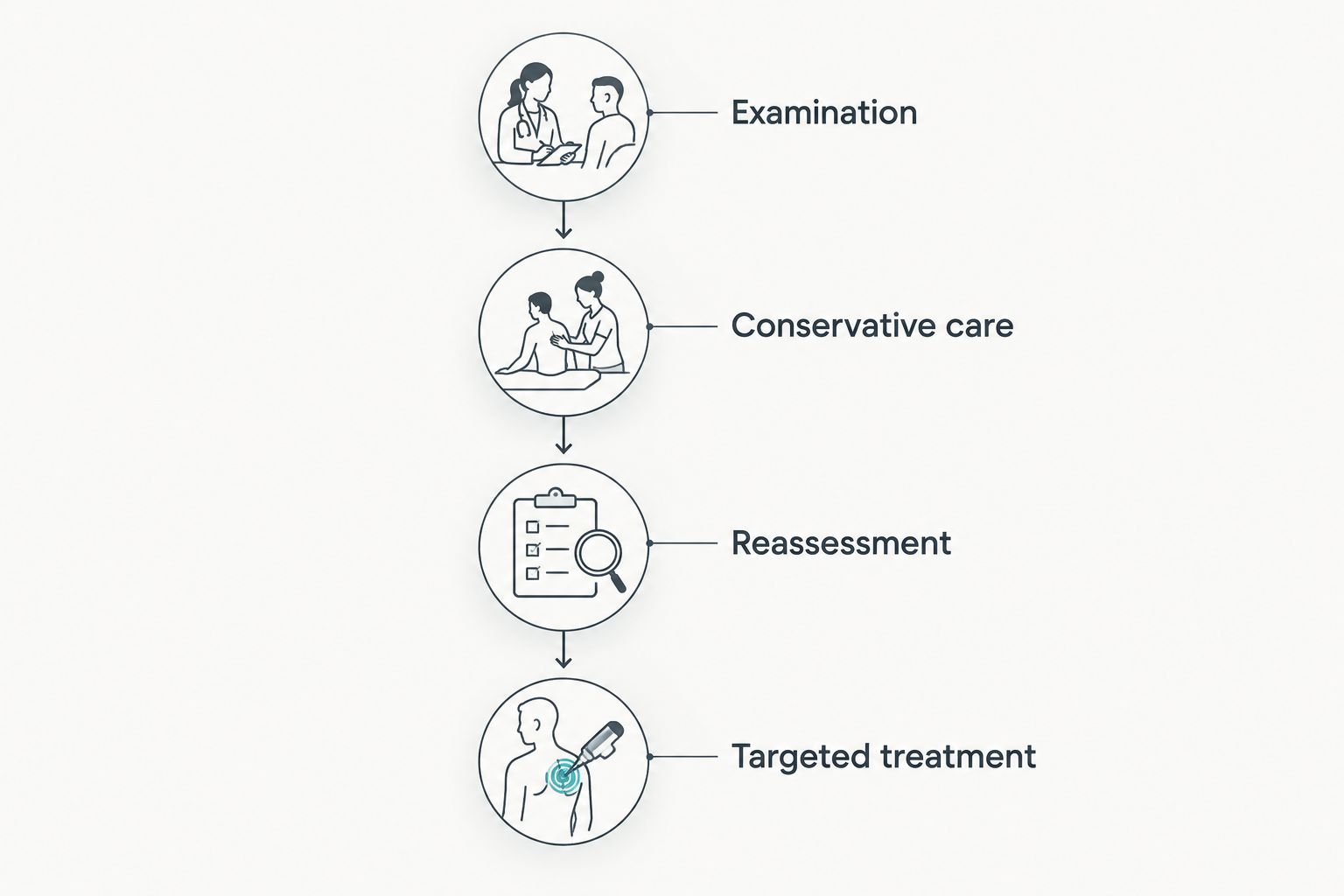
Neurological changes can require faster assessment rather than continued conservative care.
Hudson Pain and Spine provides interventional pain management for patients in Bergen, Passaic, and Middlesex counties. Bring your imaging reports, medication list, previous treatment history, and a description of which activities your symptoms prevent.
Request a neck pain evaluation
Discuss persistent neck and arm symptoms and whether interventional pain treatment fits your condition.
FAQ
What’s the best treatment for a herniated disc in the neck?
Physical therapy with activity modification is the usual starting approach when symptoms are stable and there are no neurological warning signs. Persistent radiating arm pain can justify an injection discussion, while progressive weakness requires prompt assessment.
Can a herniated neck disc improve without surgery?
Yes, cervical herniated disc symptoms often improve without surgery. Improvement in pain does not necessarily mean the disc looks normal on imaging, so treatment decisions also depend on function and the neurological examination.
Is an epidural injection better than physical therapy?
A cervical epidural injection and physical therapy serve different purposes. An injection targets inflammation around irritated nerves, while therapy develops movement tolerance and strength; selected patients use both.
How long should I try nonsurgical treatment?
Stable cervical radicular symptoms are commonly reassessed after about 4–6 weeks of conservative care. New weakness, walking difficulty, or other neurological changes require earlier evaluation rather than waiting for that interval.
Does a cervical epidural steroid injection fix the disc?
No, a cervical epidural steroid injection does not repair or remove a herniated disc. It aims to reduce inflammation and related pain, and the extent and duration of relief vary.
When does a herniated neck disc need surgery?
Surgery is considered for progressive neurological deficits, clinical signs of spinal cord compression, or persistent disabling symptoms despite appropriate nonsurgical treatment. A spine surgeon must connect the examination with the imaging before recommending a procedure.
Should I exercise if my arm feels numb?
Persistent or worsening arm numbness needs assessment before you intensify neck exercises. Stop exercises that increase radiating symptoms, and seek urgent care if numbness accompanies new weakness or coordination changes.
Where can I get a nonsurgical neck pain evaluation in New Jersey?
Hudson Pain and Spine provides interventional pain management from offices in Englewood, Woodland Park, and Edison. An evaluation determines whether an injection or another treatment fits your symptoms; a procedure is not automatic.
One last thing
Less pain does not always mean better nerve function. In 2026, judge progress by what your hand and arm can do—not only by your pain score. Report new dropping of objects, trouble fastening buttons, or worsening grip even if your neck hurts less.
This guide provides general education, not a diagnosis or individualized treatment instructions.
Related guides
- How to treat a herniated disc without surgery
- Signs your neck pain may be cervical radiculopathy
- How long a herniated disc takes to heal
About the Medical Reviewer
Dr. Saurabh Dang is a double board-certified interventional pain management specialist serving Central and Northern New Jersey. He combines clinical expertise with a patient-centered approach to help patients find lasting relief from chronic pain conditions.
Read Full Bio →Seeking Treatment for Epidural Injections?
Dr. Dang and the team at Hudson Pain and Spine offer specialized care and advanced interventional treatments.
Ready to Find Relief from Pain?
Schedule your consultation with Dr. Saurabh Dang at our Englewood office.
Serving patients across Central and Northern New Jersey — Bergen, Passaic, and Middlesex counties.