
How long does a herniated disc take to heal?

Medically reviewed by
Dr. Saurabh Dang, MD, MBA

A herniated disc can start feeling better within days to weeks, but symptom recovery often takes several months; the American Academy of Orthopaedic Surgeons (AAOS) reports that most people with a lumbar herniated disc are symptom-free within 3 to 4 months. That does not mean the disc has returned to its original shape, and numbness or weakness can follow a different recovery timeline. This 2026 guide explains what improvement looks like and when waiting is unsafe.
TL;DR
- How long does a herniated disc take to heal? Symptoms often improve over weeks, while recovery can take months.
- AAOS reports most people with lumbar disc herniation are symptom-free within 3 to 4 months.
- Less sciatica does not prove that a herniated disc has disappeared on MRI.
- New bladder problems, saddle numbness, or rapidly worsening weakness require emergency evaluation.
Why this matters
Track what you can do, not just how many days have passed. Better sleep, easier walking, and less pain traveling down your leg are useful recovery signs. New weakness is not a normal milestone to wait through.
Hudson Pain and Spine provides interventional pain management for back pain, neck pain, and sciatica. Persistent symptoms deserve an examination that checks whether a disc problem actually explains your pain before treatment decisions are made.
How long does a herniated disc take to heal?
A herniated disc has several overlapping recovery timelines: pain can settle, daily function can improve, and displaced disc material can change at different rates. The AAOS patient guide on lumbar herniated discs describes improvement over several days to weeks, with most patients free of symptoms within 3 to 4 months. That guidance concerns symptoms, not a guaranteed date for structural healing.
Use this comparison to understand what a recovery estimate actually measures:
| Recovery milestone | What it means | What it does not prove |
|---|---|---|
| Early improvement | Pain becomes less intense or less frequent over days to weeks | The disc has returned to its original position |
| Symptom recovery | Most lumbar disc patients become symptom-free within 3 to 4 months, according to AAOS | Every patient recovers within that window |
| Nerve recovery | Sensation or strength improves as the affected nerve recovers | Numbness must disappear as soon as pain improves |
| Structural change | Herniated material shrinks or changes over time | Repeat imaging is necessary whenever symptoms improve |
A scan alone cannot establish whether you are recovered. Your clinician combines your symptoms, strength, sensation, reflexes, and daily function with imaging when it is needed.
These distinctions remain central to recovery planning in 2026: the calendar provides context, but the examination determines whether continued conservative care is appropriate.
Uncomplicated lumbar symptoms: often 3 to 4 months
The 3 to 4 months described by AAOS is a symptom-recovery benchmark, not a deadline. It applies to lumbar disc herniation and should not automatically be used for a neck disc problem, postoperative recovery, or symptoms involving significant neurological changes.
Many people improve without surgery. Inflammation around an irritated nerve can settle, and the body can gradually absorb some herniated material. You do not need proof that the disc looks normal before you can begin recovering function.
Progress is not always a straight line. A more active day can temporarily increase discomfort, but repeated worsening, expanding numbness, or declining strength calls for reassessment rather than another period of waiting.
Persistent symptoms: reassess around 6 weeks
Around 6 weeks is a common clinical reassessment point when symptoms are not improving with conservative care. It is not a required waiting period before asking for help, and it does not mean you automatically need surgery or an injection.
Contact your clinician sooner if pain prevents sleep, walking, or basic daily activities. An examination can identify weakness, review medication safety, and determine whether imaging or a specialist evaluation would change treatment.
For your 2026 recovery plan, establish a follow-up date rather than accepting an open-ended instruction to rest. Agree on what should improve and which changes require an earlier call.
Numbness and weakness: no fixed recovery deadline
Pain, numbness, and weakness are different symptoms. Pain can decrease while altered sensation remains, and the amount of pain does not reliably measure how well a nerve is functioning.
Persistent numbness deserves follow-up, especially if its location or intensity changes. New or progressive weakness requires prompt medical evaluation, even when your back pain feels better.
Examples include a foot that starts catching on the floor, difficulty lifting the front of your foot, or new trouble gripping objects with a neck-related problem. Do not use a general recovery estimate to explain away a new loss of function.
Why herniated disc recovery varies
Recovery depends on more than the size of a disc finding on MRI. These factors help explain why another person’s experience is not your personal forecast:
- Nerve involvement: Pain without neurological loss differs from pain accompanied by weakness or persistent sensory changes.
- Disc location: A lumbar disc can affect the leg, while a cervical disc can affect the arm or, in some cases, the spinal cord.
- Inflammation and compression: Chemical irritation and mechanical pressure both contribute to symptoms; pain relief does not necessarily mean pressure has disappeared.
- Other spinal changes: Arthritis or spinal narrowing can contribute to symptoms alongside a herniated disc.
- Activity demands: Heavy lifting, repeated bending, and prolonged positions can make returning to usual tasks more difficult.
- Treatment tolerance: Your ability to participate in rehabilitation depends partly on pain control and other health conditions.
The practical response is an individualized plan. A physically demanding job and a desk-based job do not require the same return-to-work progression, even when the MRI descriptions sound similar.
What should you do while the disc recovers?
For uncomplicated disc symptoms, the goal is tolerable movement and gradual return to function—not prolonged bed rest. Your clinician or physical therapist should adapt activity to your symptoms and neurological examination.
- Keep moving. Use comfortable walking and ordinary daily movement rather than staying in bed for extended periods. Break activities into manageable periods when necessary.
- Adjust activity. Temporarily modify lifting, repeated bending, twisting, or positions that consistently worsen radiating pain. Avoid treating every uncomfortable movement as permanent damage.
- Build capacity. Follow an individualized rehabilitation plan that progresses strength, endurance, and useful movement. There is no single exercise that suits every disc herniation.
- Reassess symptoms. Report new weakness, spreading numbness, or a declining ability to walk or use your arm. Review persistent symptoms rather than repeatedly pushing through them.
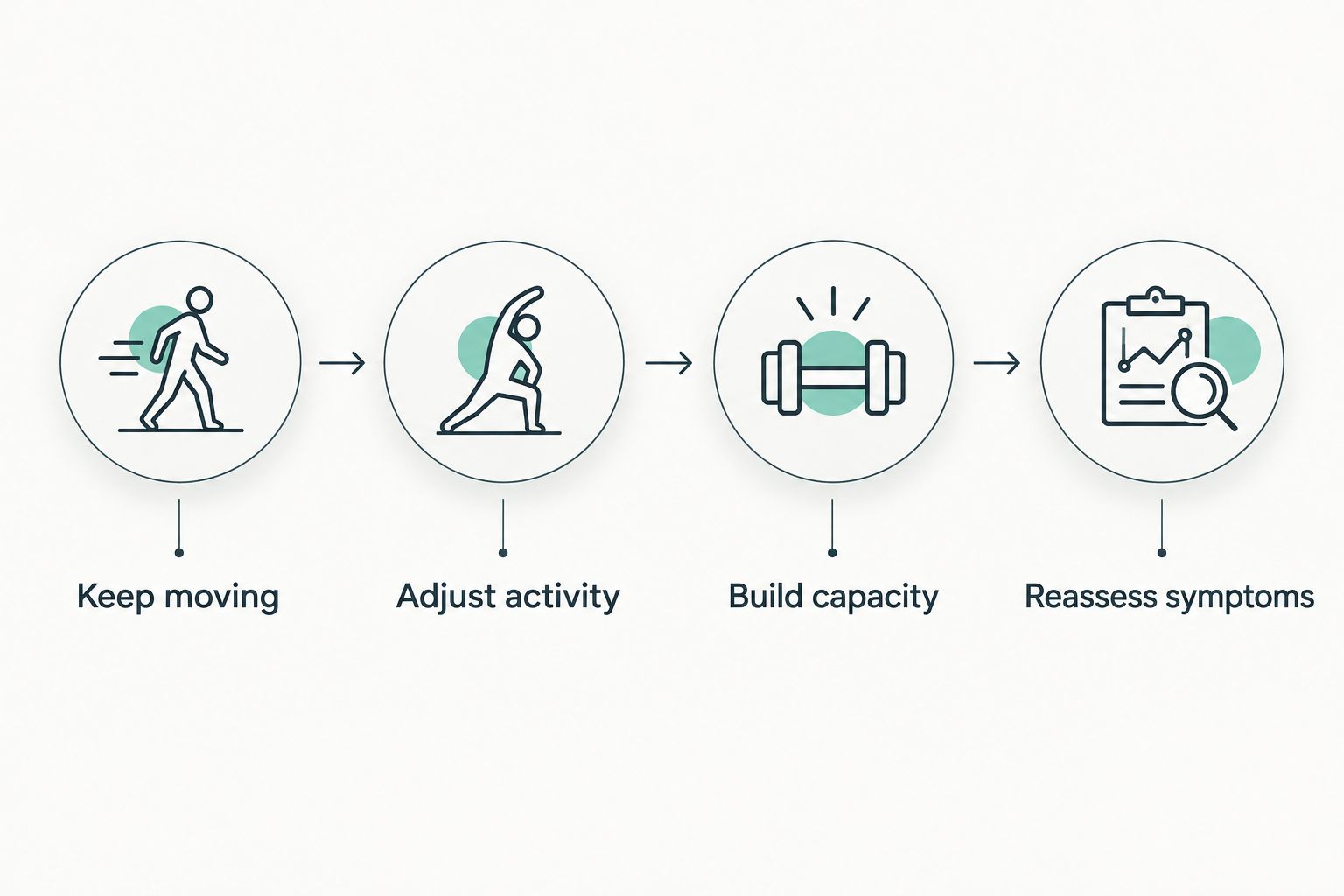
Activity should progress with your function, while new neurological symptoms require reassessment.
A useful 2026 recovery record includes your walking tolerance, sleep disruption, pain location, and any changes in strength or sensation. Bring that record to follow-up visits. It gives your clinician more useful information than a pain score alone.
Which treatments help, and what are their limits?
Treatment should address your symptoms and examination findings, not simply the word herniation on an MRI report. Conservative care, injections, and surgery serve different purposes.
| Option | Best for | Potential benefit | Main limitation or risk |
|---|---|---|---|
| Activity modification and physical therapy | Patients without urgent neurological findings who need to rebuild function | Supports movement, strength, and return to daily tasks | Requires participation and adjustment; exercises can aggravate symptoms if poorly matched |
| Clinician-guided medication | Patients needing symptom control to sleep or remain active | Reduces pain or inflammation, depending on the medicine | Side effects and medical conditions limit suitable choices; medication does not repair the disc |
| Epidural steroid injection | Selected patients with persistent nerve-root pain | Reduces inflammation around an irritated spinal nerve | Relief varies; bleeding, infection, and nerve injury are procedural risks |
| Surgical evaluation | Patients with progressive deficits or disabling symptoms despite appropriate care | Determines whether relieving nerve compression is appropriate | Surgery has risks and does not guarantee complete symptom resolution |
An epidural steroid injection does not push a disc back into place or guarantee faster structural healing. Its purpose is symptom relief, sometimes to help you participate in rehabilitation. Read more about treating a herniated disc without surgery.
Hudson Pain and Spine provides pain management for New Jersey patients seeking interventional evaluation of persistent back pain or sciatica. The practice offers epidural injections and nerve blocks; whether either fits your symptoms depends on a clinical assessment. A pain management visit does not replace emergency care or surgical evaluation when neurological findings require it.
Does a herniated disc heal faster with an injection?
A 3 to 4 months symptom-recovery benchmark does not become a guaranteed shorter timeline after an injection. Epidural steroids target inflammation, not the displaced disc material itself.
If an injection reduces pain, you still need a sensible activity progression. Feeling better is not permission to immediately resume every lift, workout, or repetitive task that previously aggravated symptoms.
Does pain after 6 weeks mean I need surgery?
Pain after 6 weeks does not automatically mean you need surgery. Persistent symptoms call for reassessment of the diagnosis, neurological examination, and response to treatment.
A surgical opinion becomes more relevant when disabling symptoms persist despite appropriate nonsurgical care or when neurological deficits develop. Progressive weakness or emergency symptoms require earlier action, regardless of how long pain has been present.
When should you get urgent medical care?
Go to an emergency department for new bladder or bowel control problems, inability to urinate, or numbness around the groin and saddle area. These symptoms can indicate cauda equina syndrome, which requires urgent assessment.
Rapidly worsening weakness, new difficulty walking, or neurological symptoms affecting both legs also require urgent evaluation. With neck symptoms, new hand clumsiness or balance problems can indicate spinal cord involvement.
Fever with severe spinal pain, significant trauma, or back pain with a history of cancer also warrants prompt medical assessment. A herniated-disc label should never prevent evaluation for another cause.
FAQ
How long does a herniated disc take to heal without surgery?
Herniated-disc symptoms often improve over weeks, and AAOS reports that most people with lumbar disc herniation are symptom-free within 3 to 4 months. Structural changes and nerve recovery do not necessarily follow the same timeline.
Can a herniated disc heal on its own?
A herniated disc can improve without surgery as inflammation settles and the body absorbs some displaced material. Improvement does not require the disc to look completely normal on MRI.
How do I know my herniated disc is getting better?
Improvement usually means less radiating pain and better sleep, walking, or daily function. New weakness or expanding numbness is a reason for reassessment, not a reassuring recovery sign.
Is walking good for a herniated disc?
Comfortable walking is generally appropriate for uncomplicated herniated-disc symptoms. Adjust the distance and pace to your tolerance, and seek assessment if walking triggers worsening neurological symptoms.
Should I stay in bed until my disc heals?
Prolonged bed rest is not recommended for uncomplicated herniated-disc symptoms. Use tolerable movement and clinician-guided activity adjustments instead.
Do I need another MRI to prove my disc has healed?
A repeat MRI is not routinely needed just to document recovery when symptoms and function are improving. Your clinician considers imaging when new findings or persistent symptoms would change treatment.
Where can I discuss pain management for a herniated disc in New Jersey?
Hudson Pain and Spine provides pain management in Englewood, Woodland Park, and Edison. A clinical evaluation determines whether persistent disc-related symptoms fit interventional treatment or require another type of care.
One last thing
An abnormal MRI and a recovering patient can exist at the same time. Disc changes also occur in people without symptoms, so the scan must match your history and examination.
For your 2026 follow-up, ask: Which findings explain my symptoms, what functional improvement should I expect next, and what would change the treatment plan? Those answers are more useful than a promised healing date.
Related guides
- Herniated disc treatment for active adults and athletes
- How long does sciatic nerve pain last?
- How to connect physical therapy to interventional pain treatment
About the Medical Reviewer
Dr. Saurabh Dang is a double board-certified interventional pain management specialist serving Central and Northern New Jersey. He combines clinical expertise with a patient-centered approach to help patients find lasting relief from chronic pain conditions.
Read Full Bio →Seeking Treatment for Epidural Injections?
Dr. Dang and the team at Hudson Pain and Spine offer specialized care and advanced interventional treatments.
Ready to Find Relief from Pain?
Schedule your consultation with Dr. Saurabh Dang at our Englewood office.
Serving patients across Central and Northern New Jersey — Bergen, Passaic, and Middlesex counties.