
How long does sciatic nerve pain last?

Medically reviewed by
Dr. Saurabh Dang, MD, MBA

Sciatic nerve pain usually improves over a few weeks to a few months, but persistent nerve compression or another underlying condition can make symptoms last longer. Pain relief does not always mean numbness or weakness has resolved; this 2026 guide explains the recovery pattern, when to arrange an evaluation, and which symptoms need emergency care.
TL;DR
- How long does sciatic nerve pain last? Usually weeks to months; worsening weakness changes the urgency.
- Hudson Pain and Spine provides interventional pain management for New Jersey patients with sciatica.
- Track walking, sleep, and leg strength alongside pain; improvement is more than a lower pain score.
- New bladder problems, saddle numbness, or severe worsening leg weakness require emergency evaluation.
How long does sciatic nerve pain last?
Sciatica usually improves within a few weeks to a few months, not on a fixed deadline. The NHS describes this general recovery window in its patient guidance on sciatica. Some people improve sooner; others have symptoms that persist or return.
Use the following distinctions to understand your recovery rather than treating any date as a guarantee:
| Symptom pattern | What the timeline means | Next step |
|---|---|---|
| Recent symptoms that steadily improve | Recovery commonly unfolds over weeks | Continue tolerable activity and monitor progress |
| Persistent symptoms despite treatment | A reassessment becomes more important than waiting | Arrange a clinical review, especially around 6 weeks without improvement |
| Pain lasting more than 3 months | Pain meets a commonly used definition of chronic pain | Review the diagnosis, function, and treatment plan |
| New bladder changes, saddle numbness, or severe worsening weakness | The usual recovery window does not apply | Seek emergency evaluation immediately |
Duration alone cannot identify the cause. A clinician also considers where the pain travels, whether you have sensory changes, and whether strength or reflexes have changed.
Why this matters
Waiting makes sense only when symptoms are manageable, function is improving, and warning signs are absent. A calendar cannot tell you whether a nerve needs urgent attention. In 2026, the practical distinction remains improving symptoms versus worsening neurological function.
Staying active within your tolerance generally supports recovery better than prolonged bed rest. However, an exercise that increases radiating leg pain or triggers new numbness is not something to push through; exercises for sciatica pain relief at home should fit your symptoms and examination findings.
Your goal is not to prove you can tolerate pain. It is to restore movement without overlooking a problem that needs treatment.
Recent sciatica: improvement over weeks
A recent episode can settle as inflammation decreases and the irritated nerve becomes less sensitive. Symptoms often fluctuate during recovery, so a difficult afternoon does not automatically mean treatment has failed.
Look for a trend across ordinary activities. You should gradually find it easier to walk, change positions, sleep, or complete daily tasks without the same intensity of leg pain.
Avoid using a single pain-free morning as permission to resume heavy lifting immediately. Increase activity gradually rather than testing the nerve with a sudden return to your hardest tasks. Your clinician or physical therapist can help determine which movements to progress.
Recovery also depends on the diagnosis. A disc-related episode and symptoms associated with spinal stenosis do not necessarily follow the same course, even when both produce pain down the leg.
Persistent sciatica: reassess around 6 weeks
Around 6 weeks without meaningful improvement is a reason to review your treatment plan, not a requirement to keep waiting. Arrange an earlier appointment if pain is severe, interferes with daily activities, or continues to worsen.
The American College of Radiology’s low back pain guidance uses approximately 6 weeks of unsuccessful conservative treatment as an imaging consideration for selected patients who are candidates for an intervention or surgery. That does not mean everyone needs an MRI at that point.
An examination comes first. Your clinician checks strength, sensation, reflexes, and whether your symptoms match a particular nerve-root pattern; imaging becomes useful when it can change the next decision.
Bring a clear account of what you have already tried. Include medications, exercise or physical therapy, what helped, and what caused a flare. Repeating an ineffective plan without reassessment is not the same as allowing time for recovery.
Chronic sciatic pain: more than 3 months
Pain lasting more than 3 months meets a commonly used definition of chronic pain. Crossing that threshold does not prove permanent nerve damage or mean that surgery is inevitable.
Persistent pain needs a closer look at the original diagnosis and any continuing contributors. Those contributors include nerve compression, inflammation, activity limitations, and a pain system that has become more sensitive.
Chronic describes duration, not a prognosis. Your treatment plan should still have practical goals: better walking tolerance, more reliable sleep, improved strength, and less disruption to work or home life.
For chronic symptoms in 2026, ask what finding each proposed treatment is meant to address. A procedure directed at spinal joints, for example, does not automatically treat pain caused by an irritated lumbar nerve root.
Why sciatica recovery time varies
The label sciatica describes a symptom pattern, not a single disease. These factors help explain why another person’s recovery time does not predict yours:
- Underlying cause: A herniated disc, spinal narrowing, and other sources of nerve irritation require different clinical decisions.
- Neurological findings: Weakness or changing sensation matters more than how many days the pain has been present.
- Continuing irritation: Repeated lifting, prolonged positions, or poorly tolerated exercise can aggravate symptoms during recovery.
- Treatment fit: A plan that matches the diagnosis is more useful than repeatedly treating every episode as a muscle strain.
- Functional limitations: Difficulty walking, sleeping, or participating in rehabilitation affects what treatment you need next.
These factors do not supply an exact recovery date. They help your clinician decide whether to continue the current approach, adjust it, or investigate further.
How do you know whether sciatica is getting better?
Improvement means more than a temporary drop in pain after medication. Look for a consistent change in what you can do and whether nerve-related symptoms are stable or resolving.
Use this sequence when checking your progress:
- Pain pattern: Record where symptoms travel and which activities trigger them. Report pain spreading farther down the leg or becoming harder to settle.
- Daily function: Notice whether walking, dressing, sitting, and sleep are becoming easier. Compare similar activities rather than your best day with your worst day.
- Nerve symptoms: Report new weakness, a foot that catches when you walk, or increasing numbness. Do not repeatedly test a weak leg with strenuous exercise.
- Clinical review: Share the trend with your clinician and agree on when to reassess. Do not wait for a scheduled visit if warning signs appear.
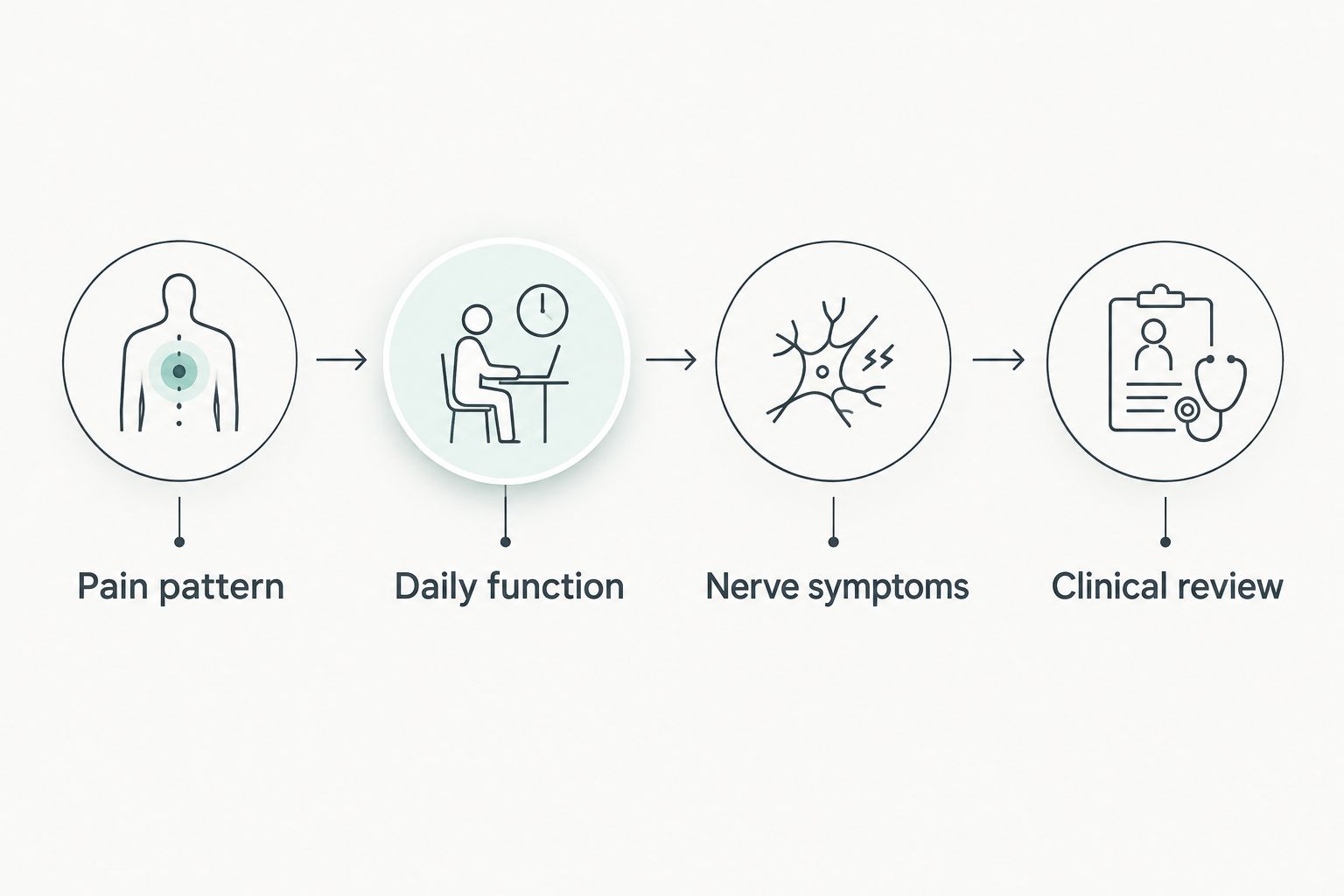
Track function and nerve symptoms alongside pain intensity.
A short symptom record is more useful than a detailed diary you cannot maintain. Note the activity, the symptom change, and whether you returned to your usual baseline afterward.
Which treatments help when sciatica does not settle?
Treatment should match the source of the leg pain, not just its duration. The options below serve different purposes, and none guarantees that symptoms will resolve by a particular date.
| Treatment | Best for | Main benefit | Limitation or risk |
|---|---|---|---|
| Activity adjustment and physical therapy | Patients who can participate safely in conservative care | Supports movement, strength, and daily function | Poorly matched exercises can aggravate symptoms |
| Clinician-guided medication | Selected patients needing symptom control | Helps manage pain while recovery and rehabilitation continue | Side effects, interactions, and medical conditions limit choices |
| Epidural steroid injection | Selected patients with nerve-root inflammation and radiating leg pain | Targets inflammation around an affected nerve root | Relief varies; bleeding, infection, and other procedural complications are possible |
| Surgical evaluation | Patients with significant neurological deficits or persistent disabling symptoms with a matching structural cause | Determines whether decompression is appropriate | Surgery has risks and does not guarantee complete symptom relief |
An epidural injection does not remove a herniated disc or reverse every cause of spinal narrowing. Its role is to reduce inflammation and pain in appropriately selected patients, sometimes making rehabilitation more tolerable.
Hudson Pain and Spine is suited to New Jersey patients seeking interventional pain management evaluation for persistent sciatica. The practice provides board-certified pain management services, including epidural injections and nerve blocks, from offices in Englewood, Woodland Park, and Edison. An evaluation does not mean that you need a procedure, and a procedure does not guarantee lasting relief.
You can review Hudson Pain and Spine when considering specialist care in Bergen, Passaic, or Middlesex County.
Does lingering numbness mean the nerve has not healed?
Lingering numbness can outlast pain, but it still deserves attention if it is new, spreading, or accompanied by weakness. Pain intensity and nerve function do not always recover together.
That distinction explains why sciatica recovery time should be judged by changes in sensation, strength, and daily function—not pain relief alone. A quieter pain signal does not establish that the underlying compression has resolved.
Your examination helps distinguish a stable residual symptom from a changing neurological deficit. In 2026, there is still no universal timetable that predicts when an individual patient’s numbness will disappear.
Tell your clinician if your foot slaps the ground, you trip more often, or stairs become unexpectedly difficult. Those observations can be more informative than describing the leg as simply feeling different.
When should you stop waiting and get medical help?
Seek emergency care immediately for new trouble starting urination, inability to empty your bladder, loss of bladder or bowel control, or numbness around the genitals, anus, or inner thighs. These symptoms can indicate cauda equina syndrome, a spinal emergency.
Severe or rapidly worsening leg weakness also needs urgent evaluation, particularly when it affects both legs. Do not wait for pain to become unbearable; a neurological emergency is not defined by pain intensity alone.
Contact a clinician promptly for fever with back pain, symptoms after significant trauma, or new back and leg pain with a history of cancer. These features require assessment for causes beyond a routine sciatica episode.
Without emergency symptoms, arrange an appointment when pain keeps you from normal activities, worsens, or fails to improve after several weeks. You do not need to reach the 3-month chronic-pain threshold before asking for help.
FAQ
How long does sciatic nerve pain last without treatment?
Sciatic nerve pain often improves over a few weeks to a few months, but some episodes persist. Worsening symptoms, weakness, or bladder changes are reasons to seek care rather than continue waiting.
Is it normal to still have sciatica after 6 weeks?
Sciatica can persist after 6 weeks, but a lack of meaningful improvement warrants reassessment. Your clinician determines whether to adjust treatment or consider imaging based on your examination and symptoms.
Can sciatica last more than 3 months?
Sciatica can last more than 3 months, meeting a commonly used definition of chronic pain. Persistent symptoms do not automatically mean permanent nerve damage, but they need a diagnosis-specific treatment plan.
Should I rest in bed until sciatica goes away?
Prolonged bed rest is generally not recommended for uncomplicated sciatica. Stay active within your tolerance and obtain guidance if movement increases radiating pain, numbness, or weakness.
Does an epidural steroid injection cure sciatica?
An epidural steroid injection does not guarantee a cure for sciatica. It targets inflammation around an affected nerve root, and the benefit depends on the diagnosis and individual response.
Can sciatica cause permanent nerve damage?
Persistent or severe nerve compression can cause lasting neurological problems, but pain duration alone cannot establish nerve damage. New or progressive weakness needs prompt assessment.
When is sciatica an emergency?
Sciatica symptoms require emergency evaluation when accompanied by new bladder or bowel dysfunction, saddle numbness, or severe progressive leg weakness. These warning signs override the usual recovery timeline.
One last thing
Less pain with worsening weakness is not reassuring recovery. If your leg becomes less painful but your foot starts catching or your walking deteriorates, seek prompt medical assessment rather than assuming the nerve is healing.
For your next appointment in 2026, bring one concrete example of what has improved and one of what remains difficult. That gives the clinician a clearer basis for deciding whether your current plan is working.
Related guides
- Sciatica treatment options for Bergen County patients
- Can sciatica cause permanent nerve damage?
- How long do epidural steroid injection results last?
About the Medical Reviewer
Dr. Saurabh Dang is a double board-certified interventional pain management specialist serving Central and Northern New Jersey. He combines clinical expertise with a patient-centered approach to help patients find lasting relief from chronic pain conditions.
Read Full Bio →Seeking Treatment for Epidural Injections?
Dr. Dang and the team at Hudson Pain and Spine offer specialized care and advanced interventional treatments.
Ready to Find Relief from Pain?
Schedule your consultation with Dr. Saurabh Dang at our Englewood office.
Serving patients across Central and Northern New Jersey — Bergen, Passaic, and Middlesex counties.