
Best treatments for shoulder pain in 2026

Medically reviewed by
Dr. Saurabh Dang, MD, MBA

Best overall for confirmed nerve-driven shoulder pain: suprascapular nerve block. Best for chronic tendon degeneration: platelet-rich plasma (PRP) injections. Best for frozen shoulder: hydrodilatation with corticosteroid. Best for full-thickness tears that haven’t responded to anything else: rotator cuff repair surgery. Those four calls anchor this ranking of the best treatments for shoulder pain in 2026, built around what the pain is actually coming from rather than which treatment sounds newest.
TL;DR
- Suprascapular nerve block ranks best overall for widespread shoulder pain that injections alone haven’t fixed.
- Corticosteroid injections work fastest for bursitis but relief typically fades in 6 to 12 weeks.
- PRP injections suit active adults with chronic tendon degeneration who want to avoid surgery.
- Frozen shoulder responds best to hydrodilatation with corticosteroid, not to a generic anti-inflammatory shot.
- Rotator cuff repair surgery stays a last-resort pick, reserved for confirmed full-thickness tears.
Why this matters
Shoulder pain isn’t one condition, and treating it like one is why so many patients cycle through the same anti-inflammatory routine for months without change. Bursitis, a torn rotator cuff, frozen shoulder, and nerve irritation from the neck can all present as “my shoulder hurts when I lift my arm,” and each needs a different fix. Getting the diagnosis right before picking a treatment for rotator cuff shoulder pain matters more in 2026 than which clinic has the newest equipment.
A board-certified pain specialist starts with imaging and a physical exam, not a standard injection protocol. That distinction is what separates a treatment plan that resolves the pain from one that just numbs it for a few weeks at a time.
What makes the best treatment for shoulder pain
- Matches the actual diagnosis — bursitis, tendon tear, frozen shoulder, and referred nerve pain each need a different first move.
- Backed by orthopedic or pain-medicine literature, not just anecdote or a clinic’s house brand of care.
- Speed of relief — some injections work in days, physical therapy takes weeks, regenerative options like PRP build over months.
- Durability — single-flare control versus lasting improvement in shoulder function.
- Downtime required — office-based procedures versus surgical recovery measured in months.
- Position on the escalation ladder — conservative options come first; invasive procedures are reserved for cases that don’t respond.
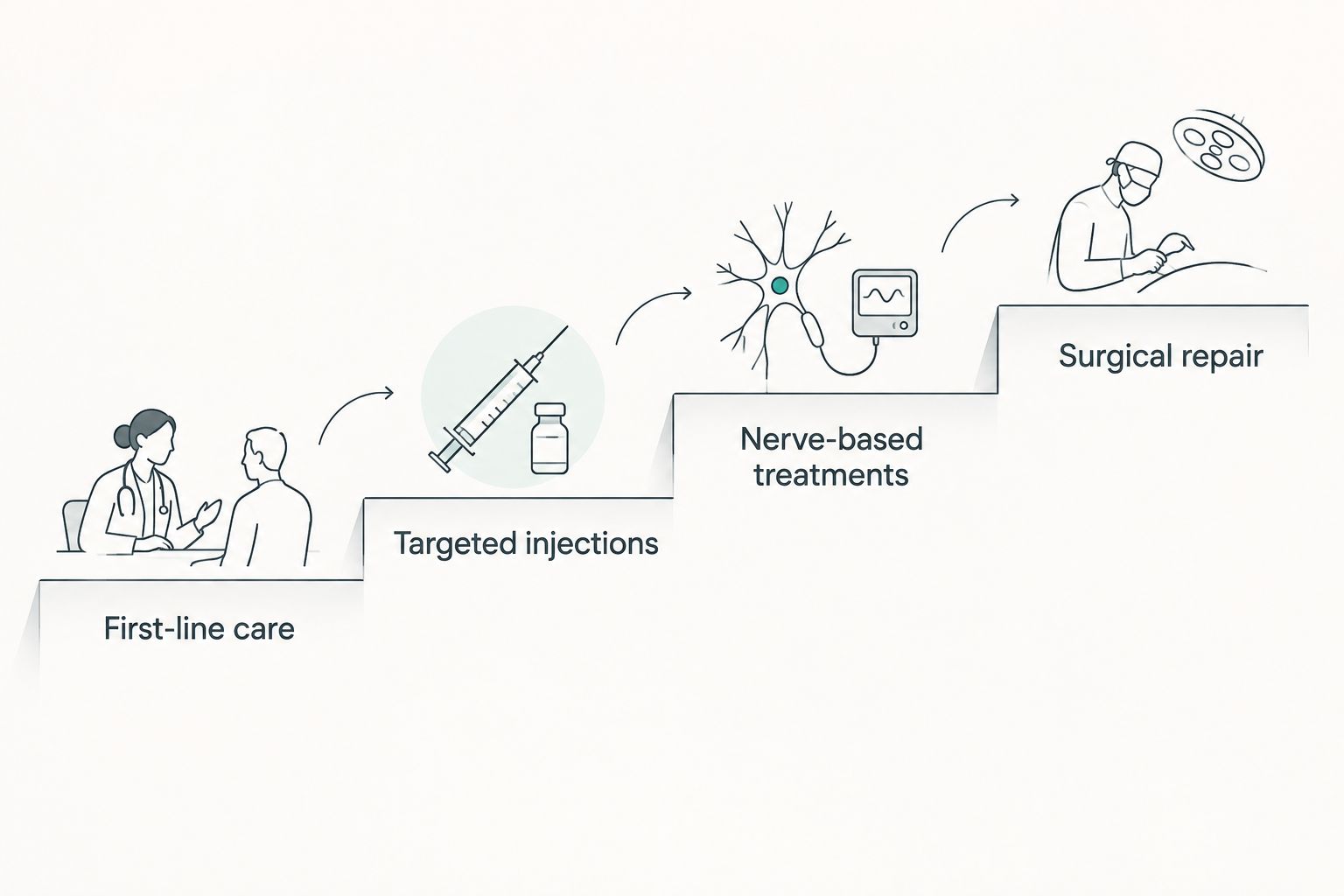
Treatment escalates from conservative to surgical only when the simpler option stops working.
Shoulder pain treatments at a glance
| Treatment | Best for | Standout feature | Key limitation |
|---|---|---|---|
| Physical therapy and activity modification | Early-stage rotator cuff strain, mild impingement | No downtime, corrects the movement pattern causing pain | Slower relief; needs weeks of consistent effort |
| Corticosteroid injection | Shoulder bursitis, acute inflammatory flares | Relief often felt within days | Effects typically fade in 6 to 12 weeks; limited injections per year |
| PRP injection | Chronic tendon degeneration in active adults | Uses the patient’s own plasma to support tissue repair | Results build gradually, not immediate |
| Suprascapular nerve block | Widespread pain unresponsive to first-line injections | Targets the nerve supplying most of the shoulder joint | More reliable as diagnostic tool than standalone long-term fix |
| Hydrodilatation with corticosteroid | Frozen shoulder with restricted range of motion | Stretches the tightened capsule under imaging guidance | Usually paired with a directed stretching program |
| Rotator cuff repair surgery | Confirmed full-thickness tears | Restores tendon anchoring surgically | Months-long recovery and rehab |
1. Physical therapy and activity modification: best for early-stage rotator cuff strain
A structured program of rotator cuff strengthening and posture correction is where most shoulder pain treatment starts, and for good reason. It addresses the mechanical cause — weak stabilizers, poor scapular positioning, overhead overuse — instead of just quieting the symptom.
Physical therapy pros:
- No procedural risk or downtime
- Builds strength that prevents the next flare-up
- Works alongside every other treatment on this list
Physical therapy cons:
- Relief takes weeks, not days
- Requires consistent home exercise to hold gains
- Doesn’t fix a structural tear or a frozen capsule
Best for: mild impingement or tendinopathy caught early. Verdict: start here for most new shoulder pain.
2. Corticosteroid injection: best for shoulder bursitis and acute flares
A corticosteroid injection into the subacromial bursa calms acute inflammation fast, often within a few days. It’s the standard second step when physical therapy alone hasn’t controlled a flare of bursitis or impingement.
Corticosteroid injection pros:
- Fast, office-based relief
- Low cost relative to procedural alternatives
- Doubles as a diagnostic tool — response to the injection helps confirm the pain source
Corticosteroid injection cons:
- Relief usually fades in 6 to 12 weeks
- Repeated injections in the same joint are limited due to tissue effects
- Doesn’t repair a torn tendon
Best for: bursitis or acute inflammatory flares. Verdict: reliable short-term option, not a standalone long-term plan.
3. PRP injection: best for chronic tendon degeneration in active adults
Platelet-rich plasma concentrates growth factors from the patient’s own blood and injects them directly into degenerated tendon tissue. It’s aimed at chronic rotator cuff tendinopathy that hasn’t responded to rest, PT, or a corticosteroid shot — the kind of wear-and-tear pain common in pickleball players and other overhead athletes.
PRP injection pros:
- Uses the patient’s own biology, no synthetic steroid
- No limit on repeat use the way steroid injections have
- Growing body of orthopedic literature supporting use in chronic tendinopathy
PRP injection cons:
- Results build over months, not days
- Not a fit for acute inflammatory pain
- Requires an active tissue-repair process to work — won’t fix a fully torn tendon
Best for: chronic tendon degeneration in patients who want to avoid surgery. Details on how PRP therapy treats joint pain apply directly to shoulder tendinopathy. Verdict: strong option before considering surgery.
4. Suprascapular nerve block: best for widespread pain that hasn’t responded to injections
The suprascapular nerve supplies sensation to roughly 70% of the shoulder joint, which makes a targeted nerve block useful when pain is diffuse rather than pinpointed to one structure. It’s both a treatment and a diagnostic step — if the block relieves the pain, that confirms the nerve as the pain source and opens the door to longer-acting options.
Suprascapular nerve block pros:
- Treats widespread pain that localized injections miss
- Doubles as a diagnostic confirmation for further treatment
- Office-based procedure with minimal recovery time
Suprascapular nerve block cons:
- Diagnostic block effects are often temporary
- Best paired with radiofrequency ablation for durable relief
- Not the right first step for a clearly localized tendon problem
Best for: shoulder pain that’s diffuse or unresponsive to first-line injections. Read what to expect after a nerve block procedure before scheduling one. Verdict: best overall pick for confirmed nerve-driven pain.
5. Hydrodilatation with corticosteroid: best for frozen shoulder
Frozen shoulder, or adhesive capsulitis, doesn’t respond to the same playbook as bursitis or a tendon tear because the problem is a tightened, thickened joint capsule, not inflammation alone. Hydrodilatation injects fluid under imaging guidance to stretch the capsule, usually combined with a corticosteroid to control the accompanying inflammation.
Hydrodilatation pros:
- Directly addresses the capsular tightness driving frozen shoulder
- Can shorten a condition that otherwise runs 1 to 3 years untreated
- Combines mechanical and anti-inflammatory relief in one procedure
Hydrodilatation cons:
- Needs to be paired with a directed stretching program afterward
- Not effective for bursitis or a rotator cuff tear
- May require more than one session for full range-of-motion recovery
Best for: diagnosed adhesive capsulitis with restricted range of motion. Full detail on how to treat frozen shoulder covers staging and timelines. Verdict: best for frozen shoulder specifically.
6. Rotator cuff repair surgery: best for confirmed full-thickness tears
Surgical repair reattaches a torn rotator cuff tendon to bone and stays the last stop on this list for a reason — it’s effective for full-thickness tears confirmed on MRI, but it carries a recovery timeline of months and isn’t a first-line fix for tendinopathy or bursitis.
Rotator cuff repair pros:
- Directly repairs a structural tear that injections can’t fix
- High success rate for appropriately selected tears
- Often the only durable fix once a tendon is fully torn
Rotator cuff repair cons:
- Months-long recovery and structured rehab
- Not appropriate for partial tears or tendinopathy without a tear
- Surgical risk that conservative and interventional options avoid
Best for: full-thickness tears unresponsive to conservative and interventional care. Verdict: reserve for confirmed structural tears, not general shoulder pain.
How we ranked these treatments
Each entry above was judged against the same six criteria from the section above: diagnostic fit, evidence base, speed of relief, durability, downtime, and position on the escalation ladder. The suprascapular nerve block ranks highest overall because it’s the treatment most likely to fit a patient whose diagnosis is still unclear after a course of physical therapy and a corticosteroid shot — it treats and diagnoses in one step. Frozen shoulder and confirmed tears get their own top picks because forcing them through the same steroid-injection pathway as bursitis wastes months.
Which shoulder pain treatment should you choose?
For a new ache from overhead lifting or a racquet sport, start with physical therapy and activity modification — most mild impingement resolves without an injection. If a flare of bursitis is limiting sleep and daily function, a corticosteroid injection gets you moving again within days.
For chronic tendon pain in an otherwise active adult who wants to avoid surgery, PRP is the stronger long-term bet over repeat steroid shots. If the shoulder has stopped bending in multiple directions and feels genuinely stuck, hydrodilatation for frozen shoulder is the specific fix, not a generic anti-inflammatory.
Patients over 65 managing shoulder arthritis alongside diabetes or heart disease tend to do best when a pain specialist coordinates directly with the primary care team, the same continuity that a solid Medicare primary care for seniors relationship is built around, so one provider tracks the whole picture instead of leaving referrals to chance. And when imaging confirms a full-thickness tear that hasn’t budged with conservative care, surgical repair stops being a last resort and becomes the right next step.
Get an accurate shoulder pain diagnosis
Board-certified evaluation across Englewood, Woodland Park, and Edison, NJ.
FAQ
What is the best treatment for shoulder pain in 2026?
There isn’t one best treatment for every case — physical therapy fits early rotator cuff strain, corticosteroid injections fit bursitis flares, PRP fits chronic tendon degeneration, and a suprascapular nerve block fits widespread pain that hasn’t responded to injections. Matching the treatment to the diagnosis matters more than picking a single ‘best’ option.
Is PRP better than a cortisone shot for shoulder pain?
PRP works better for chronic tendon degeneration since it supports tissue repair over months, while cortisone controls acute inflammation faster but only for 6 to 12 weeks. The right choice depends on whether the underlying problem is inflammatory or degenerative.
How long does relief from a suprascapular nerve block last?
A diagnostic nerve block typically provides temporary relief, which confirms the nerve as the pain source. Longer-lasting relief usually requires pairing the block with radiofrequency ablation once the diagnosis is confirmed.
Can frozen shoulder be treated without surgery?
Yes — hydrodilatation with corticosteroid, combined with a directed stretching program, is the standard non-surgical approach for adhesive capsulitis. Left untreated, frozen shoulder can run 1 to 3 years through its freezing, frozen, and thawing phases.
When does shoulder pain need surgery instead of injections?
Surgery becomes the right call when imaging confirms a full-thickness rotator cuff tear that hasn’t improved with physical therapy, injections, or nerve-based treatments. Partial tears and tendinopathy without a full tear usually respond to non-surgical care first.
Does insurance cover shoulder pain injections?
Coverage varies by plan and by procedure, and prior authorization is common for nerve blocks and regenerative injections. Confirming benefits before scheduling avoids a surprise bill.
What causes shoulder pain that doesn’t go away with rest?
Persistent shoulder pain usually points to bursitis, a rotator cuff tear, frozen shoulder, or referred nerve pain from the neck rather than simple overuse. An exam and imaging identify which one is driving the pain before treatment starts.
One last thing
The suprascapular nerve supplies most of the sensation in the shoulder joint, which is exactly why a nerve block outperforms a generic steroid shot when the pain is spread out rather than pinpointed — it’s treating the wiring, not just the joint. If a round of physical therapy and one injection hasn’t moved the needle by 2026 standards of care, that’s the point to ask about a nerve block instead of repeating the same shot a third time.
Related guides
- Best treatments for rotator cuff shoulder pain
- Best treatments for shoulder bursitis pain
- How to treat frozen shoulder (adhesive capsulitis) pain
- How platelet-rich plasma therapy treats joint pain
- How to choose an interventional pain specialist in New Jersey
About the Medical Reviewer
Dr. Saurabh Dang is a double board-certified interventional pain management specialist serving Central and Northern New Jersey. He combines clinical expertise with a patient-centered approach to help patients find lasting relief from chronic pain conditions.
Read Full Bio →Seeking Treatment for Nerve Block Injections?
Dr. Dang and the team at Hudson Pain and Spine offer specialized care and advanced interventional treatments.
Ready to Find Relief from Pain?
Schedule your consultation with Dr. Saurabh Dang at our Englewood office.
Serving patients across Central and Northern New Jersey — Bergen, Passaic, and Middlesex counties.