
Can you exercise after a nerve block injection?

Medically reviewed by
Dr. Saurabh Dang, MD, MBA

You can return to exercise after a nerve block injection when your treating clinician clears you, the procedure’s activity restrictions have ended, and you have normal strength, sensation, and balance. Do not work out while the treated area is numb or weak: pain relief does not mean the underlying problem has healed.
TL;DR
- Can you exercise after a nerve block injection? Resume only after procedure-specific clearance and recovery of strength and sensation.
- Hudson Pain and Spine provides nerve block treatment; ask your treating clinician for an individual return-to-exercise plan.
- Gentle walking and a gym workout place different demands on the treated area; neither overrides your discharge instructions.
- Diagnostic nerve blocks sometimes require specific movements and a pain diary, not an unrestricted workout.
Can you exercise after a nerve block injection?
Yes, but not simply because your pain has improved. Your discharge instructions determine when you can restart activity, and any remaining numbness, weakness, dizziness, or unsteadiness means you should postpone exercise. A block performed with surgery also carries the surgeon’s restrictions.
Use the following comparison to discuss your activity plan with your clinician. For the broader recovery process, read what to expect after a nerve block procedure.
| Activity | Best for | Benefit after clearance | Main limitation |
|---|---|---|---|
| Gentle walking | Returning to basic movement | Lets you assess comfortable movement on a stable surface | An affected leg or impaired balance creates a fall risk |
| Prescribed rehabilitation | Rebuilding condition-specific function | Matches movement to your diagnosis and treatment goals | The program needs adjustment around procedure restrictions |
| Stretching or yoga | Restoring an approved range of motion | Allows controlled movement without added weights | Deep positions can stress an area whose warning signals remain reduced |
| Resistance training | Returning to strength goals | Supports progressive rebuilding once cleared | Heavy loads demand reliable strength, sensation, and technique |
| Running or court sports | Returning to sport-specific activity | Restores the demands of your usual sport | Impact, rapid turns, and balance demands require additional readiness |
There is no single exercise timetable that applies to every nerve block in 2026. The nerve targeted, medication used, reason for treatment, and any accompanying procedure all affect your instructions.
Why this matters
A local anesthetic can reduce pain while also changing sensation or muscle control. You can therefore feel better without being ready to lift, run, or balance safely. Less pain is not the same as restored function.
This distinction matters whether you are returning to recreational exercise or a physical job. Carrying groceries upstairs, lifting a child, and moving equipment can load the treated area just as a workout does.
Use this 2026 guide to prepare questions for your clinician, not to replace your discharge paperwork. If advice conflicts, follow your treating team’s procedure-specific instructions and ask for clarification before exercising.
Why return-to-exercise instructions vary
Your clinician bases your activity restrictions on more than the injection site. These factors explain why another patient’s experience is not a reliable schedule for your recovery:
- Nerve location: A block affecting an arm or leg can alter the strength or sensation needed for gripping, weight-bearing, or balance.
- Medication used: Local anesthetic changes nerve signaling temporarily. A steroid, when included, serves a different purpose and does not provide immediate proof of tissue recovery.
- Reason for the block: A diagnostic injection evaluates a suspected pain source; a therapeutic injection aims to treat symptoms.
- Sedation: Sedating medication can impair alertness and coordination even when the injection area feels comfortable.
- Underlying condition: A tendon injury, joint problem, or recent operation can still restrict exercise after pain improves.
- Recovery symptoms: Persistent weakness, unexpected numbness, or worsening symptoms require reassessment rather than progression.
Ask which of these factors applies to your procedure. A useful answer identifies both the restriction and the condition that must be met before it ends.
How should you restart exercise after clearance?
Return in stages rather than testing your usual workout immediately. The first session should assess tolerance, not performance. Keep your clinician’s restrictions in place even if the activity feels easy.
- Review instructions. Confirm which activities are allowed, which remain restricted, and whether your clinician expects a pain diary.
- Check function. Make sure you have the strength, sensation, alertness, and balance needed for the approved activity. Do not use heavy lifting or a difficult balance task to test recovery.
- Start gently. Choose a familiar, controlled activity that your clinician has approved. Avoid adding new movements during the initial return.
- Track symptoms. Notice pain, tingling, weakness, swelling, and changes in movement during activity and afterward.
- Build gradually. Increase demands only when your response and treatment plan support it. Change the workload rather than jumping directly to your previous routine.
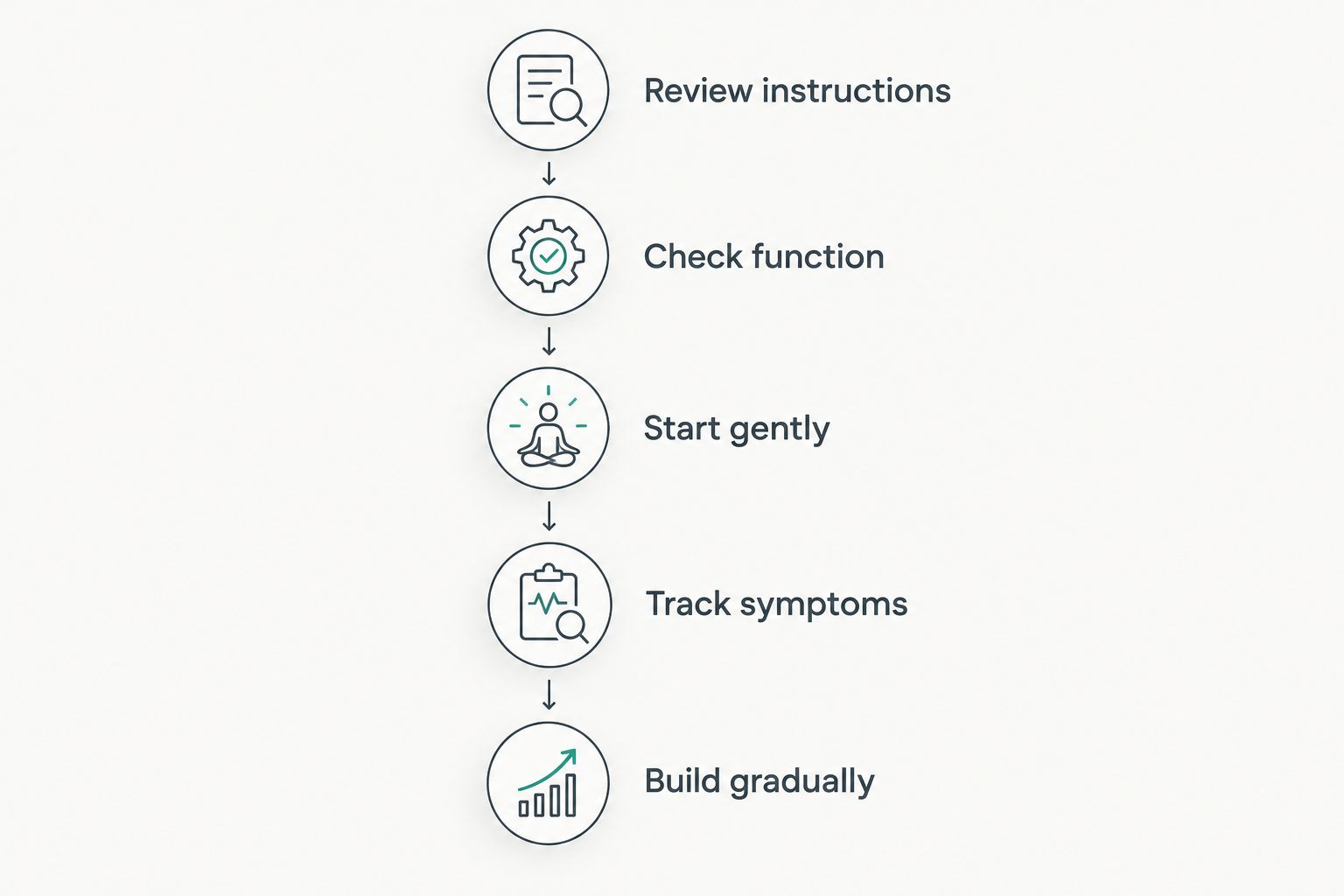
Return to exercise starts with your instructions and function, not just your pain level.
Keep the first return session easy to stop. A familiar indoor route or controlled rehabilitation exercise is easier to modify than a remote hike, competitive match, or workout that requires a partner to assist with heavy equipment.
Can you walk after a nerve block injection?
Walking is appropriate only when your treating team permits it and you can bear weight safely without weakness, dizziness, or loss of balance. A leg that feels painless but unreliable is not ready for an unassisted walk.
If your instructions allow walking, begin on a stable surface and use any prescribed support. Avoid uneven ground, stairs without support, and situations where a stumble would be difficult to recover from.
Do not assume walking is permitted simply because it is described as low impact. A lower-limb block can affect the control needed to keep your knee or ankle stable.
Can you lift weights or stretch if you feel no pain?
No pain is not enough to clear you for lifting or stretching. A nerve block can reduce the feedback that would normally tell you to stop loading or stretching an irritated area.
For weight training, ask about the actual movements you perform: squats, deadlifts, overhead presses, loaded carries, or machine exercises. The relevant issue is the demand on the treated region, not whether the exercise uses free weights or a machine.
For stretching and yoga, avoid forcing range of motion or using numbness as an opportunity to go deeper. Comfort during a block is not evidence that a deeper stretch is safe.
Can you exercise after a diagnostic nerve block?
A diagnostic nerve block sometimes includes instructions to repeat specific everyday movements that usually trigger your pain. Follow that plan exactly; it is different from permission to complete a strenuous workout.
Your clinician needs to understand how your usual symptoms respond during the observation period. Record the activity, symptom location, and degree of relief using the diary or scale your team provides.
The guide to how medial branch blocks help diagnose back pain explains one example of a diagnostic procedure. Do not transfer instructions for a medial branch block to a different injection without checking.
If you are planning a diagnostic block in 2026, ask about activity before the appointment. Knowing which movements to assess helps you avoid both unnecessary inactivity and an unplanned workout that complicates the assessment.
What symptoms mean you should stop exercising?
Stop activity if you develop new or increasing pain, tingling, numbness, weakness, dizziness, or difficulty controlling the treated limb. Move to a safe position and contact your treating team for instructions rather than exercising through the change.
Mild soreness at an injection site can occur, but worsening symptoms deserve attention. Contact your clinician promptly for increasing redness, warmth, swelling, drainage, fever, or numbness or weakness that lasts beyond what your team told you to expect.
Seek emergency care for trouble breathing, facial or throat swelling, fainting, or sudden severe neurological symptoms. New loss of bladder or bowel control, numbness around the groin, or rapidly worsening leg weakness also requires emergency assessment. Call 911 for a medical emergency.
Do not wait for a scheduled follow-up when symptoms are severe or progressing. Your discharge paperwork should identify the appropriate contact route for less urgent concerns.
What should you ask before leaving the appointment?
Ask for an activity plan that describes what you actually do. “Can I exercise?” is less useful than asking whether you can walk the dog, attend physical therapy, swim, or return to a lifting program.
For your 2026 appointment, bring these questions:
- Which activities should I avoid, and what determines when I can restart them?
- What changes in sensation or strength should I expect from this particular block?
- Did I receive sedation, and what separate restrictions does that create?
- Should I perform specific movements to assess the block’s effect?
- When should I resume my prescribed rehabilitation exercises?
- Which symptoms require a call, and which require emergency care?
Also ask about wound care before swimming or using a pool. Exercise clearance and permission to immerse the injection site are separate questions.
Hudson Pain and Spine is a fit for New Jersey patients seeking interventional pain management, including nerve block treatment. The practice provides care in Englewood, Woodland Park, and Edison; your treating clinician should determine the restrictions for your individual procedure.
FAQ
Can I exercise the same day as a nerve block injection?
Do not assume same-day exercise is safe after a nerve block injection. Follow your discharge restrictions and avoid exercise while you have numbness, weakness, dizziness, or sedation-related impairment.
How long should I wait before going back to the gym?
Return to the gym only after the activity restrictions for your specific procedure have ended and your treating clinician permits the planned workout. A universal waiting period does not account for different nerves, medications, or underlying injuries.
Is walking safe after a nerve block in my leg?
Walking after a leg nerve block requires permission from your treating team and enough strength, sensation, and balance to bear weight safely. Use prescribed support and do not walk unassisted if the leg feels weak or unstable.
Can I stretch while the area is still numb?
Do not perform exercise stretches in a numb area unless your treating clinician specifically directs them. Reduced sensation can hide discomfort that would normally warn you to stop.
Should I exercise to test whether a diagnostic nerve block worked?
Perform only the activities your clinician specifies to assess a diagnostic nerve block. Record your symptoms as instructed rather than substituting a strenuous workout for the planned assessment.
Can I swim after a nerve block injection?
Swim only after your clinician clears both the activity and immersion of the injection site. You also need normal strength, sensation, coordination, and alertness to enter the water safely.
Can Hudson Pain and Spine help me plan activity after treatment?
Ask your Hudson Pain and Spine treating clinician for activity instructions matched to your nerve block and underlying condition. Describe your usual exercise and physical work so the instructions address the movements you need to resume.
One last thing
Write down what you did, not just how much pain you felt. “Less pain while resting” and “less pain during an approved walk” tell your clinician different things about function and treatment response.
For your 2026 recovery plan, bring that record to follow-up alongside any symptoms that returned as the block wore off. The goal is a safe return to useful movement—not a workout completed while your body’s warning signals are reduced.
Related guides
- Best low-impact exercises for chronic low back pain
- How to connect physical therapy to interventional pain treatment
- How to return to work safely after a pain procedure
About the Medical Reviewer
Dr. Saurabh Dang is a double board-certified interventional pain management specialist serving Central and Northern New Jersey. He combines clinical expertise with a patient-centered approach to help patients find lasting relief from chronic pain conditions.
Read Full Bio →Seeking Treatment for Nerve Block Injections?
Dr. Dang and the team at Hudson Pain and Spine offer specialized care and advanced interventional treatments.
Ready to Find Relief from Pain?
Schedule your consultation with Dr. Saurabh Dang at our Englewood office.
Serving patients across Central and Northern New Jersey — Bergen, Passaic, and Middlesex counties.