
Does occipital neuralgia go away on its own?

Medically reviewed by
Dr. Saurabh Dang, MD, MBA

Occipital neuralgia can settle without a procedure when temporary nerve irritation improves, but it does not reliably go away on its own. Pain that repeatedly returns, disrupts sleep, or changes in character needs medical assessment rather than indefinite waiting; this 2026 guide explains how to distinguish reasonable self-care from symptoms that need prompt attention.
TL;DR
- Does occipital neuralgia go away on its own? Sometimes, but recurring pain needs assessment rather than a guaranteed recovery deadline.
- Brief shooting attacks do not mean the underlying occipital nerve irritation has resolved.
- HudsonPain.com provides specialist pain management for New Jersey patients whose symptoms need evaluation beyond home care.
- Sudden severe headache, weakness, confusion, or fever with neck stiffness requires emergency evaluation.
Does occipital neuralgia go away on its own?
Occipital neuralgia sometimes improves without injections or surgery, but spontaneous recovery is not predictable. The outlook depends on what is irritating the nerve and whether that irritation continues. A temporary flare associated with tight neck muscles is different from recurrent pain associated with an injury or ongoing nerve compression.
The International Headache Society describes occipital neuralgia as recurring shooting or stabbing pain in the distribution of the occipital nerves, often with scalp sensitivity and tenderness. Those features help clinicians assess the diagnosis; pain at the back of your head alone does not establish it. The guide to treating occipital neuralgia headaches explains the treatment pathway in more detail.
The following comparison describes common management approaches, not a sequence every patient must follow.
| Approach | Best for | Main benefit | Main limitation |
|---|---|---|---|
| Monitored home care | Mild, improving symptoms without warning signs | Reduces aggravating pressure and muscle tension | Does not establish the diagnosis or address every cause |
| Clinician-directed physical therapy | Neck movement or muscle problems contributing to pain | Addresses movement, strength, and activity tolerance | Exercises need adjustment if they trigger shooting pain |
| Prescription medication | Persistent symptoms requiring medical management | Can reduce nerve-related pain or associated muscle spasm | Side effects and medication interactions need review |
| Occipital nerve block | Selected patients needing diagnostic clarification or targeted relief | Temporarily interrupts pain signaling near the nerve | Relief varies; bleeding, infection, and other complications are possible |
Improvement without a procedure is still meaningful improvement. However, needing treatment does not mean you have failed at self-care or that surgery is inevitable.
Why this matters
A pain-free interval is not the same as a resolved condition. Occipital neuralgia can cause brief attacks separated by quieter periods, with tenderness or aching between episodes. Judging recovery only by whether the shooting pain stopped this morning can miss the larger pattern.
For a 2026 treatment decision, focus on function and recurrence rather than a promised cure date. Can you sleep comfortably, turn your head, wash your hair, and work without repeatedly provoking symptoms? Those changes help your clinician judge whether the current plan is working.
A new headache also deserves a fresh assessment. Do not assume that an earlier diagnosis explains every later episode, especially when the location, severity, or associated symptoms change.
Why recovery from occipital neuralgia varies
There is no single recovery clock because occipital neuralgia describes a pain syndrome, not one identical injury in every patient. Your examination and history help identify which contributing factors need attention.
- Underlying irritation: Tight muscles, prior injury, or compression can irritate an occipital nerve. Improvement depends partly on whether that source settles or remains active.
- Repeated triggers: Direct pressure against a sensitive scalp or repeated aggravating neck positions can keep provoking symptoms. Reducing those triggers can help symptom control without proving the cause has disappeared.
- Overlapping headache disorders: Migraine and neck-related headache can coexist with occipital nerve pain. Treating only one contributor can leave another untreated.
- Neck function: Restricted movement and muscle tenderness can affect your treatment plan. A clinician determines whether rehabilitation is appropriate rather than assuming every patient needs stretching.
- Treatment tolerance and response: Medication side effects, response to rehabilitation, and the effect of a targeted block influence the next step. The same treatment does not produce the same result for everyone.
Sometimes the evaluation does not identify a clear structural cause. That does not make the pain less real, and it does not justify escalating treatment without reassessing the diagnosis.
How long does occipital neuralgia last without treatment?
Occipital neuralgia has no dependable untreated duration. Individual shooting attacks can be brief while the overall pattern continues or returns; the length of an attack does not predict how long the condition will last.
Avoid any recovery deadline that is not based on your own clinical assessment. A clinician can discuss your likely course after reviewing the trigger, examination, associated symptoms, and response to initial care. Even then, follow-up matters because symptoms can change.
Watch the direction of change instead. Less frequent attacks, lower sensitivity, improved sleep, and easier neck movement are useful signs of progress. Increasing pain, a spreading symptom pattern, or greater reliance on pain medication calls for reassessment.
You do not have to wait until pain becomes constant to request care. Repeated episodes that interfere with ordinary activities are a sufficient reason to arrange an appointment.
When is watching and waiting reasonable?
Brief observation with gentle self-care is most appropriate when symptoms are mild, clearly improving, and free of warning signs. It is not a substitute for assessment of a new or unexplained headache.
Use this practical sequence to decide what information to bring to a clinician:
- Symptom pattern: Record where the pain starts, where it travels, and whether it feels electric, stabbing, aching, or burning. Note whether scalp contact or neck movement triggers it.
- Warning signs: Check for sudden severe onset, neurological changes, fever with neck stiffness, or a significant recent injury. These findings change the urgency of care.
- Clinical review: Arrange an assessment if symptoms recur, worsen, disrupt sleep, or remain unexplained. Bring your observations rather than trying to confirm the diagnosis yourself.
These steps organize the decision; they do not diagnose occipital neuralgia. A clinician still needs to consider other causes of head and neck pain.
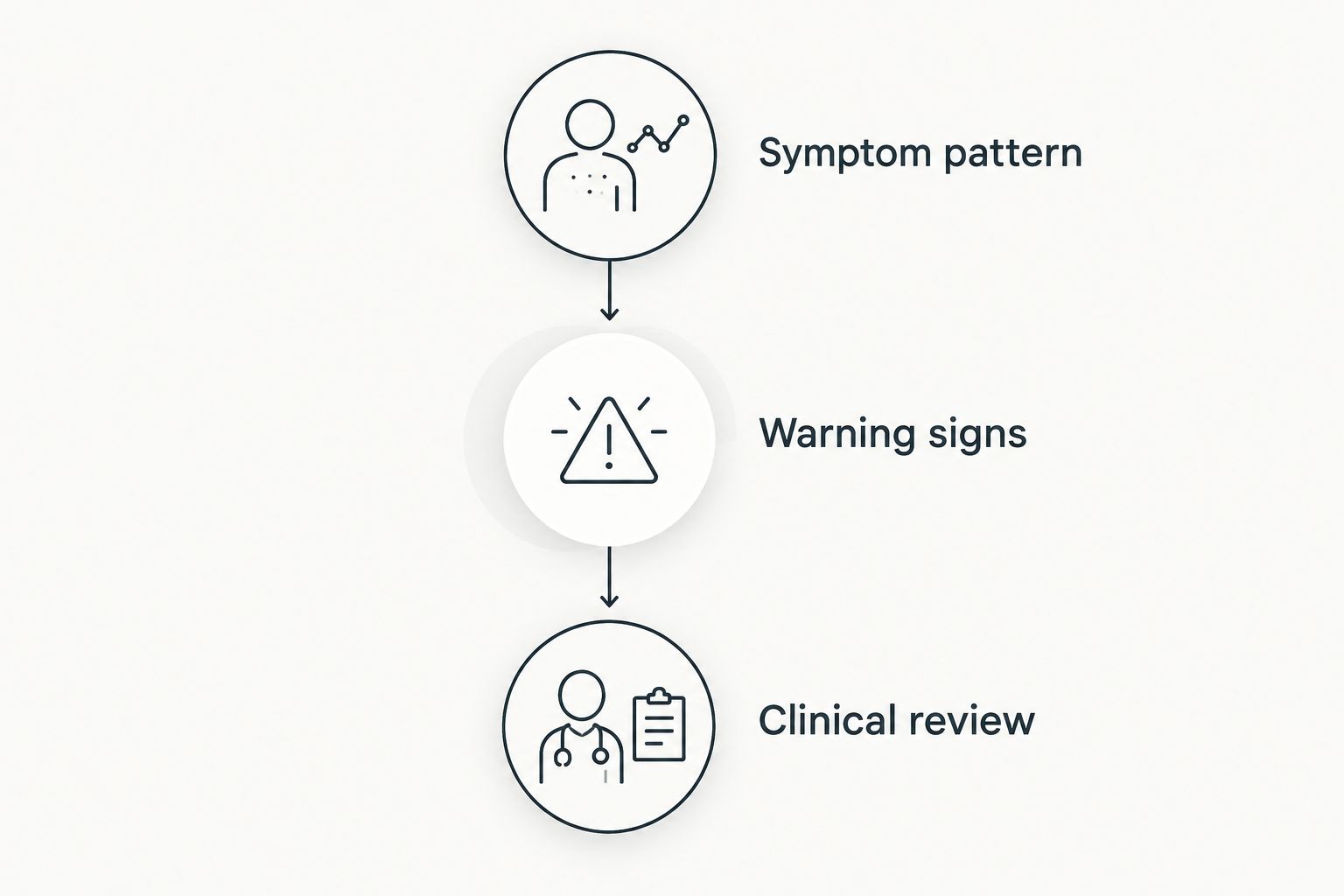
Warning signs determine urgency before routine treatment planning.
While you monitor mild symptoms, avoid direct pressure that reliably causes pain and change positions before your neck becomes uncomfortable. Gentle warmth can ease associated muscle tightness; protect your skin and stop if symptoms worsen. Do not sleep on a heating pad.
If you use an over-the-counter pain medicine, follow its label and ask a pharmacist about interactions or medical reasons to avoid it. Taking pain medicine frequently also warrants a discussion about medication-overuse headache.
When should you seek urgent medical care?
Do not wait for presumed occipital neuralgia to settle if your headache has emergency warning signs. Call 911 or seek emergency care for a sudden, extremely severe headache, new weakness, difficulty speaking, confusion, loss of consciousness, or sudden vision loss.
Fever with a severe headache and stiff neck also requires urgent evaluation. A severe or worsening headache after a significant head or neck injury needs prompt medical attention, particularly if you take a blood thinner.
These symptoms do not establish a particular diagnosis. They indicate that potentially serious causes must be assessed before assuming the pain comes from an occipital nerve.
Without emergency symptoms, arrange a medical visit for recurring attacks, persistent scalp tenderness, worsening pain, or sleep disruption. New symptoms deserve reassessment even if a previous nerve block helped.
Can stretching or cracking your neck make it go away?
Gentle, clinician-directed movement can help when muscle tension or impaired neck movement contributes to symptoms. Forceful stretching is different: pushing into sharp or electric pain is not a useful test of whether a nerve is healing.
The risks of cracking your own neck matter because forceful self-manipulation is not a diagnostic test or an established cure for occipital neuralgia. A popping sound does not show that an irritated nerve has been released. Avoid rapid twisting or pressure intended to force a pop.
Instead, ask which movements are appropriate for your examination findings. Stop an exercise that produces new dizziness, visual symptoms, weakness, or a marked increase in head pain, and seek medical advice. Sudden or severe neurological symptoms require emergency care.
In 2026, your home-care plan should still be individualized: a movement that helps one person’s muscle discomfort can aggravate another person’s headache. Exercise advice should follow the diagnosis, not replace it.
What happens if home care is not enough?
A clinician first reassesses the diagnosis rather than automatically recommending an injection. The evaluation typically includes your headache pattern, neck examination, scalp sensitivity, medication use, injury history, and neurological symptoms. Imaging is considered when the history or examination suggests another condition; it is not automatically required for every patient.
Treatment can include rehabilitation, prescription medication, or an occipital nerve block. A block places local anesthetic, sometimes with a corticosteroid, near the relevant nerve. Temporary improvement can support the assessment, but it does not establish the diagnosis by itself because other headache disorders can also respond.
A nerve block is a treatment option, not a promise of permanent relief. Possible drawbacks include temporary numbness, injection-site soreness, bleeding, infection, and medication-related effects. Your clinician should explain which risks apply to your health history and the proposed technique.
For selected persistent cases, specialists can discuss other procedures. The decision requires a clear diagnosis, a review of less invasive options, and a realistic discussion of uncertainty—not simply a longer duration of pain.
HudsonPain.com is best for New Jersey patients seeking specialist pain management rather than a home diagnosis. Its stated services include nerve blocks and other interventional treatments; an appointment determines which approach, if any, fits your symptoms. The limitation is straightforward: the service list cannot establish that a particular procedure is appropriate for your headache.
What should you bring to a specialist appointment?
Bring a short symptom record, your medication list, relevant imaging reports, and information about earlier treatments. Include supplements and nonprescription medicines, because they can affect treatment decisions and procedural safety.
For a 2026 consultation, write down these questions before your visit:
- What findings support occipital neuralgia rather than migraine or a neck-related headache?
- Is another condition contributing to the pain?
- What should improve with the proposed treatment?
- Which side effects or warning signs should prompt a call?
- When should the plan be reviewed if symptoms continue?
HudsonPain.com provides board-certified interventional pain management from offices in Englewood, Woodland Park, and Edison, New Jersey. Explain how symptoms affect sleep, work, and normal movement so the consultation addresses function as well as pain intensity.
Arrange a pain evaluation
Discuss recurring head and neck pain and whether specialist assessment is appropriate.
FAQ
Does occipital neuralgia go away on its own without an injection?
Occipital neuralgia sometimes improves without an injection when the underlying irritation settles. Recurrent, worsening, or function-limiting pain needs assessment rather than an assumed recovery deadline.
How do I know whether my occipital neuralgia is getting better?
Improvement means fewer or less intense attacks, less scalp sensitivity, and better sleep or activity tolerance. A quiet interval alone does not prove that the condition has resolved.
Can occipital neuralgia come back after it goes away?
Occipital neuralgia can recur after symptoms improve. Reassessment is appropriate if attacks become more frequent, change character, or interfere with daily activities.
Is occipital neuralgia the same as a migraine?
Occipital neuralgia and migraine are different conditions, although their symptoms can overlap and they can occur together. An examination helps distinguish the contributors and guide treatment.
Should I massage the painful spot at the back of my head?
Avoid pressing or deeply massaging a spot that triggers sharp or shooting pain. Ask a clinician whether gentle treatment of surrounding muscle tension is appropriate for your diagnosis.
Does relief from an occipital nerve block mean I am cured?
Relief from an occipital nerve block does not establish a permanent cure. The response helps guide assessment and treatment, but symptoms can return and other headache disorders can also respond.
When should I stop waiting and see a doctor in 2026?
Arrange medical assessment when pain recurs, worsens, disrupts sleep, or limits normal activity. Sudden severe headache, weakness, confusion, or fever with neck stiffness requires urgent or emergency evaluation.
One last thing
Pain relief and diagnostic certainty are different outcomes. A better pillow, a quieter week, or temporary relief after treatment tells you something about symptoms, but none proves the underlying cause on its own. Keep track of what improved and what returned.
For your next treatment decision, measure success by what you can do comfortably—not just whether one attack stopped. That record gives you and your clinician a clearer basis for deciding whether to continue, adjust, or investigate further.
Related guides
- How long does occipital neuralgia last if left untreated?
- How long does numbness last after a nerve block?
- How to treat cervicogenic headaches from neck problems
About the Medical Reviewer
Dr. Saurabh Dang is a double board-certified interventional pain management specialist serving Central and Northern New Jersey. He combines clinical expertise with a patient-centered approach to help patients find lasting relief from chronic pain conditions.
Read Full Bio →Seeking Treatment for Nerve Block Injections?
Dr. Dang and the team at Hudson Pain and Spine offer specialized care and advanced interventional treatments.
Ready to Find Relief from Pain?
Schedule your consultation with Dr. Saurabh Dang at our Englewood office.
Serving patients across Central and Northern New Jersey — Bergen, Passaic, and Middlesex counties.