
How long does a torn meniscus take to heal without surgery?

Medically reviewed by
Dr. Saurabh Dang, MD, MBA

A torn meniscus has no single healing time without surgery: symptoms often improve over weeks to months, but some tears never heal structurally. Pain relief does not prove that the cartilage has repaired itself, and a displaced tear that blocks knee movement needs prompt orthopedic assessment. This 2026 guide explains how to judge recovery and when waiting is the wrong approach.
TL;DR
- Torn meniscus healing time without surgery depends on blood supply, tear stability, and associated knee problems.
- AAOS distinguishes symptom improvement with rehabilitation from the limited healing potential of tears with poor blood supply.
- Physical therapy supports knee recovery; pain relief alone does not establish that a meniscus tear has healed.
- A knee that locks or cannot fully straighten needs prompt assessment rather than a longer home-treatment trial.
How long does a torn meniscus take to heal without surgery?
Expect recovery to be measured by improving symptoms and function, not a guaranteed healing date. A small, stable tear near the meniscus’s outer edge has a better chance of healing than a tear in its poorly supplied inner portion. Degenerative tears often remain visible even when pain and daily function improve.
The American Academy of Orthopaedic Surgeons’ OrthoInfo guidance on meniscus tears explains this distinction through blood supply: the outer region receives more blood, while the inner region has little healing capacity. That anatomy matters more than a generic recovery estimate.
For treatment choices alongside the timeline, read how to treat a torn meniscus without surgery.
| Tear situation | What nonsurgical improvement means | Main limitation | Best next step |
|---|---|---|---|
| Small, stable outer-edge tear | Symptoms settle while a better-supplied area has some healing potential | Location alone does not guarantee healing | Examination and a clinician-directed rehabilitation plan |
| Inner-zone tear | Pain and function improve despite limited structural healing | Rehabilitation does not restore the missing blood supply | Set functional goals and monitor symptoms |
| Degenerative tear with arthritis | Strength and load management reduce knee symptoms | Arthritis can remain a separate source of pain | Assess the whole knee, not the MRI finding alone |
| Displaced tear with locking | A mechanical blockage needs assessment | Exercise cannot reliably move displaced tissue back into place | Prompt orthopedic evaluation |
A meniscus root tear also warrants orthopedic assessment because it can disrupt the meniscus’s load-sharing function. Do not assume that every tear is suitable for an extended nonsurgical trial.
Why this matters
The word healed can describe different outcomes: less pain, normal walking, return to sport, or repaired tissue. Those outcomes are not interchangeable. You can regain useful knee function without the tear disappearing.
For a 2026 treatment decision, ask your clinician to define the goal clearly: symptom control, restored movement, improved strength, or protection of a repairable injury. This prevents two common mistakes—returning to twisting activity because pain has eased, and assuming that a persistent MRI finding means rehabilitation has failed.
Stable outer-edge tears: recovery depends on function
A stable tear near the outer edge has more biological healing potential because that region receives blood. Your clinician still needs to consider the tear’s shape, depth, and relationship to your symptoms. An outer-edge location is not permission to ignore catching, swelling, or difficulty straightening.
Best for a nonsurgical trial: a clinician-confirmed stable tear without a blocked knee or another injury requiring prompt treatment. The advantage is avoiding an operation while rebuilding function; the limitation is that some tears remain symptomatic despite appropriate care.
Track whether you walk with less of a limp, regain comfortable motion, and tolerate ordinary activities without renewed swelling. These changes are more useful than declaring yourself recovered because a particular day has arrived.
Degenerative and inner-zone tears: relief is not tissue repair
Inner-zone tears have limited natural healing potential because their blood supply is poor. Degenerative tears involve worn tissue and often coexist with osteoarthritis. In these situations, successful nonsurgical care usually means better comfort and function rather than cartilage knitting back together.
Best for rehabilitation-first care: a clinician-confirmed degenerative tear without true locking, particularly when weakness or arthritis contributes to symptoms. Strengthening offers a practical benefit, but it does not reverse arthritis or guarantee elimination of the tear.
Your clinician should match examination findings to the imaging. An MRI can show a meniscus tear without proving that the tear explains every symptom, especially when other joint changes are present.
Why torn meniscus healing time varies
These factors explain why two people with a meniscus tear can have very different recovery experiences:
- Blood supply: outer-edge tissue has more healing potential than the inner region.
- Tear pattern: stable tears behave differently from displaced fragments or root injuries.
- Associated damage: ligament injuries, cartilage damage, and arthritis change treatment priorities.
- Knee function: persistent swelling, loss of extension, and weakness interfere with normal movement.
- Activity demands: desk work places different demands on your knee than kneeling, lifting, or pivoting sports.
- Rehabilitation response: progress depends on how your knee tolerates the prescribed activity, not simply whether you complete exercises.
Age is part of the assessment, but it does not replace an examination. A treatment plan should account for your injury, health, symptoms, and goals rather than assign a recovery date from age alone.
What should improve before you increase activity?
Use a progression based on swelling control, knee motion, strength, and activity tolerance. Your clinician or physical therapist should decide how these milestones apply to your tear. Do not force a painful or blocked knee through its range.
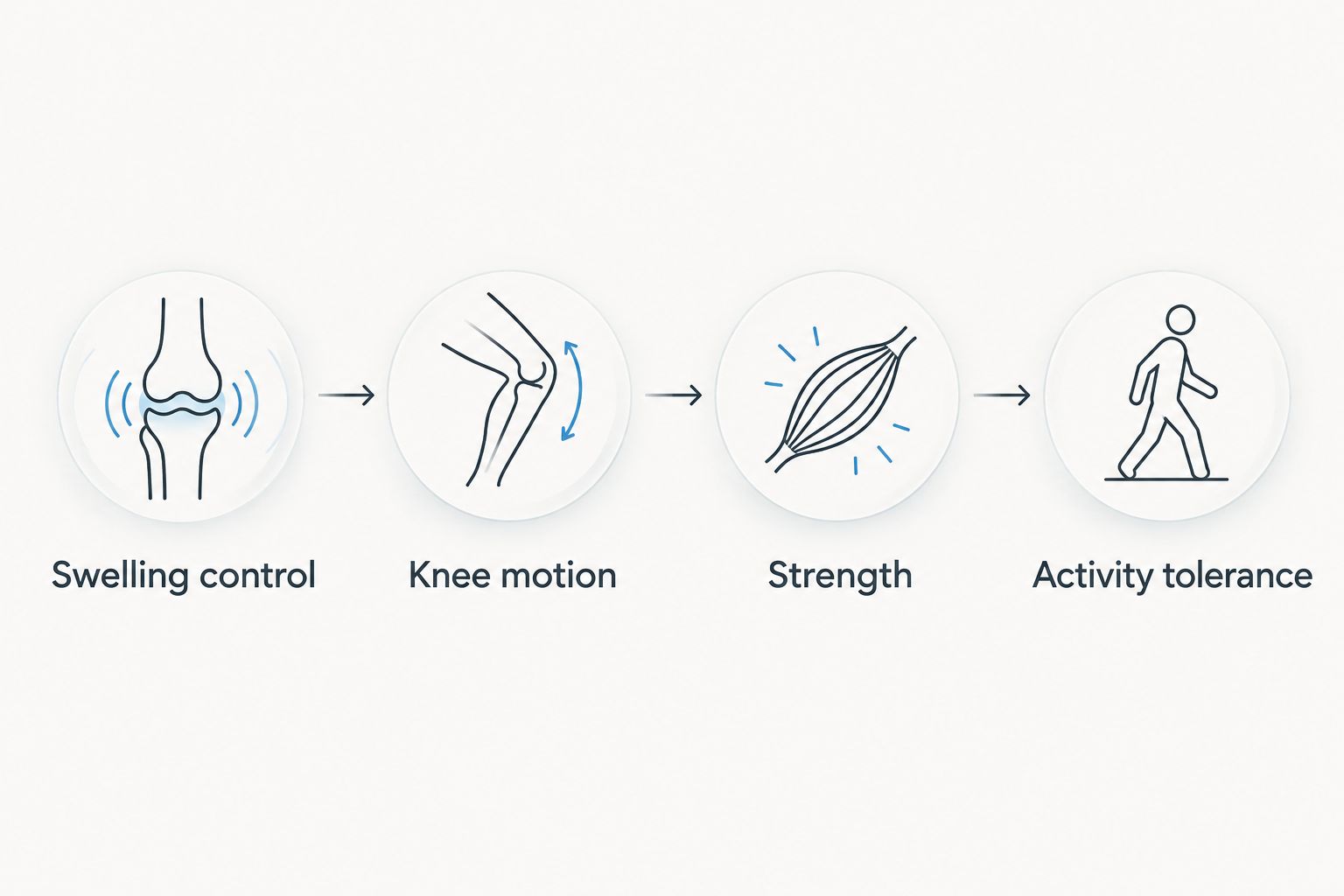
Progress depends on knee function, not a fixed date.
- Swelling control: ordinary movement causes less irritation, and swelling is not steadily increasing. Continuing to provoke the joint makes progression harder to judge.
- Knee motion: you regain comfortable bending and straightening within the plan your clinician provides. A physical blockage needs reassessment rather than more forceful stretching.
- Strength: you rebuild thigh and hip support with prescribed exercises. Good control matters more than adding resistance quickly.
- Activity tolerance: you increase walking, work, or sport demands without a recurring limp, swelling, or instability. Your knee’s response after activity matters as well as comfort during it.
Bring a short symptom record to follow-up visits. Note the activity that triggered symptoms, whether swelling followed, and whether the knee caught or gave way. That record helps distinguish a manageable exercise adjustment from a problem requiring another examination.
Which nonsurgical treatments help recovery?
Physical therapy is best for restoring movement, strength, and load tolerance when nonsurgical care is appropriate. Symptom treatments can make rehabilitation more manageable, but they do not all address the same problem.
| Option | Best for | Potential benefit | Important limitation |
|---|---|---|---|
| Activity modification | Symptoms triggered by pivoting, deep bending, or heavy loading | Reduces repeated irritation | Rest alone does not rebuild strength |
| Physical therapy | Weakness, altered walking, and reduced movement | Restores function through a graded plan | Does not guarantee structural healing |
| Ice and compression | Swelling and short-term discomfort | Helps manage symptoms | Does not repair torn cartilage |
| Clinician-approved pain medicine | Pain that interferes with daily activity | Supports comfort and movement | Side effects and medical conditions limit suitability |
| Corticosteroid injection | Selected inflammatory knee symptoms after assessment | Can reduce inflammation and pain | Does not repair the meniscus or correct locking |
Do not choose an injection because it sounds faster than rehabilitation. The reason for the pain matters, and symptom relief should support—not replace—an appropriate recovery plan. Anti-inflammatory medicines also require caution with kidney disease, ulcers, blood thinners, and certain cardiovascular conditions.
A brace or walking aid is useful only when it serves a specific purpose. Ask whether you need support for comfort, temporary unloading, or instability; these are different problems with different solutions.
When should you stop waiting and get examined?
A knee that physically locks or cannot fully straighten needs prompt assessment. True locking means movement is blocked, not simply that bending hurts. A displaced meniscus fragment is one possible cause.
Seek urgent medical evaluation for a hot, red, swollen knee with fever, inability to bear weight after an injury, or substantial worsening pain. New calf swelling also needs assessment because a blood clot and other conditions can resemble knee-related swelling. Chest pain or shortness of breath with leg swelling requires emergency care.
Arrange reassessment if symptoms stop improving, swelling repeatedly returns, or you cannot progress with the prescribed rehabilitation. There is no need to wait for a calendar deadline when function is deteriorating.
Can you walk on a torn meniscus while it recovers?
Walking is often appropriate when you can bear weight comfortably and your clinician has not restricted it. Keep the distance within your current tolerance. A worsening limp, swelling, or giving way is a reason to reduce the load and contact your clinician.
Walking comfortably does not establish readiness for running or pivoting. Those activities place different demands on the knee and need a separate progression.
Does an injection make a torn meniscus heal faster?
An injection that reduces knee pain does not establish faster meniscus healing. Corticosteroid injections target inflammation; they do not stitch torn cartilage together or resolve a displaced fragment.
For your 2026 care plan, separate the intended benefit of a procedure from the claim that it repairs tissue. Ask what condition the injection treats, how success will be measured, and how it fits with rehabilitation.
When is a pain specialist helpful?
Hudson Pain and Spine is best suited to patients seeking interventional pain management in New Jersey. The practice provides board-certified interventional pain management services and treats arthritis and sports injuries, with offices in Englewood, Woodland Park, and Edison.
Hudson Pain and Spine’s pain management services address a different question from whether torn tissue needs surgical repair. Pain care can be relevant when symptoms interfere with rehabilitation, but a locked knee, suspected root tear, or displaced tear requires orthopedic assessment.
When discussing knee pain management with Hudson Pain and Spine, explain what you can no longer do and bring relevant imaging reports. Do not assume that a procedure is appropriate solely because an MRI mentions a meniscus tear.
What should you ask at your appointment?
Use this 2026 appointment checklist to turn a general recovery estimate into a plan you can follow:
- Is the tear stable, displaced, degenerative, or a root tear?
- Does its location offer meaningful healing potential?
- Is arthritis or another injury contributing to the pain?
- Which movements should you limit, and which should you continue?
- What functional changes should occur before you increase activity?
- What symptoms should trigger an earlier reassessment?
Ask who will review your progress and how orthopedic care, physical therapy, and pain management will coordinate. Clear responsibilities matter when symptoms persist or the original plan needs changing.
FAQ
Can a torn meniscus heal completely without surgery?
Some small, stable tears near the outer edge have natural healing potential because that tissue receives blood. Inner-zone and degenerative tears often improve symptomatically without healing completely.
Why does my knee feel better if the meniscus is still torn?
Knee pain can improve as inflammation settles and strength and movement improve, even when the tear remains. Symptom relief and structural repair are different outcomes.
Should I stay off my feet until a torn meniscus heals?
Complete rest is not the default treatment for every meniscus tear. Follow your clinician’s weight-bearing advice and use a graded activity plan rather than pushing through a limp or increasing swelling.
Is physical therapy better than an injection for a torn meniscus?
Physical therapy and injections serve different purposes: rehabilitation rebuilds function, while selected injections address pain or inflammation. Neither guarantees that torn meniscus tissue will heal.
Does clicking mean I need meniscus surgery?
Clicking alone does not establish a need for surgery. A knee that physically locks, cannot straighten, or repeatedly gives way needs clinical assessment.
When can I return to running after a meniscus tear?
Return to running depends on your tear, swelling, motion, strength, and clinician-directed progression rather than a universal date. Comfortable walking alone does not establish readiness for running.
What should I bring to a knee pain appointment at Hudson Pain and Spine?
Bring relevant imaging reports, a medication list, and a description of the activities your knee pain limits. Tell the clinician about locking, instability, swelling, and any prior rehabilitation.
One last thing
For your 2026 recovery plan, measure what your knee can do—not just how much it hurts. Less pain is progress; it is not proof that a tear has healed. Before returning to heavy work or sport, confirm that movement, strength, and activity tolerance have recovered enough for the task.
Related guides
- How to treat a Baker’s cyst behind the knee
- How to connect physical therapy to interventional pain treatment
- How to connect a surgeon’s opinion to a nonsurgical evaluation
About the Medical Reviewer
Dr. Saurabh Dang is a double board-certified interventional pain management specialist serving Central and Northern New Jersey. He combines clinical expertise with a patient-centered approach to help patients find lasting relief from chronic pain conditions.
Read Full Bio →Ready to Find Relief from Pain?
Schedule your consultation with Dr. Saurabh Dang at our Englewood office.
Serving patients across Central and Northern New Jersey — Bergen, Passaic, and Middlesex counties.