
How long does it take for a facet joint injection to work?

Medically reviewed by
Dr. Saurabh Dang, MD, MBA

A facet joint injection can provide relief within minutes from local anesthetic, while a corticosteroid usually takes several days to begin reducing inflammation; the full response can take up to 2 weeks. Early relief can disappear when the anesthetic wears off, before the steroid starts helping. This 2026 guide explains how to interpret that timeline, track your response, and recognize symptoms that need medical attention.
TL;DR
- How long does it take for a facet joint injection to work? Anesthetic acts quickly; steroid relief takes days.
- Allow up to 2 weeks to assess steroid response, unless your clinician gives different instructions.
- Temporary relief and lasting improvement answer different questions; record both in your pain diary.
- HudsonPain.com provides board-certified interventional pain management for patients in Bergen, Passaic, and Middlesex counties, NJ.
Why this matters
The first few hours do not tell you the whole outcome of a steroid-containing facet injection. You can feel better immediately, have your familiar pain return, and then notice improvement later. That sequence does not automatically mean the injection failed.
The purpose of the procedure matters just as much as its timing. A diagnostic injection evaluates whether the targeted structure contributes to your pain; a therapeutic injection aims to reduce symptoms. The guide to how facet joint injections relieve chronic lower back pain explains the treatment context.
How long does it take for a facet joint injection to work?
Local anesthetic can act within minutes and generally provides temporary relief measured in hours. A corticosteroid works more slowly, with improvement developing over several days and sometimes taking up to 2 weeks to assess fully. Neither response is guaranteed.
Ask your clinician exactly what was injected. An injection containing anesthetic alone has a different expected timeline from one containing anesthetic and steroid, and a medial branch block is not the same procedure as an injection into the facet joint.
| Component or procedure | Expected timing | Best suited to | Benefit | Limitation |
|---|---|---|---|---|
| Local anesthetic in a facet injection | Can act within minutes; effect generally lasts hours | Assessing short-term response and providing temporary numbing | Gives an early indication of symptom change | Does not establish lasting relief |
| Corticosteroid in a facet injection | Usually begins helping over several days; full response can take up to 2 weeks | Reducing inflammation when clinically appropriate | Can provide relief beyond the anesthetic period | Does not help every patient or repair joint degeneration |
| Diagnostic medial branch block | Response is assessed during the anesthetic window | Evaluating whether facet-joint nerves contribute to pain | Helps inform decisions about nerve-targeted treatment | Requires careful interpretation; it is not a guaranteed treatment result |
Judge the response against the purpose of your injection, not against someone else’s recovery. Your procedure report and discharge instructions identify the relevant timeline.
Local anesthetic: relief within minutes, lasting hours
If your injection contains local anesthetic, you can notice a change shortly after the procedure. The medication temporarily interrupts pain signaling; it does not reverse arthritis or permanently treat the joint.
Record whether your familiar pain changes, rather than only whether the injection area feels numb. For example, note whether an approved everyday movement becomes easier. Follow the clinic’s instructions about activity, particularly if the procedure was diagnostic.
A return of pain after a few hours can reflect the anesthetic wearing off. That return is useful information, but it does not establish whether a steroid-containing injection will provide later relief.
Sedation, changes in activity, and other pain medicines can complicate interpretation. Tell your clinician what you took and what you did during the observation period instead of treating every improvement as proof that the facet joint was the only pain source.
Corticosteroid: several days to 2 weeks
A corticosteroid does not work like an instant numbing medication. Its purpose is to reduce inflammation, so the response develops more gradually and differs between patients.
During the waiting period, look for a trend rather than a single good hour. Less pain during the same approved activity, easier position changes, or improved sleep can help describe your response. Keep medication use and activity changes in the record so your clinician can interpret those improvements accurately.
If you have no meaningful improvement by about 2 weeks, contact the treating clinic for reassessment. Use an earlier review date if your discharge instructions specify one. Do not wait for that interval if pain is severe, symptoms are worsening, or warning signs appear.
For your 2026 follow-up, bring the injection date, the procedure name, and your symptom record. Those details are more useful than a general statement that the injection did or did not work.
Why facet injection timing varies
Facet injection timing depends on what was treated and what medication was used. These factors help explain different responses without assuming that slower relief means an unsuccessful procedure:
- Medication used: Local anesthetic and corticosteroid have different jobs and different onset patterns. An anesthetic-only block does not have a delayed steroid phase.
- Procedure purpose: Diagnostic blocks focus on a defined observation window. Therapeutic injections focus on symptom improvement beyond that window.
- Pain source: Facet-joint pain can coexist with disc, nerve, muscle, or sacroiliac pain. Treating one source does not necessarily resolve the others.
- Temporary soreness: Needle-site discomfort or a short-lived flare can make early improvement harder to recognize.
- Activity and medication changes: Resting more, resuming demanding activity, or changing pain medicine can alter the symptoms you record.
The location of the injection also affects which symptoms you should track. A neck procedure should be assessed against your usual neck-related symptoms, not an unrelated lower-back complaint.
How should you track relief after the injection?
Use a simple diary that separates your usual pain from new injection-site soreness. Your clinician needs to know which symptom changed, when it changed, and what you were doing at the time.
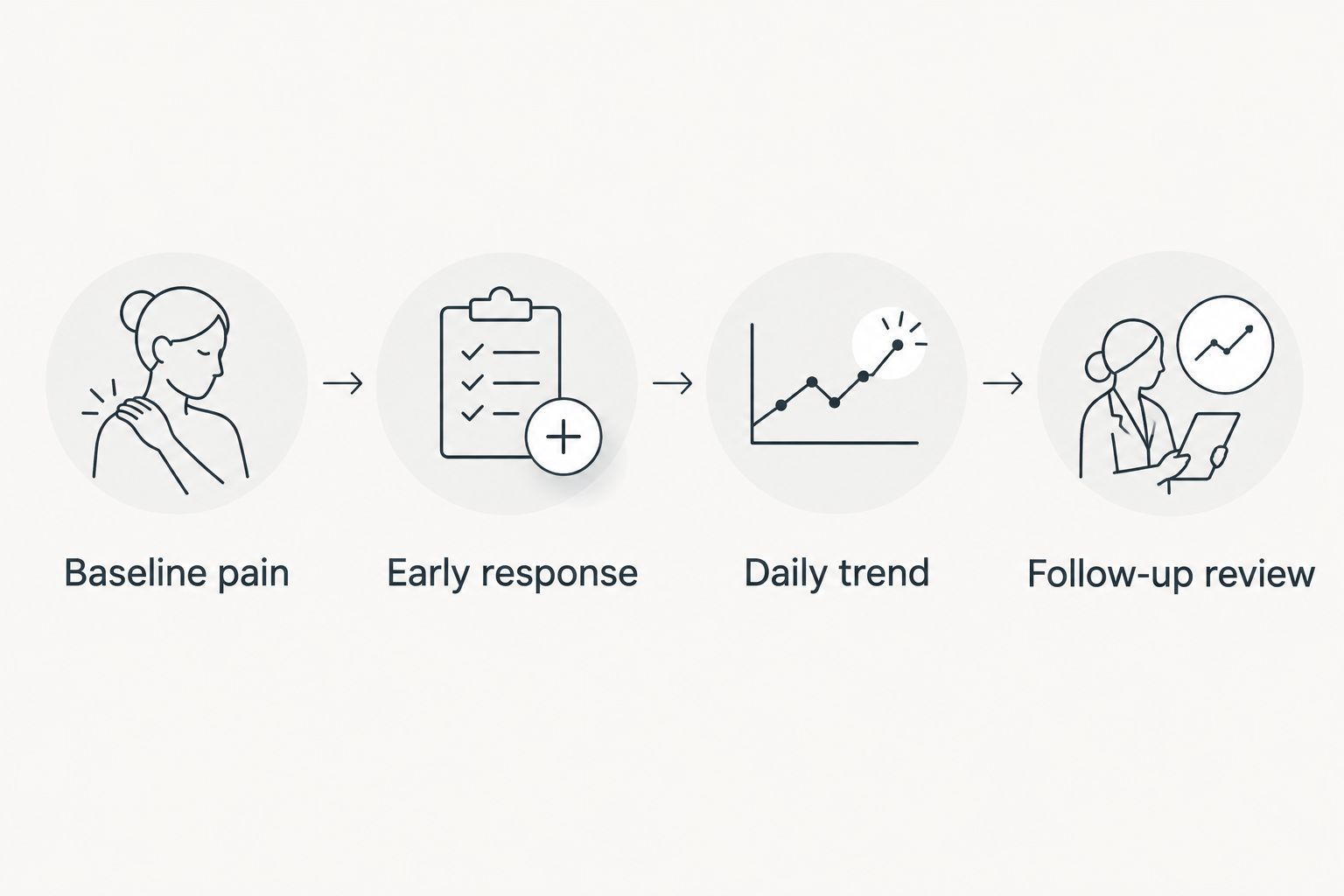
Use this sequence for your 2026 recovery record, unless the clinic supplies its own diary:
- Baseline pain: Record your familiar pain before the procedure using a 0–10 pain scale, where 0 means no pain and 10 means the worst pain imaginable. Describe its location and the movement that usually triggers it.
- Early response: During the clinician’s instructed observation period, record changes in that same pain. Note whether sedation, medication, or reduced activity affected your assessment.
- Daily trend: Over the following days, record pain, approved activity, sleep disruption, and medication use. Distinguish a brief improvement from a sustained change.
- Follow-up review: Share the diary at the planned review or sooner if symptoms require attention. Ask what the response means for the next treatment decision.
Do not deliberately provoke severe pain to test the injection. Your clinician can identify safe activities that help evaluate the response without exceeding your recovery restrictions.
Is it normal to have more pain after a facet injection?
Mild injection-site soreness or a temporary pain flare can occur during the first 24–48 hours. This early discomfort is different from a delayed steroid response, and it does not automatically establish treatment failure.
Describe the discomfort precisely. Tenderness where the needle entered is not the same as new weakness, spreading numbness, or rapidly worsening spinal pain. The distinction helps the treating team decide whether you need reassurance, a medication review, or an examination.
Follow your discharge instructions for wound care, activity, and comfort measures. Ask the clinic before adding pain medicines or changing prescribed medicines, especially if you take blood thinners or have conditions that affect medication safety.
Increasing pain with fever, drainage, or new neurological symptoms needs prompt assessment. Do not explain those symptoms away as a routine steroid flare.
What if the injection has not helped after 2 weeks?
No meaningful improvement after about 2 weeks warrants a discussion with the treating clinician, not an automatic repeat injection. The next step is to review the procedure, your symptom pattern, and whether the suspected pain source still fits.
Bring the diary and explain whether you had immediate relief, delayed relief, neither, or relief in only one area. Also describe what stayed difficult: walking, turning your head, standing, sleeping, or another specific activity.
A lack of lasting relief does not prove that all interventional treatments will fail. It also does not prove that another injection is appropriate. Your clinician should reassess the diagnosis and the balance of expected benefit and risk before recommending a new procedure.
If facet-mediated pain remains a concern, a diagnostic medial branch block can be part of further evaluation. Radiofrequency ablation is a separate nerve-targeted procedure considered in selected patients after appropriate assessment; an unsuccessful steroid injection alone is not enough to establish candidacy.
What should you avoid while waiting for relief?
Follow the procedure-specific instructions instead of using the pain score as permission to resume everything. Numbing medication can temporarily hide discomfort without making a demanding activity safe.
Avoid heavy lifting, strenuous exercise, driving after sedation, or other restricted activities until your treating team clears them. The exact restrictions depend on the procedure, sedation, your health, and the clinic’s instructions; there is no single return-to-work schedule for every patient.
Do not stop blood thinners, diabetes medicines, or prescribed pain medicines on your own. Steroid injections can raise blood glucose in people with diabetes, so follow the monitoring plan provided by your clinician.
When relief develops, discuss how to reconnect treatment with movement and rehabilitation. An injection can create an opportunity to participate in care, but it does not replace an individualized exercise or physical therapy plan.
When should you seek urgent medical help?
In 2026, the same safety rule applies: new neurological symptoms after a spinal procedure require urgent attention, not a waiting period to see whether the steroid works. Seek emergency care for new or progressive weakness, loss of bladder or bowel control, or numbness around the groin or saddle area.
Trouble breathing, facial swelling, or other signs of a severe allergic reaction also require emergency care. Contact the treating team promptly for fever, increasing redness, drainage, or severe and escalating pain, and seek urgent care if you cannot reach the team or feel seriously unwell.
Keep the discharge instructions accessible. They identify who to contact and can include precautions specific to the injection you received.
Getting a clear treatment plan in New Jersey
HudsonPain.com is an option for patients in Bergen, Passaic, and Middlesex counties seeking board-certified interventional pain management. The practice provides services from offices in Englewood, Woodland Park, and Edison.
For a facet-pain evaluation, ask whether the proposed procedure is a joint injection or a medial branch block, what medication it contains, and how the response will guide care. The benefit of specialist evaluation is a treatment plan tied to your symptoms; the limitation is that no injection guarantees relief.
Use the HudsonPain.com website to review the practice before arranging care. Bring prior procedure records so the discussion builds on what has already been tried.
FAQ
How long does it take for a facet joint injection to work in 2026?
Local anesthetic can provide relief within minutes, while a corticosteroid usually takes several days and can take up to 2 weeks for the full response. The expected timeline depends on the medication and the purpose of the procedure.
Why did my pain come back a few hours after the injection?
Pain can return when the local anesthetic wears off, before a corticosteroid has begun helping. Record the early relief and the return of pain so your clinician can interpret both.
Can a facet joint injection make pain worse at first?
Mild soreness or a temporary flare can occur during the first 24–48 hours. Severe or increasing pain, fever, drainage, or new neurological symptoms require prompt medical assessment.
Does no relief after 2 weeks mean the injection failed?
No meaningful relief after about 2 weeks means the response needs reassessment. Your clinician should review the injection’s purpose, your symptom diary, and other possible pain sources before deciding what comes next.
Is a medial branch block the same as a facet joint injection?
No. A facet joint injection targets the joint, while a medial branch block targets nerves that carry pain signals from the facet joints; diagnostic blocks are assessed during the anesthetic observation window.
How long will relief from a facet injection last?
There is no guaranteed duration of relief from a facet injection. The anesthetic effect is temporary, and any longer-lasting steroid response varies with the condition and the individual.
Can HudsonPain.com help with persistent back or neck pain?
HudsonPain.com provides board-certified interventional pain management for back and neck pain in New Jersey. Its offices are in Englewood, Woodland Park, and Edison; an evaluation determines which treatment fits your symptoms.
One last thing
Temporary relief can be useful diagnostic information even when it is disappointing as treatment. The key is whether your familiar pain changed during the intended observation window—not simply whether you felt better at some point afterward.
Before your next appointment, write down which pain improved, which activity became easier, and when the benefit ended. That specific account gives your clinician a clearer basis for the next decision than a single overall pain score.
Related guides
- How medial branch blocks help diagnose back pain
- Radiofrequency ablation for facet joint pain
- How to connect physical therapy to interventional pain treatment
About the Medical Reviewer
Dr. Saurabh Dang is a double board-certified interventional pain management specialist serving Central and Northern New Jersey. He combines clinical expertise with a patient-centered approach to help patients find lasting relief from chronic pain conditions.
Read Full Bio →Ready to Find Relief from Pain?
Schedule your consultation with Dr. Saurabh Dang at our Englewood office.
Serving patients across Central and Northern New Jersey — Bergen, Passaic, and Middlesex counties.