
How much does a ketamine infusion cost for chronic pain?

Medically reviewed by
Dr. Saurabh Dang, MD, MBA

Ketamine infusion cost for chronic pain requires an individualized estimate in 2026 because your total depends on the prescribed treatment plan, what the clinic includes, and your insurance benefits. Request a written estimate for the entire proposed course—not just an infusion—and ask whether evaluation, monitoring, follow-up, and repeat treatments are included.
TL;DR
- Ketamine infusion cost chronic pain searches should lead to a written, itemized treatment estimate—not a session-only comparison.
- Intravenous ketamine for chronic pain is an off-label treatment; insurance payment is not automatic.
- Compare the proposed course, monitoring, follow-up, and reassessment before committing to treatment.
- HudsonPain.com provides board-certified interventional pain management for patients seeking specialist evaluation in New Jersey.
How much does a ketamine infusion cost for chronic pain?
There is no single charge that answers what you personally will owe. A clinic’s infusion estimate and your final out-of-pocket responsibility are different questions: the first concerns its services, while the second also depends on your benefits and any separate billing.
Start with the clinic’s written treatment proposal. For broader billing questions, the guide to pain management procedures without insurance explains the questions to bring to a billing discussion.
Use this breakdown to check the scope of a ketamine estimate before comparing clinics.
| Estimate component | What to ask | Why the answer matters |
|---|---|---|
| Initial evaluation | Is the consultation included or billed separately? | A treatment estimate does not necessarily include the assessment that precedes it. |
| Infusion treatment | What exactly does the quoted service include? | You need to distinguish the infusion from the complete visit. |
| Clinical monitoring | Are supervision, monitoring, and recovery included? | These are part of evaluating the service, not optional details to ignore. |
| Proposed course | How many visits does the clinician recommend before reassessment? | A session estimate does not describe the full treatment commitment. |
| Follow-up | Is the response review included? | The plan should explain how benefit and side effects will be assessed. |
| Additional services | Are tests, medications, or other services billed separately? | Separate services can change your responsibility. |
Compare like-for-like treatment plans. An estimate without its inclusions is not enough to make an informed decision.
Why this matters
A financial commitment should follow a clinical decision, not replace it. Ketamine is not an appropriate treatment for every cause of chronic pain, and an infusion does not guarantee meaningful or lasting improvement.
Intravenous ketamine use for chronic pain is off-label in the United States. Off-label means the use is outside the drug’s FDA-approved labeling; it does not mean the treatment is automatically inappropriate or automatically covered by insurance.
For your 2026 decision, separate three issues: whether the treatment fits your diagnosis, whether the proposed setting meets your clinical needs, and what you would owe. A favorable answer to one does not answer the others.
A single infusion estimate versus a treatment-course estimate
A single-visit estimate helps you understand one appointment. A treatment-course estimate helps you understand the proposed plan. Neither tells you whether treatment will work for you.
Ask the clinician to explain the intended schedule and the point at which your response will be reviewed. Do not assume that another patient’s schedule applies to your condition.
| Estimate type | Best for | Advantage | Limitation |
|---|---|---|---|
| Single-visit estimate | Understanding one proposed appointment | Makes the immediate service easier to review | Does not explain the complete course or later care |
| Treatment-course estimate | Planning the initial treatment commitment | Shows the scope of the proposed plan | Requires clear terms if the plan changes or stops |
| Repeat-treatment estimate | Discussing care after an initial response | Clarifies a possible future commitment | Does not establish that repeat treatment will be necessary or beneficial |
Before accepting a course estimate, ask what happens if side effects require a change or the clinician recommends stopping. Request the clinic’s written payment and cancellation terms rather than assuming unused visits are refundable.
Keep the medical recommendation separate from the payment arrangement. A prepaid course is a financial agreement, not evidence that every planned infusion is medically necessary.
Why ketamine infusion estimates vary
The useful comparison is the scope of care behind each estimate. Ask clinics to describe these factors rather than treating every infusion appointment as an identical service.
- Treatment protocol: Ask about the planned infusion duration, schedule, and clinical reason for that protocol.
- Number of visits: Confirm the proposed initial course and when the clinician will reassess your response.
- Care setting: Identify where treatment takes place and whether separate facility billing applies.
- Included services: Clarify evaluation, medication administration, monitoring, recovery, and follow-up.
- Additional assessment: Ask whether your health history requires testing or consultation before proceeding.
- Insurance arrangements: Confirm the exact service, network status, and your plan’s coverage requirements.
For a 2026 estimate, obtain current written answers from both the treating clinic and your insurer. A previous patient’s bill is not a reliable description of your benefits or treatment plan.
Do not interpret a more extensive protocol as proof of better results. Ask why the proposed approach fits your diagnosis and what evidence supports using it in your situation.
How to get an estimate you can actually use
Follow this sequence before scheduling treatment. It connects the clinical recommendation to the billing information you need.
- Clinical evaluation: Bring your diagnosis, relevant records, medication list, and history of treatments that helped or failed. Ask why ketamine is being considered.
- Treatment plan: Request the proposed schedule, monitoring arrangements, recovery instructions, and reassessment point in writing.
- Itemized estimate: Ask the billing team to separate included services from anything billed outside the proposed course.
- Coverage check: Give your insurer the diagnosis and billing information supplied by the clinic. Ask for a written coverage response when available.
- Response review: Agree on how the clinician will evaluate benefit, side effects, and the decision to continue or stop.
The clinician determines the treatment plan; the billing team explains the estimate; the insurer explains your benefits. Do not ask one party’s answer to stand in for all three.
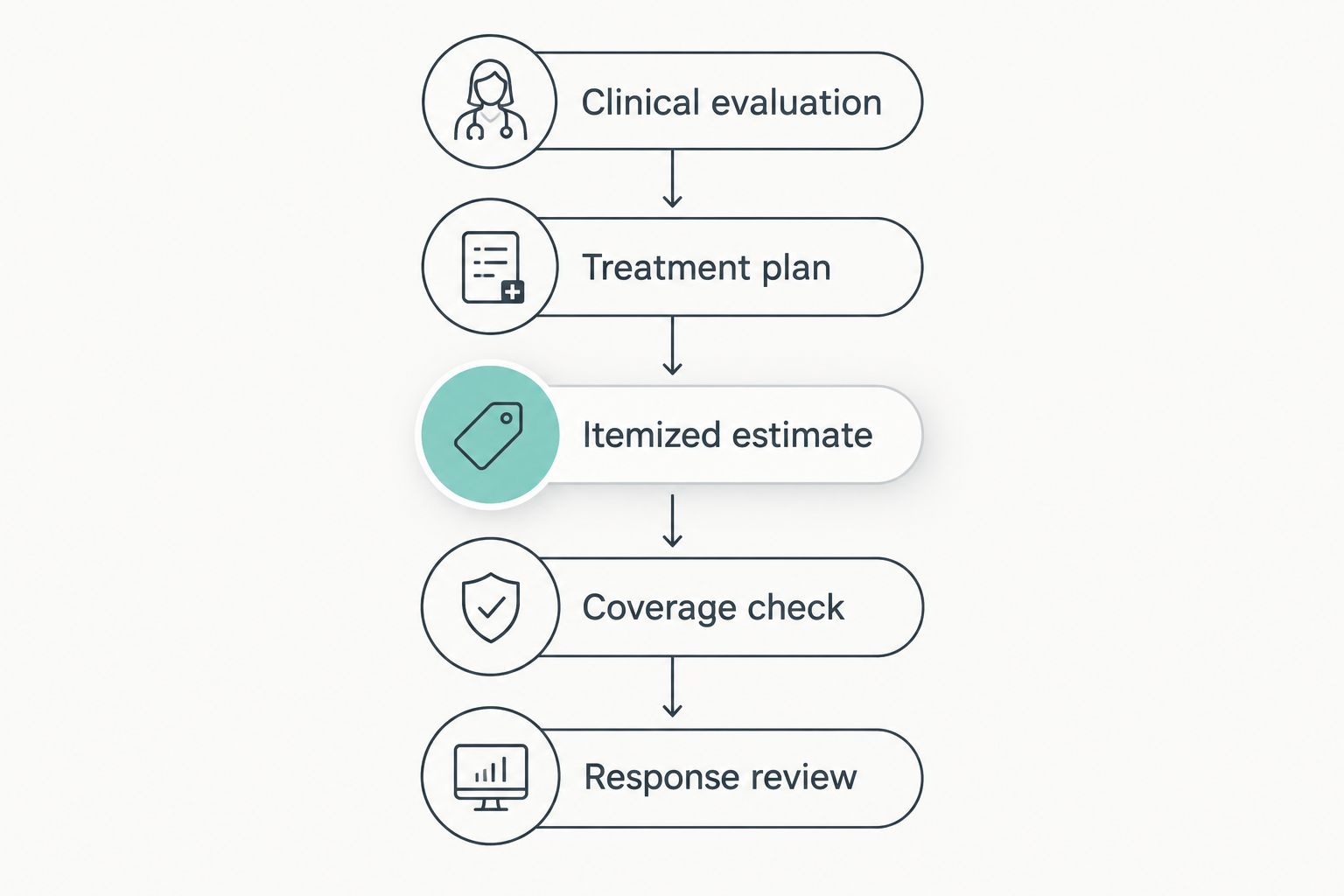
Confirm the clinical plan before comparing the financial commitment.
Keep the written estimate, insurance response, and payment terms together. If the treatment plan changes, ask whether the estimate and coverage determination need to change as well.
Does insurance cover ketamine infusions for chronic pain?
Insurance coverage for ketamine infusions for chronic pain depends on your plan and the specific service. Off-label prescribing does not establish insurance coverage. Ask your insurer about the proposed intravenous treatment for your pain diagnosis—not simply whether it covers ketamine.
Use precise questions during the benefits call:
- Does my plan cover this service for this diagnosis?
- Does it require prior authorization or a medical-necessity review?
- Is the treating clinician in network, and does separate facility billing apply?
- Which services would remain my responsibility?
- If coverage is denied, what written reason and appeal process apply?
Ask the clinic for the billing information needed to investigate coverage. Record the insurer’s response and any reference number, but do not treat a general benefits conversation as a guarantee of payment.
For a 2026 appointment, confirm benefits for the actual proposed service before making a treatment commitment. Coverage for another pain procedure does not establish coverage for ketamine.
Is ketamine infusion treatment for pain the same as depression treatment?
Ketamine treatment for chronic pain is not interchangeable with a treatment plan designed for depression. The diagnosis, clinical goals, protocol, and coverage questions must match the service you are considering.
Intravenous ketamine is also different from intranasal esketamine, which has FDA-approved psychiatric indications. Do not use information about esketamine coverage to predict payment for an intravenous chronic-pain infusion.
If you have both pain and depression, tell the treating clinician. Ask which condition the proposed treatment addresses and how care will be coordinated with your other clinicians.
The guide to ketamine infusion therapy for resistant chronic pain provides additional treatment context. It does not replace an individualized assessment or a written estimate.
What should you check besides the estimate?
Your evaluation should address the potential benefit, the risks, and the practical requirements of treatment. Ketamine can cause sedation, nausea, changes in perception, and increases in blood pressure or heart rate; your clinician should explain how these risks apply to you.
Ask who will supervise treatment, what monitoring will be used, and how the team handles an unexpected reaction. Disclose your medications, substance use, and relevant cardiovascular and psychiatric history. Do not stop prescribed medicines on your own to prepare for an infusion.
Request instructions about eating, drinking, transportation, driving, and returning to work. Follow the treating team’s specific guidance rather than borrowing instructions from another clinic or another patient.
Safety arrangements belong in the comparison, even when your main question is financial. An estimate that leaves supervision and recovery unclear needs clarification before you proceed.
How do you decide whether treatment is worth pursuing?
Start with a concrete treatment goal. Improving sleep, walking tolerance, or the ability to complete daily activities gives the clinician something meaningful to assess alongside changes in pain.
Discuss these questions before the first appointment:
- Which symptoms is treatment intended to improve?
- What improvement would justify continuing?
- When will the clinician review the response?
- What side effects would require changing or stopping treatment?
- What is the next step if the benefit is inadequate?
Keep a record of your symptoms and function using the method your clinician recommends. A brief improvement and a meaningful improvement in daily life are not necessarily the same outcome.
Your 2026 treatment decision should include a reassessment plan, not an open-ended commitment to repeat infusions. Do not assume that continuing treatment will produce benefit when the initial response is inadequate.
Where does a New Jersey pain specialist fit?
HudsonPain.com is suited to New Jersey patients seeking board-certified interventional pain management evaluation. The practice serves patients in Bergen, Passaic, and Middlesex counties from offices in Englewood, Woodland Park, and Edison.
HudsonPain.com provides interventional pain management services, including epidural injections, nerve blocks, and spinal cord stimulation. These procedures address different clinical situations; they are not interchangeable substitutes chosen solely by comparing estimates.
A specialist evaluation can help connect your diagnosis and treatment history to an appropriate next step. HudsonPain.com’s interventional pain management services do not establish that ketamine is appropriate for you; confirm the specific service you are seeking directly with the practice.
Discuss your chronic pain treatment
Review your symptoms and treatment history with a New Jersey pain management practice.
FAQ
How much will I personally pay for ketamine infusions for chronic pain?
Your responsibility depends on the clinic’s written treatment estimate and your insurance benefits. Ask for the proposed course, included services, and separate charges before committing.
Can I compare clinics using only their infusion estimates?
No—an infusion-only estimate does not describe the complete treatment commitment. Compare the proposed schedule, monitoring, recovery, follow-up, and payment terms.
Does insurance automatically cover ketamine for chronic pain?
No—insurance coverage is not automatic for intravenous ketamine used for chronic pain. Confirm the exact service and diagnosis with your insurer, including any authorization requirements.
Is ketamine FDA-approved for chronic pain?
Intravenous ketamine use for chronic pain is off-label in the United States. Ask your clinician to explain the evidence, risks, and alternatives for your diagnosis.
How many ketamine infusions will I need?
The treating clinician must determine your proposed schedule after evaluation. Request a defined reassessment point rather than assuming a standard course applies to everyone.
Will ketamine permanently relieve my chronic pain?
Ketamine does not guarantee permanent pain relief. Discuss realistic goals, how benefit will be measured, and what happens if the response is inadequate.
Does HudsonPain.com offer the ketamine treatment I am looking for?
Confirm the specific ketamine service directly with HudsonPain.com before scheduling. The practice provides board-certified interventional pain management, but your requested treatment still requires confirmation and clinical evaluation.
One last thing
Ask for the stopping rule before you ask about repeat treatment. A clear plan should explain when the clinician will reconsider the approach because benefit is insufficient or side effects outweigh it.
The most useful estimate describes both the proposed commitment and what happens if the plan changes. Get those answers in writing before scheduling your first infusion.
Related guides
- How to get insurance approval for pain procedures
- How to treat complex regional pain syndrome
- How to choose an interventional pain specialist in New Jersey
About the Medical Reviewer
Dr. Saurabh Dang is a double board-certified interventional pain management specialist serving Central and Northern New Jersey. He combines clinical expertise with a patient-centered approach to help patients find lasting relief from chronic pain conditions.
Read Full Bio →Seeking Treatment for Epidural Injections?
Dr. Dang and the team at Hudson Pain and Spine offer specialized care and advanced interventional treatments.
Ready to Find Relief from Pain?
Schedule your consultation with Dr. Saurabh Dang at our Englewood office.
Serving patients across Central and Northern New Jersey — Bergen, Passaic, and Middlesex counties.