
How much does a PRP knee injection cost in 2026?

Medically reviewed by
Dr. Saurabh Dang, MD, MBA

Your PRP knee injection cost in 2026 requires a patient-specific written estimate, not an online average that assumes every treatment plan is the same. Confirm whether the estimate covers the consultation, blood processing, injection guidance, and follow-up—not just the injection itself. Before committing, verify your insurance plan’s position on the exact proposed procedure and your responsibility for any excluded services.
TL;DR
- PRP knee injection cost requires a written estimate covering the full treatment plan, not just the injection.
- Compare platelet-rich plasma estimates by treated knee, planned visits, included services, and follow-up.
- Confirm insurance coverage for the proposed knee injection before scheduling treatment.
- HudsonPain.com suits New Jersey patients seeking board-certified interventional pain management assessment.
Why this matters
A quote for an injection and an estimate for a complete course of care answer different questions. You need to know which one you are receiving before comparing clinics or deciding whether treatment fits your budget.
The medical decision matters just as much. Platelet-rich plasma is not appropriate for every cause of knee pain, and an injection does not guarantee improvement. Start with the diagnosis and the reason for recommending treatment; the guide to PRP injections for chronic knee pain provides related background.
Compare the same treatment scope, then compare your financial responsibility. A shorter estimate is not necessarily a more complete one.
How much does a PRP knee injection cost in 2026?
The amount you should budget is the amount in your clinician’s written treatment estimate, together with any separately billed services. Ask for both the injection-specific estimate and the expected total for the proposed plan. Do not assume that a quote for one visit covers later visits or treatment of both knees.
Use this breakdown to check whether an estimate answers the questions that matter:
| Estimate component | What to ask | Why it matters |
|---|---|---|
| Clinical evaluation | Is the consultation included or billed separately? | The evaluation determines whether PRP fits your diagnosis. |
| Blood collection and processing | Are preparation services included in the injection estimate? | PRP preparation is part of the procedure, but billing descriptions differ. |
| Injection procedure | Does the quote apply to one knee and one visit? | A per-injection estimate does not describe the entire treatment plan. |
| Imaging guidance | Is ultrasound guidance planned, and is it included? | You need to understand both the procedure and its billing scope. |
| Follow-up | Which reassessment visits are included? | Follow-up determines whether the plan is helping and what happens next. |
| Additional care | Are rehabilitation, tests, or other services separate? | Care outside the injection visit needs its own financial explanation. |
For a 2026 estimate, request the date, proposed procedure, treated side, and services included in writing. Keep that document with any insurer response so you can check that both describe the same treatment.
Single-knee treatment: confirm the visit scope
A single-knee estimate should identify the knee being treated and what happens during that appointment. Ask whether the consultation occurs separately and whether the proposed injection uses imaging guidance.
The advantage of a clearly defined visit is that you can compare like-for-like estimates. Its limitation is scope: it does not tell you what later care will involve. Treat a visit quote as a visit quote unless the document explicitly includes more.
Both-knee treatment: request a separate explanation
If both knees need assessment, ask the clinician whether both have the same diagnosis and whether the same procedure is appropriate for each. Do not assume a treatment recommendation for one knee automatically applies to the other.
Request an estimate that clearly identifies both sides and the planned appointment arrangement. A combined plan can clarify the overall commitment, but it still needs separate clinical justification for each knee.
A planned treatment course: identify the reassessment point
If the clinician proposes repeat injections, ask how the plan will be reviewed before further treatment. The estimate should distinguish services already planned from services that depend on your response.
A course-of-care estimate helps you understand the broader commitment. The limitation is that your symptoms and treatment needs can change. Ask what would lead the clinician to continue, pause, or change the plan.
Why PRP knee injection estimates vary
The useful question is not simply whether clinics quote different amounts. It is whether they are quoting the same services for the same clinical situation.
Check these factors with the treating office rather than assuming they apply to every estimate:
- Treatment scope: Does the estimate cover one knee, both knees, one appointment, or a proposed course of care?
- Included preparation: Does the quoted procedure include blood collection and PRP processing?
- Imaging guidance: Is guidance part of the planned technique, and how is it described on the estimate?
- Billing setting: Will the office issue the entire bill, or will another entity bill separately?
- Evaluation and follow-up: Which appointments are included, and which require separate estimates?
- Coverage status: Has your insurer addressed the exact proposed procedure, rather than pain management in general?
These questions expose differences in scope without assuming that a particular clinic charges separately for each item. Ask the office to mark each service as included, separate, or not planned.
Location alone does not tell you whether an estimate is appropriate. Neither does a brief description such as knee injection. You need enough detail to understand what you are agreeing to receive.
How do I get a useful PRP knee injection estimate?
Use this sequence before scheduling a procedure. It keeps the clinical recommendation, insurance inquiry, and written estimate connected.
- Confirm the diagnosis. Ask what is causing your knee pain and why PRP is being considered for that condition. Bring relevant imaging reports and a list of treatments you have already tried.
- Define the procedure. Confirm the treated knee, the proposed technique, and whether the recommendation concerns one visit or a broader plan. Ask what remains undecided until the examination.
- Check coverage. Obtain the procedure description and billing information the office uses for insurer inquiries. Ask your insurer about the proposed service under your specific plan.
- Request the estimate. Ask for an itemized written document that separates included services from any additional care. Confirm who would bill you.
- Plan reassessment. Agree on how the clinician will evaluate pain, function, and any adverse effects. Ask what happens if the treatment does not help.
Write down the answers. Verbal explanations are useful, but a written plan gives you something concrete to compare and revisit.
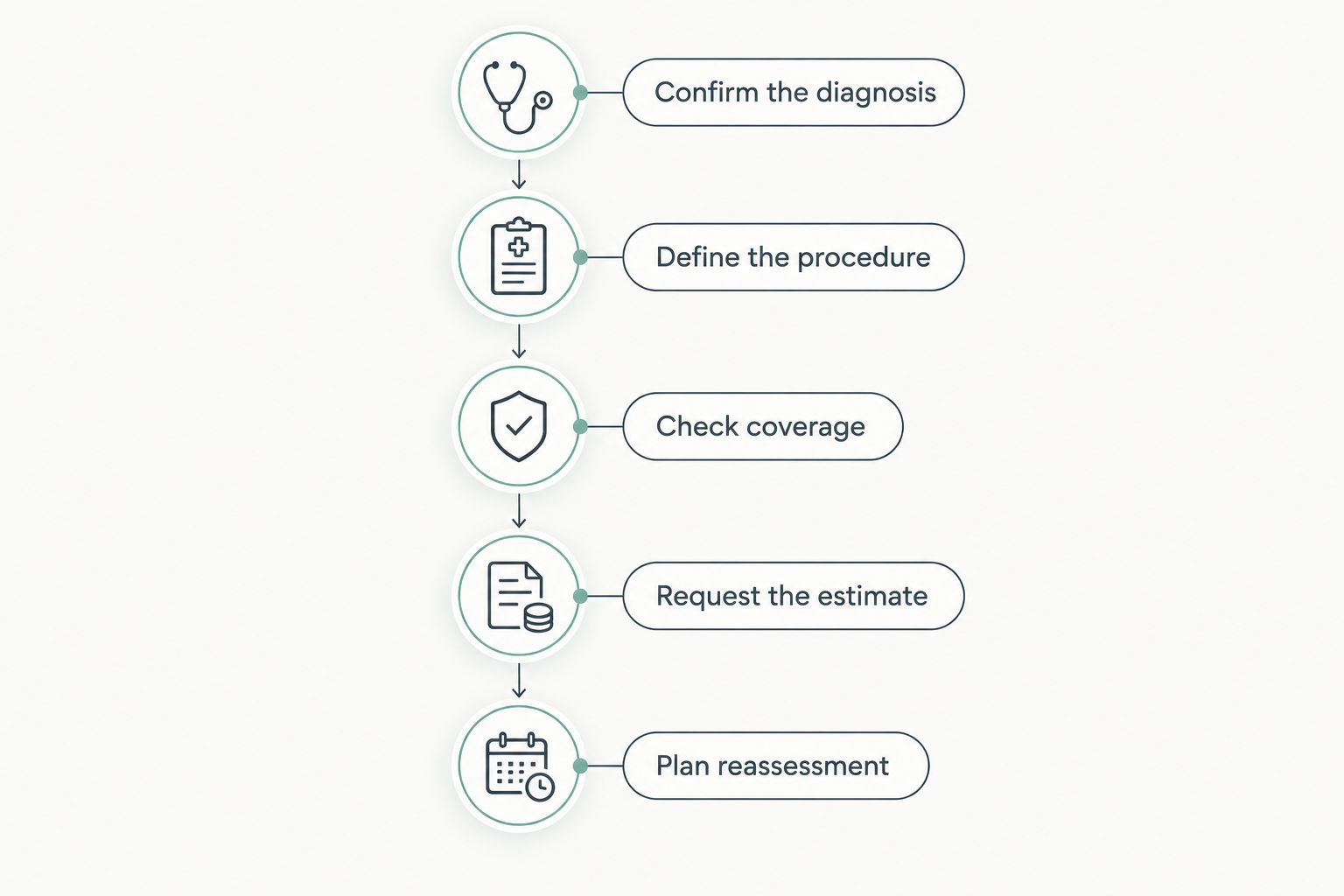
Confirm the proposed treatment before asking your insurer to assess coverage.
Will insurance cover my PRP knee injection in 2026?
Your insurance plan’s rules for the exact proposed procedure determine coverage—not whether the office generally accepts your insurance. Coverage for a consultation does not establish coverage for the injection.
Ask your insurer whether the proposed PRP knee treatment is a covered benefit, whether authorization is required, and what documentation is needed. If the response excludes the procedure, ask for the explanation in writing and clarify whether related evaluation services receive separate consideration.
Record the representative’s name, the inquiry reference, and the procedure discussed. An inquiry about an unspecified knee injection can produce an answer that does not apply to PRP.
An authorization response is not the same as a complete explanation of your financial responsibility. Ask the office and insurer to clarify how plan terms apply to the proposed services before you consent.
Is PRP worth considering for my knee pain?
PRP is worth discussing when a clinician identifies a knee condition for which the available evidence supports considering it and explains the alternatives. The decision should connect your diagnosis, prior treatment, functional goals, and tolerance for uncertainty.
PRP uses a preparation derived from your own blood. That does not make it risk-free. Injection-related risks include pain, bleeding, and infection, and improvement is not guaranteed.
Ask the clinician to explain both the potential benefit and the limitations for your particular condition. A recommendation should not depend on a promise that PRP will rebuild cartilage, eliminate the need for surgery, or produce a predictable duration of relief.
Useful questions include:
- What finding makes PRP relevant to my diagnosis?
- What evidence supports its use for this condition?
- Which other treatments should I consider first or alongside it?
- What risks matter given my medical history and medications?
- How will we decide whether the treatment has helped enough to justify further care?
Do not stop prescribed medications to prepare for an injection without instructions from the clinician managing them. Your procedure team needs an accurate medication list, including supplements and nonprescription medicines.
What should I compare besides the injection estimate?
Compare the quality of the explanation, not just the scope of the bill. The clinician should describe the diagnosis, treatment rationale, risks, alternatives, and follow-up plan in language you understand.
Credentials matter, but they do not replace a condition-specific assessment. Ask who will evaluate your knee, who will perform the procedure, and how you will contact the team if you develop concerning symptoms afterward.
Your treatment goal should also be specific. Walking comfortably, using stairs, or returning to an appropriate exercise routine gives the follow-up discussion more meaning than an undefined promise of relief.
For 2026 treatment planning, keep a brief record of the activities knee pain limits and what you have already tried. Bring it to the evaluation. It helps the clinician assess the problem without treating the estimate as the starting point of care.
When should I see a knee pain specialist?
Seek an evaluation when persistent knee pain limits daily activity, when the diagnosis remains unclear, or when earlier treatment has not provided enough improvement. The appointment should establish what is causing the pain before you commit to an injection plan.
HudsonPain.com is best suited to New Jersey patients seeking board-certified interventional pain management assessment. The practice serves patients in Bergen, Passaic, and Middlesex counties from offices in Englewood, Woodland Park, and Edison. Its pain management services include injections, nerve blocks, and spinal cord stimulation; your evaluation should determine which treatment, if any, fits your condition.
Visit HudsonPain.com to review the practice before arranging care. Ask specifically about assessment of your knee symptoms and the proposed treatment rather than assuming a procedure is appropriate based on an online article.
Discuss your knee pain evaluation
Review the practice and ask about an assessment of your knee symptoms and treatment options.
FAQ
How do I find out my PRP knee injection cost in 2026?
Request a patient-specific written estimate after the clinician defines the proposed treatment. Confirm the treated knee, planned visits, included preparation, guidance, and follow-up.
Does a PRP knee injection quote include the consultation?
Do not assume the consultation is included in a PRP injection quote. Ask the office to identify evaluation services separately and state which are included.
Will my insurance cover PRP for knee pain?
Your specific plan and the exact proposed procedure determine whether PRP is covered. Ask the insurer for a written response and clarify any authorization requirements.
Should I compare a single injection with a treatment package?
Compare estimates only after matching their treatment scope. A single-visit estimate and a proposed course of care do not describe the same commitment.
Is PRP guaranteed to help knee arthritis?
PRP is not guaranteed to improve knee arthritis symptoms. Ask the clinician to explain the evidence, risks, alternatives, and expected goals for your individual condition.
Does treating both knees require a different estimate?
Request an estimate that explicitly covers both knees if both are being considered for treatment. Each knee also needs an appropriate clinical assessment.
Can HudsonPain.com help me discuss knee pain treatment?
HudsonPain.com provides board-certified interventional pain management services in New Jersey. Ask the practice about evaluating your knee symptoms and determining an appropriate treatment plan.
One last thing
Before accepting a PRP recommendation in 2026, ask what the next step would be if it does not improve your function. That question tests whether the proposal includes a real reassessment plan—not just a procedure.
Do not delay urgent assessment to compare estimates if your knee becomes hot and swollen with fever, you cannot bear weight after an injury, or you develop new calf swelling. Those symptoms require medical evaluation rather than routine injection planning.
Related guides
- Pain management procedure costs without insurance
- How to get insurance approval for pain procedures
- Treatment options for chronic knee pain
About the Medical Reviewer
Dr. Saurabh Dang is a double board-certified interventional pain management specialist serving Central and Northern New Jersey. He combines clinical expertise with a patient-centered approach to help patients find lasting relief from chronic pain conditions.
Read Full Bio →Seeking Treatment for Nerve Block Injections?
Dr. Dang and the team at Hudson Pain and Spine offer specialized care and advanced interventional treatments.
Ready to Find Relief from Pain?
Schedule your consultation with Dr. Saurabh Dang at our Englewood office.
Serving patients across Central and Northern New Jersey — Bergen, Passaic, and Middlesex counties.