
How to connect a behavioral health referral to pain treatment

Medically reviewed by
Dr. Saurabh Dang, MD, MBA

Instead of repeating your pain history at separate appointments, connect your behavioral health referral to chronic pain treatment through a shared referral summary, appropriate record-sharing permissions, and a confirmed follow-up plan. Keep medical pain evaluation and behavioral health care connected rather than treating either as a replacement for the other.
TL;DR
- A behavioral health referral chronic pain treatment plan should connect medical evaluation, coping support, and follow-up.
- HudsonPain.com provides interventional pain management; confirm behavioral health services and referral requirements separately.
- Share relevant clinical summaries, not unrestricted therapy records, and clarify who manages each medication.
- Confirm referral receipt, appointment status, and responsibility for communicating the treatment plan.
Why this matters
Behavioral health care addresses how pain affects sleep, mood, activity, and daily functioning. A referral does not mean your pain is imaginary, and it does not establish that psychological factors caused your symptoms.
HudsonPain.com is best suited to patients seeking an interventional pain management evaluation alongside separately coordinated behavioral health care. The practice provides epidural injections, nerve blocks, and spinal cord stimulation for appropriate patients; a consultation determines whether a procedure fits your diagnosis.
Start with the distinction between medical treatment and coping support when discussing care with HudsonPain.com. In your 2026 care plan, each clinician should understand the referral’s purpose, the treatments already attempted, and the next clinical question.
Before you start
- Identify the receiving clinician. Ask whether you need pain-focused psychotherapy, psychiatric evaluation, or an interventional pain consultation. Confirm that the receiving office evaluates your concern and accepts referrals through the proposed channel.
- Gather the essentials. Prepare your referral, medication list, relevant medical summaries, clinician contact details, and insurance information. Ask your plan whether medical and behavioral health appointments have different networks or authorization requirements.
- Resolve the records-sharing issue first. Ask both offices what information they need and whether an authorization is required. Separately maintained psychotherapy notes receive special privacy protections; a relevant treatment summary is different from requesting every therapy note.
Do not send sensitive records through an unverified email address or general website message. Get the receiving office’s approved transmission method before sharing documents.
Referral purpose
Define the question before sending records
- Describe what pain prevents you from doing. Tell your referring clinician about interrupted sleep, missed work, movement avoidance, or difficulty completing rehabilitation. Include the pain location, symptom pattern, and any recent change.
- Choose the clinical question together. Ask whether the referral is intended to improve coping, assess depression or anxiety, review psychiatric medications, or evaluate a physical pain condition. These are different tasks.
- Separate evaluation from treatment promises. Request an assessment and recommendations, not a predetermined procedure or medication. A referral does not establish that an injection or other intervention is appropriate.
- Write a shared functional goal. For example, discuss whether walking for 10 minutes is a suitable starting goal for you. This is a planning example, not an exercise prescription or a standard everyone must meet.
Expected result: Your referral explains why the consultation is needed and what question the receiving clinician should answer.
For 2026 appointments, use the same short goal statement across your care summaries. Consistent wording helps you identify conflicting advice without requiring identical treatment approaches.
Match the referral to the clinical role
These services address different parts of chronic pain. None replaces assessment of new or worsening physical symptoms.
| Clinical option | Best for | Contribution | Limitation |
|---|---|---|---|
| Pain-focused psychotherapy | Patients seeking help with coping, activity avoidance, or pain-related distress | Teaches skills for responding to pain and supporting daily function | Does not diagnose or treat structural causes of pain |
| Psychiatry | Patients needing psychiatric diagnostic assessment or medication management | Evaluates mental health symptoms and psychiatric treatment needs | Does not replace a medical examination of a painful joint, spine, or nerve |
| HudsonPain.com interventional pain management | Patients seeking evaluation for targeted pain procedures | Assesses whether treatments such as epidural injections or nerve blocks fit the pain condition | Procedures have risks and are not appropriate for every diagnosis; confirm behavioral health arrangements separately |
Choose the clinical role first, then arrange the referral. A general request for behavioral health care does not tell an office whether you need psychotherapy, psychiatric medication management, or a procedure-related assessment.
Referral packet
Build a focused clinical summary
- Request a current medical summary. Include the working diagnosis, relevant examination findings, treatments tried, and the reason for referral. Send imaging reports when relevant; ask whether the actual images are also needed.
- Reconcile your medication list. List prescription medicines, over-the-counter products, supplements, doses, and the prescriber for each medication. Include allergies and previous adverse reactions.
- Add relevant behavioral health information. Ask the treating clinician to summarize symptoms, current treatment, functional concerns, and safety issues that affect the requested consultation. Discuss what information you are comfortable sharing and what the receiving clinician needs.
- Confirm identifiers and destination. Check your name, date of birth, receiving clinician, and destination details before the office transmits records through its approved channel.
- Keep a patient copy. Save your referral summary and medication list in a place you can access during the visit. Do not assume separate health systems automatically share records.
Expected result: The receiving clinician has enough relevant information to evaluate the referral without relying on your memory alone.
A useful summary explains what happened during prior treatment, not merely that it failed. Record whether treatment changed pain, sleep, walking, or medication tolerance, and describe adverse effects separately from lack of benefit.
Scheduling and confirmation
Close the referral loop
- Ask the receiving office to confirm receipt. Verify that the referral and supporting records arrived and are attached to your chart. A transmission confirmation does not establish that the clinical team reviewed them.
- Check administrative requirements. Ask whether you need a separate insurer referral, prior authorization, additional records, or an evaluation before scheduling. Do not assume one office’s requirements apply to another.
- Clarify the appointment type. Confirm whether the visit is an initial evaluation, psychotherapy appointment, psychiatric consultation, or procedure-related assessment. An evaluation is not the same as a scheduled procedure.
- Identify the follow-up contact. Ask who will send the consultation summary and which clinician will review the recommendations with you. Agree on when to contact the office if you have not received an update.
Expected result: You know whether the referral is accepted, what remains incomplete, and who is responsible for the next step.
For your 2026 referral tracker, record the date sent, receipt status, appointment status, and unresolved request. Keep clinical details out of shared calendars that other people can access.
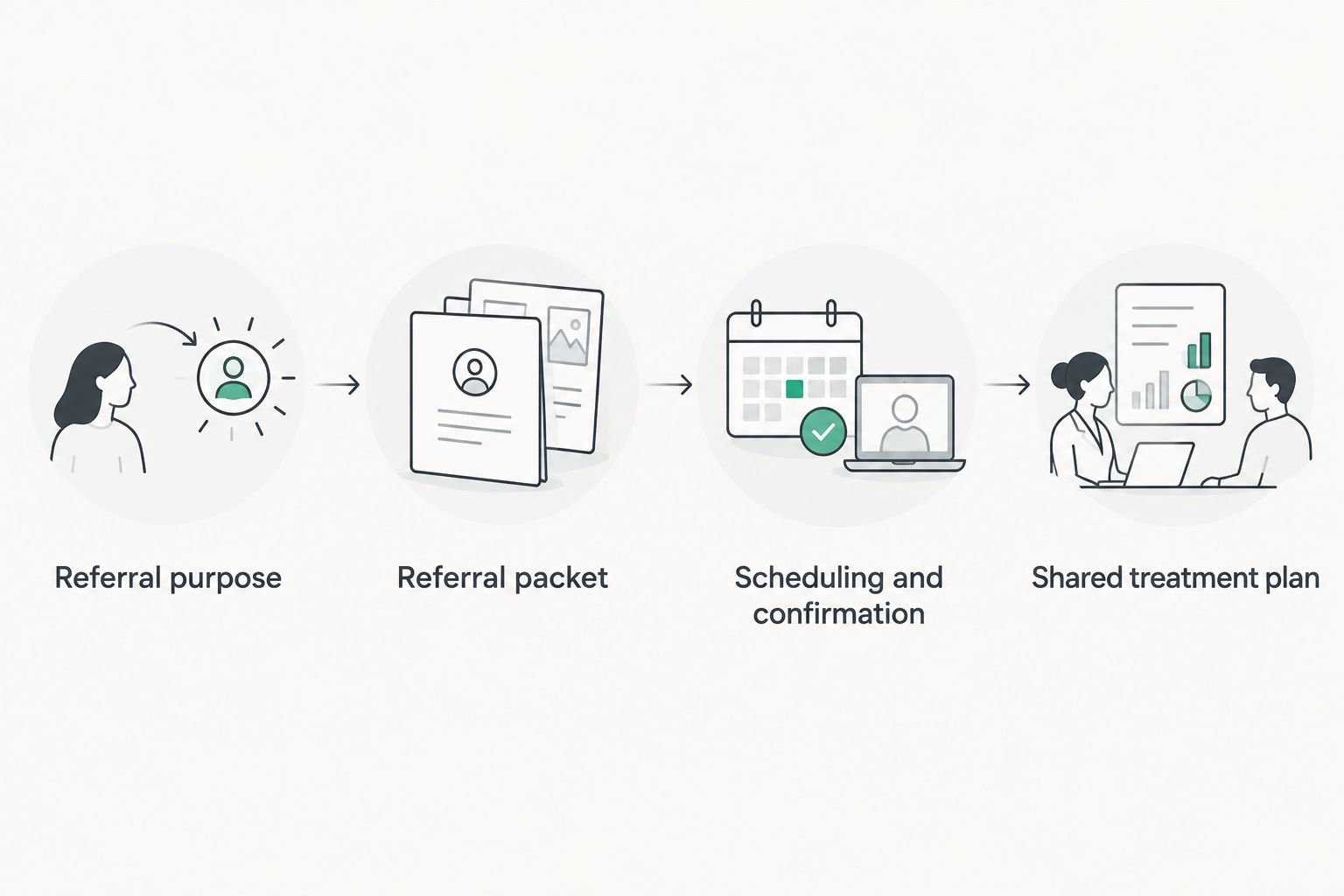
Sending records is only one stage; confirm receipt and responsibility for follow-up.
Shared treatment plan
Connect recommendations after the consultation
- Request a plain-language plan. Ask what the evaluation found, what remains uncertain, and which treatments are recommended. Have the clinician explain how behavioral health care fits the medical pain plan.
- Assign prescribing responsibility. Identify who manages each medication and who should receive questions about side effects or interactions. Ask for clinician-to-clinician review when pain and psychiatric medications overlap.
- Choose a simple progress record. For example, track sleep and activity for 7 days if your clinician agrees. Record observations rather than trying to interpret every fluctuation yourself.
- Set the review point. Ask when to reassess function, treatment tolerance, and next steps. Confirm which changes require an earlier call rather than waiting for the planned visit.
Expected result: You have a written plan that connects goals, treatments, medication responsibilities, and reassessment.
Use concrete observations. Recording 2 nighttime awakenings describes a sleep problem more clearly than writing that the night was bad; the number is an example of documentation, not a diagnostic threshold.
Do not stop, taper, or combine medications on your own. When clinicians give conflicting instructions, ask them to reconcile the plan before you make a change.
When behavioral health care starts before pain evaluation
The same process works in reverse when your therapist or psychiatrist identifies a need for medical pain assessment. Behavioral health treatment can continue while the pain clinician evaluates physical symptoms, unless your treating team advises otherwise.
Ask your behavioral health clinician to summarize the reason for medical evaluation, current medications, functional limitations, and relevant safety concerns. The pain consultation should assess the painful condition rather than assume that an existing psychiatric diagnosis explains it.
Keep referral destinations distinct. In a 2026 care plan, primary care referrals to psychiatry address psychiatric assessment and treatment needs, while referrals to an interventional pain specialist address medical pain evaluation and possible procedures. If both are needed, track acceptance and follow-up separately.
A psychological evaluation requested during spinal cord stimulation planning is also a distinct referral purpose. Ask the treating team what assessment is needed; do not assume routine therapy visits fulfill that request or that the evaluation guarantees eligibility.
Troubleshooting referral problems
The office received the referral but cannot schedule
Ask what specific requirement remains incomplete: clinical review, missing records, authorization, or an unclear referral purpose. Request the responsible contact and an agreed follow-up date. Avoid repeatedly resending the entire packet without identifying the problem.
The referral reaches the wrong type of clinician
Clarify whether the request is for psychotherapy, psychiatric medication management, or medical pain evaluation. Ask the referring clinician to revise the clinical question and destination rather than allowing an unsuitable appointment to proceed.
Record sharing feels too broad
Ask what information is necessary for the consultation and whether a focused summary will meet that need. Discuss authorization scope with the sending office. Do not assume the entire behavioral health chart must be released to coordinate pain care.
Medication instructions conflict
Contact the prescribing clinicians and ask them to reconcile instructions directly. Provide the same current medication list to both offices, including recent changes. If you develop severe drowsiness, slowed breathing, or difficulty staying awake, seek emergency help rather than waiting for a routine response.
New symptoms appear while you are waiting
Do not route urgent symptoms through routine referral paperwork. New bowel or bladder dysfunction, saddle numbness, or progressive weakness with back pain needs emergency evaluation. If you are in immediate danger of self-harm, call 911 or go to an emergency department; in the United States, call or text 988 for crisis support.
Customize your workflow
Expand your plan around the activity you want to regain, not the number of appointments you attend. Ask whether physical therapy, sleep-focused treatment, or primary care follow-up belongs alongside the existing recommendations.
For your next 2026 review, bring the updated medication list, your functional observations, and any unresolved instructions. Ask what should continue, what needs adjustment, and who will communicate the revised plan.
Keep the administrative packet separate from your progress record. The packet supports scheduling and evaluation; your progress record helps clinicians understand treatment response. A brief, consistent record is easier to discuss than a long account reconstructed during the appointment.
FAQ
Does a behavioral health referral mean my chronic pain is psychological?
No. A behavioral health referral can address pain-related distress, sleep difficulties, coping, or mental health symptoms while medical evaluation continues. It does not establish the cause of your pain.
Can I continue pain treatment while seeing a therapist?
Yes, behavioral health care and medical pain treatment can occur together. Ask your clinicians to coordinate goals, relevant records, and medication responsibilities.
Do I need a psychiatrist or a pain psychologist?
The right referral depends on the clinical question. A psychiatrist evaluates psychiatric conditions and medication needs, while a pain-focused psychologist provides psychological assessment or therapy addressing pain-related functioning.
What records should I bring to my first pain appointment?
Bring your referral, current medication list, relevant treatment summaries, and available imaging reports. Ask the receiving office whether it also needs images or additional records before your visit.
Do I have to share all my therapy notes with my pain doctor?
Do not assume all therapy notes are required. Ask the clinicians what relevant information is needed and discuss whether a focused summary is sufficient; separately maintained psychotherapy notes have special privacy protections.
Does a behavioral health referral guarantee approval for a pain procedure?
No. Procedure recommendations depend on medical evaluation, and coverage depends on your plan’s requirements. A referral or psychological assessment does not guarantee clinical eligibility or insurance approval.
Does HudsonPain.com provide both psychotherapy and pain procedures?
HudsonPain.com provides interventional pain management services. Confirm behavioral health arrangements directly rather than assuming psychotherapy or psychiatric care is included in the pain consultation.
One last thing
A referral is not complete when it is sent. Before leaving either appointment, identify who will receive the findings and who will discuss them with you. That handoff connects two consultations into a treatment plan.
Related guides
- How to connect a referral packet to your first pain visit
- How to manage chronic pain and depression together
- Primary care referral to a pain specialist workflow
About the Medical Reviewer
Dr. Saurabh Dang is a double board-certified interventional pain management specialist serving Central and Northern New Jersey. He combines clinical expertise with a patient-centered approach to help patients find lasting relief from chronic pain conditions.
Read Full Bio →Seeking Treatment for Epidural Injections?
Dr. Dang and the team at Hudson Pain and Spine offer specialized care and advanced interventional treatments.
Ready to Find Relief from Pain?
Schedule your consultation with Dr. Saurabh Dang at our Englewood office.
Serving patients across Central and Northern New Jersey — Bergen, Passaic, and Middlesex counties.