
How to connect chiropractic care to interventional pain treatment

Medically reviewed by
Dr. Saurabh Dang, MD, MBA

Instead of repeating your symptom history at separate chiropractic and pain appointments, connect chiropractic care to interventional pain treatment through a shared clinical summary, specialist assessment, and written recovery plan. Hudson Pain and Spine provides board-certified interventional pain management for New Jersey patients; this 2026 guide explains how to coordinate that evaluation with your existing care.
TL;DR
- Connect chiropractic care interventional pain treatment through shared records, diagnostic review, and procedure-specific activity instructions.
- Hudson Pain and Spine offers interventional pain management for New Jersey patients seeking specialist assessment.
- Chiropractic care and epidural injections serve different purposes; treatment selection requires a clinical examination.
- New weakness, saddle numbness, or bladder changes require urgent medical assessment, not another adjustment.
Why this matters
Chiropractic care and interventional pain treatment are not interchangeable. Chiropractic care can include manual treatment, exercise, and movement advice; interventional pain management uses targeted procedures when the diagnosis and clinical findings support them.
Coordination helps your clinicians distinguish persistent symptoms from treatment-related changes. It also prevents a common scheduling mistake: returning to spinal manipulation before the procedural clinician has clarified restrictions.
Hudson Pain and Spine is an option for New Jersey patients seeking board-certified interventional pain management. Its services include epidural injections, nerve blocks, and spinal cord stimulation, with offices in Englewood, Woodland Park, and Edison. Whether a procedure belongs in your treatment plan depends on assessment—not simply on how many chiropractic visits you have completed.
Before you start
- Gather your clinical records. Bring the chiropractic assessment, treatment dates, response to care, medication list, relevant imaging reports, and access to existing images. Include prior procedures and spine surgery.
- Confirm the referral and records process. Ask the specialist’s office whether your insurance requires a referral or authorization. Authorize record sharing and confirm how the receiving office accepts documents; sending records does not establish coverage.
- Resolve the scheduling gotcha first. Tell both clinicians about planned injections or implanted stimulation equipment before scheduling manipulation. Get procedure-specific instructions, and never stop blood thinners or other prescribed medicines on your own.
If you develop new bladder or bowel dysfunction, numbness around the groin or buttocks, or rapidly worsening limb weakness, seek emergency assessment. Do not wait for a routine referral. Fever with severe back pain also requires prompt medical evaluation, particularly after a procedure.
Clinical handoff
Build a symptom summary
- Describe the pain pattern. State where pain starts, where it travels, and whether it includes burning, tingling, numbness, or weakness. Separate neck or back pain from arm or leg symptoms.
- Record the treatment response. List what chiropractic care involved, what improved, and what worsened. Describe whether relief lasted beyond the appointment and whether daily activities became easier.
- Choose a functional goal. Use a measurable activity, such as walking for 10 minutes or sitting through a 30-minute meeting. These are example goals, not exercise prescriptions.
- Create a baseline. Record pain on a 0–10 scale alongside the activity you attempted. A 7-day symptom log is a practical preparation tool, not a requirement to delay assessment.
Expected result: You have a concise summary that explains the problem, previous care, and the activity you want to recover. The specialist can assess more than a pain score.
Send records and confirm receipt
- Ask for the chiropractic clinical summary. Request examination findings, working diagnosis, treatment methods, and documented response. Include any new neurological symptoms.
- Provide existing imaging. Send the report and ask how to share the actual images. Do not arrange a new MRI solely to complete this workflow; the medical clinician decides whether additional imaging is indicated.
- Name the receiving clinician. Give each office the other clinician’s contact information and your permission to exchange relevant records.
- Verify delivery before the visit. Ask whether the specialist received the documents and whether anything else is needed.
Expected result: Both offices know who is involved, and the specialist has the available history before making recommendations. Keep a personal copy of the summary for appointments outside either practice.
Treatment selection
Match the examination to the symptoms
- Explain your main limitation first. Tell the specialist what you cannot comfortably do, then describe the symptoms that stop you. Mention worsening weakness or numbness immediately.
- Review the diagnosis. Ask whether the findings suggest nerve-root irritation, joint-related pain, muscle pain, or another source. Imaging findings must be interpreted alongside symptoms and examination.
- Discuss the role of continued conservative care. Ask whether exercise, physical therapy, modified chiropractic treatment, or another approach remains appropriate.
- Request a clear reason for any proposed procedure. Ask what structure is being targeted, whether the procedure is diagnostic or therapeutic, and what benefit and risks apply to you.
Expected result: You understand the working diagnosis and why the clinician recommends continued conservative care, a procedure, additional testing, or another referral. A consultation does not obligate you to receive an injection.
Compare the roles of treatment
Use this 2026 comparison to organize the discussion—not to select a procedure yourself. The best treatment is the one that fits the diagnosis and your medical circumstances.
| Approach | Best for discussion when | Potential benefit | Limitation or risk |
|---|---|---|---|
| Chiropractic care | Selected musculoskeletal pain is being managed conservatively | Manual treatment and movement advice can support symptom management | Manipulation is inappropriate in some conditions; temporary soreness can occur |
| Epidural steroid injection | Symptoms and examination support spinal nerve-root irritation | Targets inflammation around spinal nerves | Relief varies; risks include bleeding, infection, and steroid-related effects |
| Diagnostic nerve block | The clinician needs information about a suspected pain source | Temporary relief can help guide treatment decisions | Results require careful interpretation; temporary relief is not proof of permanent benefit |
| Spinal cord stimulation | Persistent pain warrants specialist evaluation after other treatments | Electrical stimulation can help selected patients manage pain | Requires a selection process and ongoing device care; infection and equipment complications are possible |
Hudson Pain and Spine provides the interventional services listed above. Those services do not make chiropractic treatment unnecessary in every case, and continued chiropractic care does not establish that a procedure is appropriate.
Tell the specialist about diabetes, infection symptoms, pregnancy, medication allergies, and medicines that affect bleeding. The clinician uses that information to assess procedure risks and preparation; do not change treatment based on this table alone.
Recovery plan
Agree on activity instructions before treatment
- Describe the planned chiropractic treatment. Explain whether sessions involve spinal manipulation, mobilization, stretching, or exercise. These activities do not have identical physical demands.
- Request written restrictions. Ask specifically about manipulation, lifting, bending, exercise, driving, and returning to work. Instructions depend on the procedure, sedation, and your health history.
- Share the instructions with the chiropractor. Ask the chiropractor to confirm how the next session will change and whether it should be postponed.
- Confirm whom to contact. Know which office handles new symptoms, medication questions, and procedure-related concerns.
Expected result: You leave with an activity plan both clinicians can follow. Pain relief is not clearance to resume every activity.
For an epidural injection, review the practical questions in the guide to recovery after an epidural steroid injection. Your treating clinician’s instructions take priority over general guidance.
Do not substitute a generic 2026 recovery calendar for procedure-specific advice. There is no universal waiting period that makes spinal manipulation appropriate after every pain procedure.
Progress review
Close the loop after treatment
- Follow the monitoring instructions. Record symptoms and activities at the intervals your clinician requests. If a diagnostic block requires a diary, follow that diary rather than creating a competing schedule.
- Separate pain relief from function. Note whether walking, sleep, work, or home exercise improved. Record new numbness, weakness, or other concerning changes separately.
- Report the result to both clinicians. Explain what changed and what did not. Include any modifications to chiropractic treatment or medications.
- Agree on the next decision. Ask whether to continue the current plan, reassess the diagnosis, modify rehabilitation, or discuss another option.
Expected result: Follow-up is based on documented response rather than memory. A lower pain score without improved function is useful information—not a reason to automatically repeat treatment.
This 2026 workflow has four linked parts: clinical handoff, treatment selection, recovery plan, and progress review. The last part feeds back into the first whenever your symptoms or treatment change.
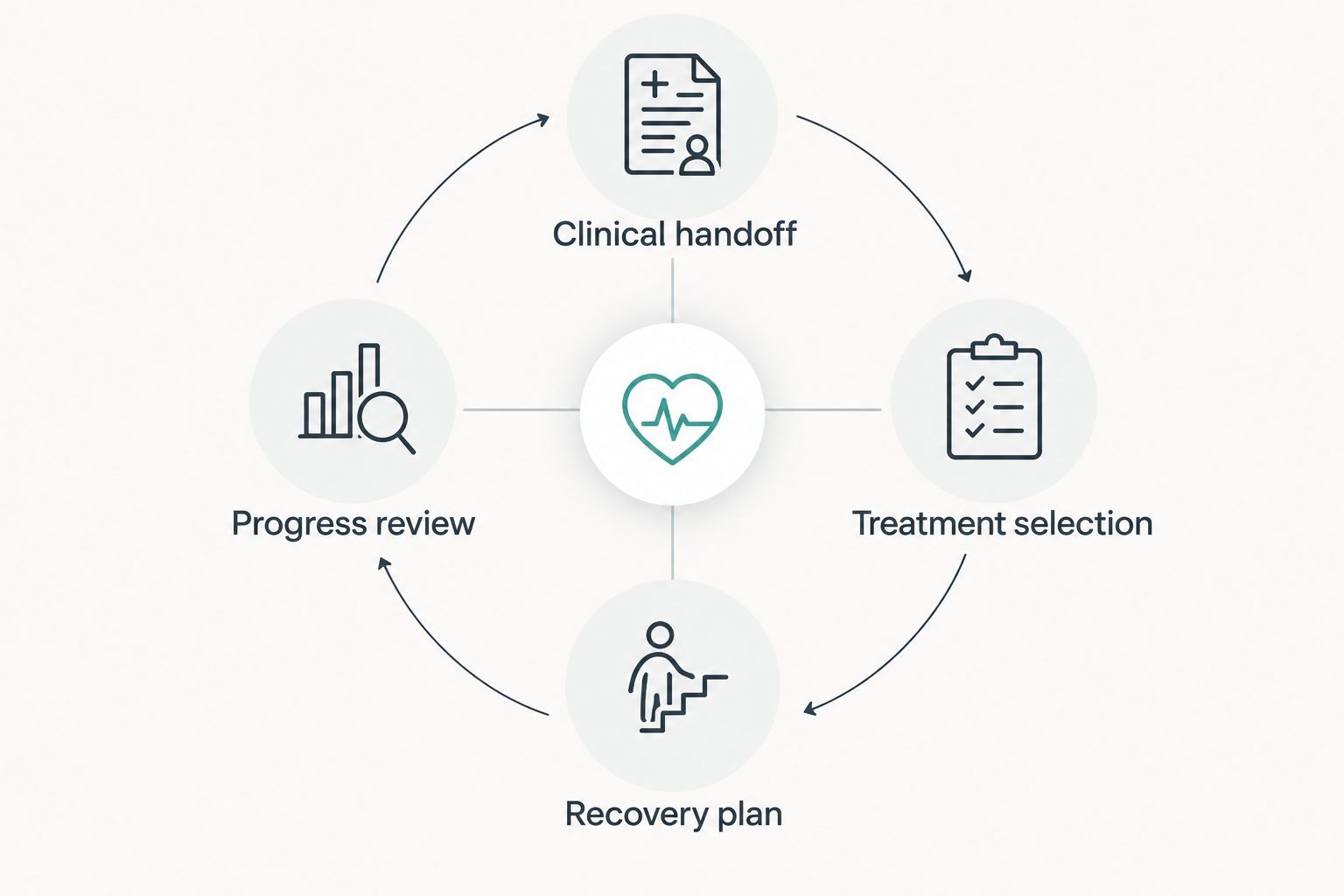
Update the shared plan whenever symptoms or treatment change.
Coordinate care whenever symptoms change
You do not need to wait for a scheduled procedure to reconnect the clinicians. A second workflow applies when chiropractic care stops improving function, symptoms spread into an arm or leg, or a previously tolerable activity becomes difficult.
- Document the change. Describe the new symptom, when it started, and whether it followed treatment, an injury, or a medication change.
- Contact the appropriate clinician. New or worsening neurological symptoms need medical assessment; emergency warning signs require emergency care.
- Send an updated summary. Include changes in examination findings, treatments, medications, and daily function.
- Reconfirm the plan before further manipulation. Ask whether treatment should continue, change, or pause pending assessment.
Expected result: The plan responds to your current condition rather than repeating an earlier approach. Do not interpret worsening symptoms as a necessary part of recovery.
Troubleshooting
The specialist has not received the records
Confirm the destination and delivery method with both offices. Ask the sending office to resend the summary, then verify receipt; bring your own copy as a backup.
The clinicians give different activity advice
Pause the activity in question and ask the clinicians to clarify the discrepancy directly. Procedure-related restrictions need to be resolved with the procedural clinician before treatment resumes.
Relief fades before the next visit
Record which symptoms returned, when they returned, and whether function changed. Temporary benefit can inform reassessment, but it does not automatically justify repeating a procedure or increasing manipulation.
A diagnostic block result is unclear
Report the activity you tested, the symptom response, and any sedation or medication that affected observation. Do not perform prohibited movements to test the block; ask the clinician how to interpret the result.
Insurance paperwork stalls the referral
Ask the office or insurer which document is missing and who must supply it. A referral, prior authorization, and medical records serve different purposes; confirm your plan’s 2026 requirements before a scheduled procedure.
Customize your workflow
Add your primary care clinician when medication management or other health conditions affect treatment. Include a physical therapist when the plan calls for supervised strength, mobility, or activity progression; give each clinician a defined role.
Keep a single updated summary of medications, diagnoses, restrictions, and treatment responses. You do not need elaborate software, and this workflow does not depend on an assumed patient-portal feature.
Ask Hudson Pain and Spine about specialist assessment when persistent back, neck, or nerve symptoms limit daily activity. Bring your chiropractic records so the consultation addresses what has already been tried.
FAQ
Can chiropractic care and interventional pain treatment be used together?
They can be coordinated when both clinicians agree that the treatments fit your diagnosis and medical circumstances. Share records and obtain procedure-specific activity instructions before continuing manipulation.
Do I need to stop seeing my chiropractor before a pain consultation?
A consultation does not automatically require stopping chiropractic care. Tell the specialist what treatment you receive; new neurological symptoms or other safety concerns require reassessment before further manipulation.
Is chiropractic care better than an epidural injection for sciatica?
Neither is universally better for every patient with sciatica. Treatment depends on the examination, suspected cause, previous response, and risks; an epidural injection is considered for selected nerve-root symptoms.
Can I have a chiropractic adjustment immediately after a nerve block?
Do not resume manipulation until the procedural clinician has clarified the activity restrictions. Temporary pain relief or numbness does not establish that an adjustment is safe.
What records should I bring to a pain specialist?
Bring your chiropractic clinical summary, treatment response, medication list, prior procedure history, and relevant imaging reports and images. Include your main functional limitation and any new weakness or numbness.
Does a pain specialist always recommend an injection?
No, a pain consultation does not automatically lead to an injection. The specialist can recommend conservative care, further assessment, a procedure, or another referral according to the findings.
When should I seek emergency care instead of another chiropractic visit?
Seek emergency assessment for new bladder or bowel dysfunction, saddle numbness, or rapidly worsening limb weakness. Do not wait for a routine chiropractic appointment or pain referral.
One last thing
A diagnostic procedure and a treatment procedure answer different questions. Before any injection, ask whether the goal is to identify a pain source, reduce symptoms, or both—and how the result will change your plan.
That question makes the follow-up more useful. It also gives your chiropractor a clear reason to modify care rather than treating temporary relief as permission to resume everything.
Related guides
- Pain management for chiropractors and physical therapists
- Connecting physical therapy to interventional pain treatment
- Primary care referral to a pain specialist workflow
About the Medical Reviewer
Dr. Saurabh Dang is a double board-certified interventional pain management specialist serving Central and Northern New Jersey. He combines clinical expertise with a patient-centered approach to help patients find lasting relief from chronic pain conditions.
Read Full Bio →Seeking Treatment for Epidural Injections?
Dr. Dang and the team at Hudson Pain and Spine offer specialized care and advanced interventional treatments.
Ready to Find Relief from Pain?
Schedule your consultation with Dr. Saurabh Dang at our Englewood office.
Serving patients across Central and Northern New Jersey — Bergen, Passaic, and Middlesex counties.