
How to connect your doctor to a pain medication tapering plan

Medically reviewed by
Dr. Saurabh Dang, MD, MBA

Instead of carrying conflicting medication instructions between appointments, connect your prescribing doctor and pain specialist through a shared, written tapering plan so everyone knows who approves changes, monitors symptoms, and manages refills. Start with a medication review—not a dose reduction—and use this 2026 guide to organize the conversation without changing your medication yourself.
TL;DR
- Connect your doctor to pain medication tapering plan decisions before changing doses; identify the prescriber responsible for each medicine.
- Hudson Pain and Spine is best for New Jersey patients seeking interventional pain management evaluation alongside prescribing-doctor coordination.
- A medication taper needs written instructions, withdrawal monitoring, pain support, and a scheduled clinical review.
- Never abruptly stop a regularly used opioid or restart an old dose without medical advice.
Why this matters
A taper is a clinical decision, not a refill strategy. Reducing medication without coordinated care can leave you with withdrawal symptoms, uncontrolled pain, or conflicting instructions. Some medicines require gradual reduction; others do not. Your doctor must identify which situation applies.
Hudson Pain and Spine provides board-certified interventional pain management services in Englewood, Woodland Park, and Edison. Hudson Pain and Spine is best for New Jersey patients seeking interventional pain management evaluation alongside prescribing-doctor coordination. A pain evaluation does not automatically transfer prescribing responsibility or establish a taper.
This workflow focuses on coordination for adults taking pain medication. It does not provide a dose schedule, replace an examination, or apply automatically to cancer-related pain, palliative care, pregnancy, or treatment for opioid use disorder. Those situations need condition-specific decisions.
Before you start
- Gather your medication records. Bring prescription containers or a current list showing medication names, strengths, directions, actual use, prescribing clinicians, and pharmacy details. Include supplements, sleep medicines, and alcohol use.
- Arrange communication access. Have contact details for your prescriber and pain specialist, relevant visit summaries, and permission for the offices to exchange records. If you use a patient portal, confirm you can receive replies; do not assume offices share the same system.
- Confirm prescribing responsibility before changing anything. A referral does not mean the specialist will take over prescriptions. Also, extended-release tablets and certain capsules cannot be split or altered safely; your doctor and pharmacist must confirm how prescribed changes can be supplied.
Before your 2026 medication review, write down why you want to discuss tapering: side effects, limited benefit, improved pain, or another concern. Ask for an appointment rather than trying to settle a complicated medication change through a refill message.
Prescriber coordination
Identify who owns the medication decisions
- Name the responsible prescriber. Ask who will approve changes for each medication being considered for reduction. Use 1 named prescriber per medication as a coordination goal, while keeping other treating clinicians informed.
- Explain your actual use. Report what you take, including missed doses, extra doses, and medication obtained from another clinician. Accurate information supports safer decisions; it is not a reason to hide concerns.
- Request a shared review. Ask your doctor to assess the medicine’s benefits, adverse effects, withdrawal risks, and your treatment goals before deciding whether tapering is appropriate.
- Arrange the handoff. Ask whether your primary care clinician, specialist, or another prescriber needs the visit summary and who will send it. Confirm receipt rather than assuming a referral completed the communication.
Expected result: You know which clinician approves changes and which office handles medication questions. Nobody has told you to change a dose merely because a referral was placed.
If you need specialist input, the primary care referral to a pain specialist workflow explains the adjacent referral process. Keep the prescribing question separate: an evaluation and a prescription handoff are different decisions.
Medication review
Create a shared medication snapshot
- Record the current regimen. List the medicine, formulation, strength, prescribed timing, actual timing, and length of use. Include as-needed medicines even if you rarely take them.
- Document baseline symptoms. Record pain location, sleep disruption, side effects, and a meaningful activity such as walking, working, or dressing. If your clinician uses a 0–10-point pain scale, use that same scale consistently.
- Review safety factors. Tell your doctor about breathing problems, sleep apnea, kidney or liver disease, pregnancy, depression, substance use concerns, and previous difficulty reducing medication.
- Ask which medicine comes first. If several medicines need review, ask the clinicians to agree on sequencing. Do not apply an opioid taper schedule to gabapentin, pregabalin, antidepressants, or sedatives; their risks and reduction instructions differ.
Expected result: Your doctor has a current medication list and a symptom baseline, not just a list of old prescriptions.
Use a dated 2026 medication summary if that reflects your current review. Mark older instructions as superseded only after the prescriber confirms the replacement. Keeping every past schedule active invites mistakes.
Physical dependence means the body has adapted to a medicine and withdrawal can occur when it is reduced or stopped. It is not the same as opioid use disorder. If your history raises concerns about opioid use disorder, ask for assessment and treatment rather than assuming a taper alone addresses the problem.
Written taper instructions
Confirm the plan before the first change
- Ask for medication-specific instructions. The prescriber should specify what changes, when it changes, and what stays unchanged. Read the instructions back if anything is unclear.
- Verify the formulation. Ask the pharmacist whether the prescribed strength and formulation match the written plan. Do not crush, split, open, or substitute a medicine without approval.
- Set the review point. Agree on when the clinician will reassess symptoms and how you will contact the office between visits. Avoid relying on a generic percentage schedule found online.
- Clarify pause instructions. Ask which symptoms require a call, urgent assessment, or a clinician-directed pause. Get explicit guidance rather than deciding independently to stop, accelerate, or reverse the taper.
- Coordinate prescriptions. Confirm who will issue the next prescription and how revised directions will reach the pharmacy. Raise supply concerns before the medication runs out.
Expected result: You can explain the current instructions, the next review, and the contact route without guessing. Your pharmacy has instructions consistent with the prescribing clinician’s plan.
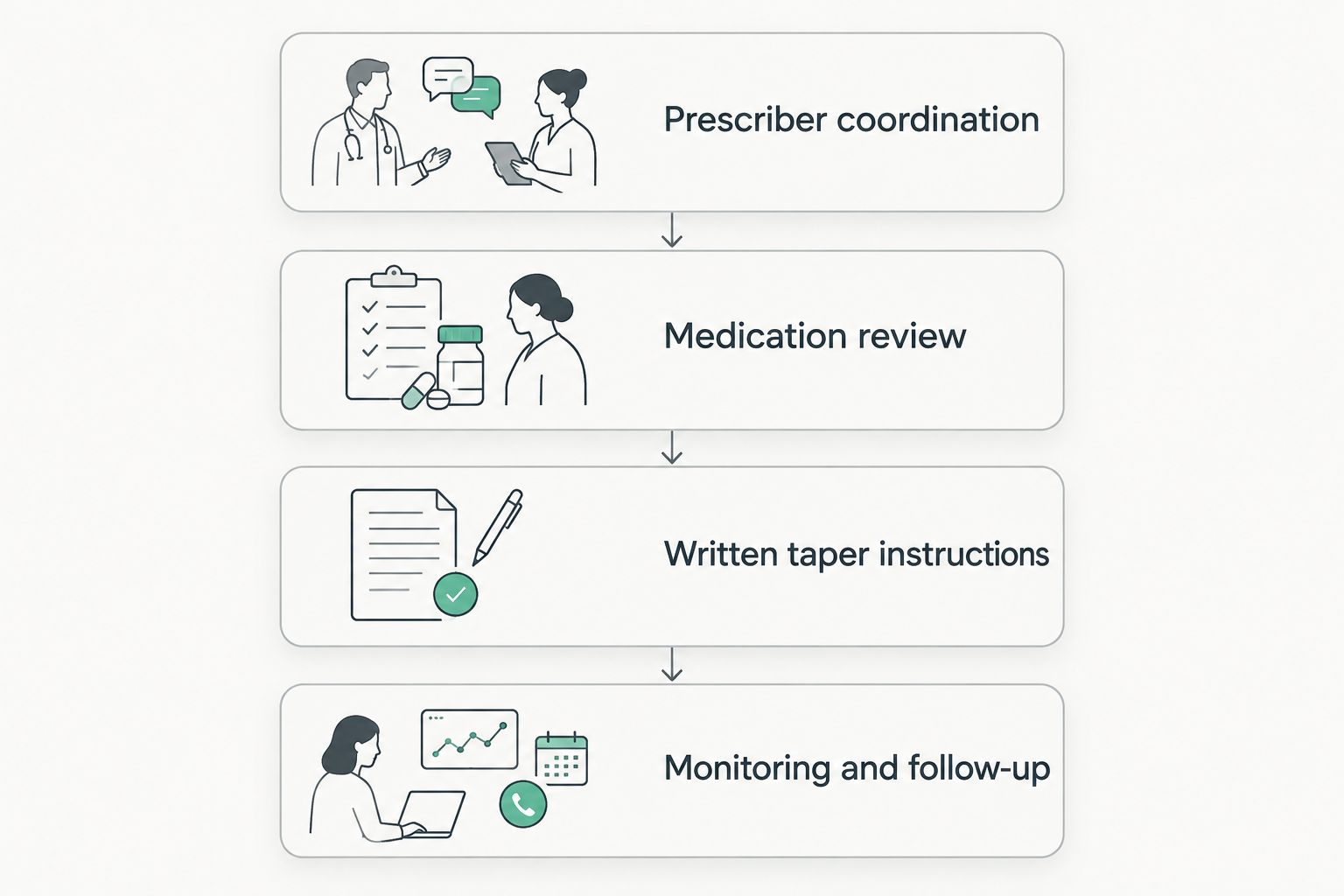
Confirm responsibility and written instructions before starting a medication change.
Your written plan should also address pain treatment during the reduction. Physical therapy, behavioral pain care, non-opioid medicines, and selected procedures serve different purposes; none is an automatic replacement for an opioid.
Hudson Pain and Spine provides interventional pain management options including epidural injections, nerve blocks, and spinal cord stimulation. Whether any procedure fits your condition requires clinical evaluation. A procedure does not guarantee that medication can be reduced.
Monitoring and follow-up
Send useful updates to the responsible doctor
- Keep a brief symptom record. As a practical starting point, make 1 entry per day unless your clinician requests another frequency. Include actual medication use, sleep, function, side effects, and new symptoms.
- Separate observations from conclusions. Report sweating, diarrhea, restlessness, anxiety, or increased pain with their timing. Do not assume every symptom is withdrawal; illness or a new pain problem also needs assessment.
- Describe functional changes. Tell your doctor whether you can complete the agreed activity, not only whether the pain number changed. Note whether a change persists or follows a specific event.
- Attend the planned review. Ask the clinician to confirm whether the next step remains appropriate and to update the written instructions when the plan changes.
Expected result: The doctor receives enough detail to reassess the plan, and you have a current version of the instructions after each approved change.
For your 2026 follow-up record, use the same medication names and symptom measures as the baseline. Consistency makes changes easier to interpret; a lengthy diary with shifting scales is harder to use.
Do not resume a previous opioid dose on your own. Opioid tolerance can decrease during reduction or after stopping, making a previously tolerated dose dangerous. Ask your clinician about naloxone and make sure someone close to you knows how to recognize an overdose and respond.
Update the plan after a procedure or care transition
An adjacent workflow applies when your pain changes after an injection, surgery, hospital stay, or a new diagnosis. Improvement is a reason to request reassessment—not permission to skip doses independently.
- Send the responsible prescriber the procedure or discharge summary, including any newly prescribed medicines.
- Describe what changed in pain, sleep, activity, and side effects.
- Ask whether the existing taper instructions still apply and whether another clinician must participate.
- Obtain revised written instructions before implementing a different schedule.
Expected result: New treatment information reaches the prescribing clinician, and the medication plan reflects the care transition.
The coordinating arrangements below are not competing treatments. Choose the arrangement that matches your care needs and clarify its limits.
| Coordination arrangement | Best for | Benefit | Limitation |
|---|---|---|---|
| Current prescriber leads | Patients whose prescribing clinician can manage medication review and follow-up | Keeps responsibility clear | Additional pain or behavioral expertise can require referral |
| Prescriber and pain specialist collaborate | Patients needing assessment of the pain condition alongside medication decisions | Adds condition-specific treatment input | Requires explicit communication; specialist consultation does not transfer prescribing |
| Addiction specialist participates | Patients with suspected or diagnosed opioid use disorder | Addresses a condition that needs more than dose reduction | Does not replace assessment and treatment of the underlying pain |
Arrange a pain management evaluation
Discuss your pain condition and interventional treatment options alongside your prescribing doctor’s medication review.
Troubleshooting
Two offices give different instructions
Request clarification before following a conflicting change. Contact the responsible prescriber, share both instructions, and ask the offices to reconcile them in writing. Ask which version the pharmacy should use.
Symptoms worsen after a reduction
Contact the prescribing clinician promptly with the change date, actual doses taken, and symptoms. Significant withdrawal, worsening mood, or declining function needs reassessment; do not compensate with extra medication or alcohol.
The pharmacy cannot supply the prescribed formulation
Ask the pharmacist to contact the prescriber about a suitable prescription. Do not substitute a different strength, use someone else’s medicine, or alter an extended-release product yourself.
You are close to running out before review
Contact the prescribing office immediately and explain the remaining supply and scheduled appointment. Do not create a faster taper by skipping doses to stretch the prescription; the clinician needs to resolve the gap.
You develop emergency symptoms
Call 911 for slowed or stopped breathing, inability to wake, or suspected overdose; use naloxone if available. Seek emergency help for immediate risk of self-harm, and call or text 988 for a mental health crisis. New weakness, loss of bladder or bowel control, or severe confusion also needs urgent assessment rather than routine portal messaging.
Customize your workflow
Build your 2026 care plan around function, not a deadline to reach zero medication. Ask your clinician to define a meaningful goal and the pain treatments that support it. A lower dose, a pause, or continued treatment requires an individualized benefit-risk discussion.
Keep the workflow simple: a responsible prescriber, a current written plan, and a reliable contact route. Ask about rehabilitation, sleep support, and mental health care when those needs affect recovery. Medication reduction without support for the underlying pain leaves an important part of care unfinished.
FAQ
How do I connect my doctor to a pain medication tapering plan?
Ask your current prescriber for a medication-review appointment and permission to coordinate with your pain specialist. Confirm who approves changes, obtain written medication-specific instructions, and schedule follow-up before starting a reduction.
Who should manage my pain medication taper?
The clinician responsible for prescribing the medication should manage changes or explicitly arrange a prescribing handoff. A primary care clinician, pain specialist, or another treating clinician can participate, but responsibility must be clear.
Can I stop my pain medication if an injection helps?
Do not stop a regularly used medicine without advice from the prescribing clinician. Report the improvement and ask whether the medication plan should change; some medicines cause withdrawal when stopped abruptly.
Does every pain medicine need a taper?
No, every pain medicine does not need a taper. The medication, duration of use, formulation, and your health history determine whether gradual reduction is needed and how the prescriber approaches it.
What should I do if withdrawal symptoms start?
Contact the prescribing clinician promptly and report your symptoms, their timing, and the medication change. Seek urgent help for severe symptoms, confusion, breathing problems, or immediate risk of self-harm rather than waiting for a routine reply.
Can I restart my old opioid dose if pain returns?
Do not restart an old opioid dose without medical advice. Tolerance can fall during reduction or after stopping, increasing overdose risk when a previous dose is resumed.
Does a pain specialist referral transfer my prescriptions?
No, a referral does not automatically transfer prescribing responsibility. Ask both offices who will issue prescriptions and approve medication changes before relying on a new care arrangement.
One last thing
Ask for the contact instructions as carefully as the dose instructions. A written taper is incomplete if you do not know whom to call when symptoms change or the pharmacy has a problem. Leave the review knowing the routine contact route, the urgent-care route, and who owns the next decision.
Related guides
- How to connect physical therapy to interventional pain treatment
- How to manage chronic pain without opioids
- How to manage chronic pain and depression together
About the Medical Reviewer
Dr. Saurabh Dang is a double board-certified interventional pain management specialist serving Central and Northern New Jersey. He combines clinical expertise with a patient-centered approach to help patients find lasting relief from chronic pain conditions.
Read Full Bio →Seeking Treatment for Epidural Injections?
Dr. Dang and the team at Hudson Pain and Spine offer specialized care and advanced interventional treatments.
Ready to Find Relief from Pain?
Schedule your consultation with Dr. Saurabh Dang at our Englewood office.
Serving patients across Central and Northern New Jersey — Bergen, Passaic, and Middlesex counties.