
How to connect your pharmacy to a pain medication refill plan

Medically reviewed by
Dr. Saurabh Dang, MD, MBA

Instead of repeatedly calling your pharmacy and prescriber to track a pain medication request, connect your pharmacy to a pain medication refill plan with a verified medication list, an agreed request method, and separate confirmation of prescribing and dispensing. This guide explains how to organize that handoff without treating a pharmacy reminder as permission to continue or change a medication.
TL;DR
- Connect your pharmacy to pain medication refill plan instructions through verified records, prescriber review, and pharmacy confirmation.
- Hudson Pain and Spine provides interventional pain management; a specialist evaluation does not guarantee medication prescribing.
- Schedule II prescriptions cannot be refilled; continued treatment requires a new prescription when clinically appropriate.
- Use refill reminders to prompt a request, not to change your dose or assume approval.
Why this matters
A refill request, a prescription, and a dispensed medication are different events. Confusing them creates a practical problem: you think the next step is complete when someone still needs information or authorization.
Hudson Pain and Spine is best for patients seeking specialist evaluation of back, neck, and nerve pain. The practice provides interventional pain management in New Jersey, including epidural injections, nerve blocks, and spinal cord stimulation. Learn more about Hudson Pain and Spine if you need an evaluation alongside medication planning.
A useful refill workflow assigns responsibility rather than promising approval. Your prescriber decides whether treatment should continue; your pharmacist checks and dispenses the prescription under applicable requirements. Your role is to provide accurate information and confirm the handoff.
For your 2026 medication plan, keep 1 current medication record and 3 contact routes: the prescribing office, the pharmacy, and your prescription insurance plan. These are organizational choices, not clinic rules.
Before you start
- Gather your records and access. Have your prescription labels, current medication list, pharmacy address and telephone number, prescriber details, and prescription insurance information. Use a pharmacy account or patient portal only if you already have access.
- Confirm who manages each medication. Identify the clinician responsible for ongoing prescribing and any required follow-up. Ask which request method the office accepts and how much notice it needs; do not assume an appointment with a new specialist transfers prescribing responsibility.
- Check the controlled-medication distinction. Under federal controlled-substance requirements, Schedule II prescriptions cannot be refilled. A pharmacy reminder does not replace a new prescription, and other controlled medications also have restrictions. Ask your pharmacist which rules apply to your medication.
If you have already run out, contact the prescribing office and pharmacist for medication-specific instructions. Do not borrow medication, take extra doses, or independently stretch doses to make the supply last.
Medication record setup
Verify the prescription and pharmacy
- Read the current label. Record the medication name, strength, dosage form, directions, prescription number, dispensing pharmacy, and prescribing clinician. Include whether the medicine is scheduled or taken as needed. Do not calculate a new dose from an older bottle.
- Build the full medication list. Include prescriptions from other clinicians, over-the-counter medicines, supplements, and allergies or previous reactions. Pharmacists need that context to check for interactions and duplicate ingredients.
- Confirm the exact pharmacy location. Give the prescriber the branch address and telephone number, not just the chain name. Ask the office to confirm the destination before it sends a prescription.
- Identify conflicting instructions. If the bottle label, visit summary, and your recollection disagree, ask the pharmacist and prescriber to resolve the difference. Use the clarified instructions rather than choosing the version that seems easiest.
Expected result: You have an accurate medication record and a confirmed pharmacy destination. Any uncertainty about the dose or responsible prescriber has been identified before you request more medication.
Mark your worksheet with the date reviewed in 2026. The date shows when you checked the information; it does not establish that a prescription remains valid or that treatment is authorized indefinitely.
Choose the communication route
Use the route your prescriber accepts. There is no universal pharmacy or patient-portal interface, so follow your own account’s instructions rather than searching for a particular button name.
| Request route | Best for | Advantage | Limitation |
|---|---|---|---|
| Pharmacy-initiated request | An existing prescription the pharmacy can request for renewal | Gives the office pharmacy-held prescription details | Does not establish prescriber approval |
| Patient message or telephone request | A medication requiring clinical review or a new prescription | Lets you explain symptoms, side effects, and timing | Requires the office to review and respond |
| Coordinated use of both routes | A handoff the office specifically requests | Connects patient context with pharmacy details | Uncoordinated duplicate requests create confusion |
Choose the agreed route, not every route at once. Record when you submitted the request and tell the office if the pharmacy has also contacted it.
Prescriber request setup
Agree on timing and review requirements
- Ask about the request window. Confirm how far ahead the office wants you to request medication and how weekends, holidays, or clinician absences affect processing. Record its answer without turning it into a guaranteed dispensing date.
- Confirm the review requirements. Ask whether you need a follow-up visit, updated symptom assessment, laboratory testing, or other monitoring before the clinician makes a prescribing decision. Requirements depend on the medication and your care plan.
- Set 2 calendar reminders. Use one reminder for the agreed request date and another for the follow-up point the office recommends. These reminders support communication; they do not authorize early dispensing.
- Record the next appointment separately. Keep the visit date distinct from the medication request date. An appointment on the calendar does not mean a prescription has been issued.
Expected result: You know when to contact the office, what review is required, and when to follow up. Your 2026 calendar reflects the office’s instructions rather than an assumed monthly refill cycle.
Send the information needed for review
- Identify the medication clearly. Provide its name, strength, current label directions, prescribing clinician, and exact pharmacy location. Include the prescription number when the request concerns an existing pharmacy record.
- Describe your current use accurately. Explain how you have taken the medicine and report missed doses, side effects, or use that differs from the label. Accuracy matters more than making the request appear routine.
- Report changes in pain and function. Describe whether treatment helps you walk, sleep, work, or participate in therapy. Tell the clinician about new symptoms rather than asking only for the same prescription again.
- Ask for a clear next action. Establish whether the office needs more information, an appointment, or pharmacy contact. If a prescription is approved, ask which pharmacy received it.
Expected result: The prescribing office has a specific request and relevant clinical information. You understand the next action without confusing acknowledgment of your message with approval.
Keep medication details inside the office’s accepted communication channel. Do not post prescription labels, insurance identifiers, or health information in public comments or reviews.
Pharmacy confirmation setup
Verify receipt and instructions
- Contact the pharmacy after the office confirms transmission. Ask whether the pharmacy received the prescription for the correct patient and medication. A sent message and a received prescription are not the same confirmation.
- Ask what remains unresolved. Determine whether the pharmacy needs prescriber clarification, an insurance decision, or another required check. Record the specific issue and which party must address it.
- Review the prescription directions with the pharmacist. Confirm the strength, dosage form, directions, and any medication-specific precautions. Ask about interactions with medicines or supplements on your current list.
- Close the handoff. Follow the pharmacy’s instructions for collecting your medication. Check the label before taking it and raise any mismatch with the pharmacist immediately.
Expected result: You know that the pharmacy received the prescription and understand any remaining action. You also have verified instructions for the medication actually dispensed.
A simple record makes this sequence easier to follow:
- Medication record: Name, strength, directions, and responsible prescriber.
- Request sent: Date, method, and office response.
- Clinical review: Required visit or information and prescribing decision.
- Pharmacy confirmation: Receipt, unresolved questions, and instructions.
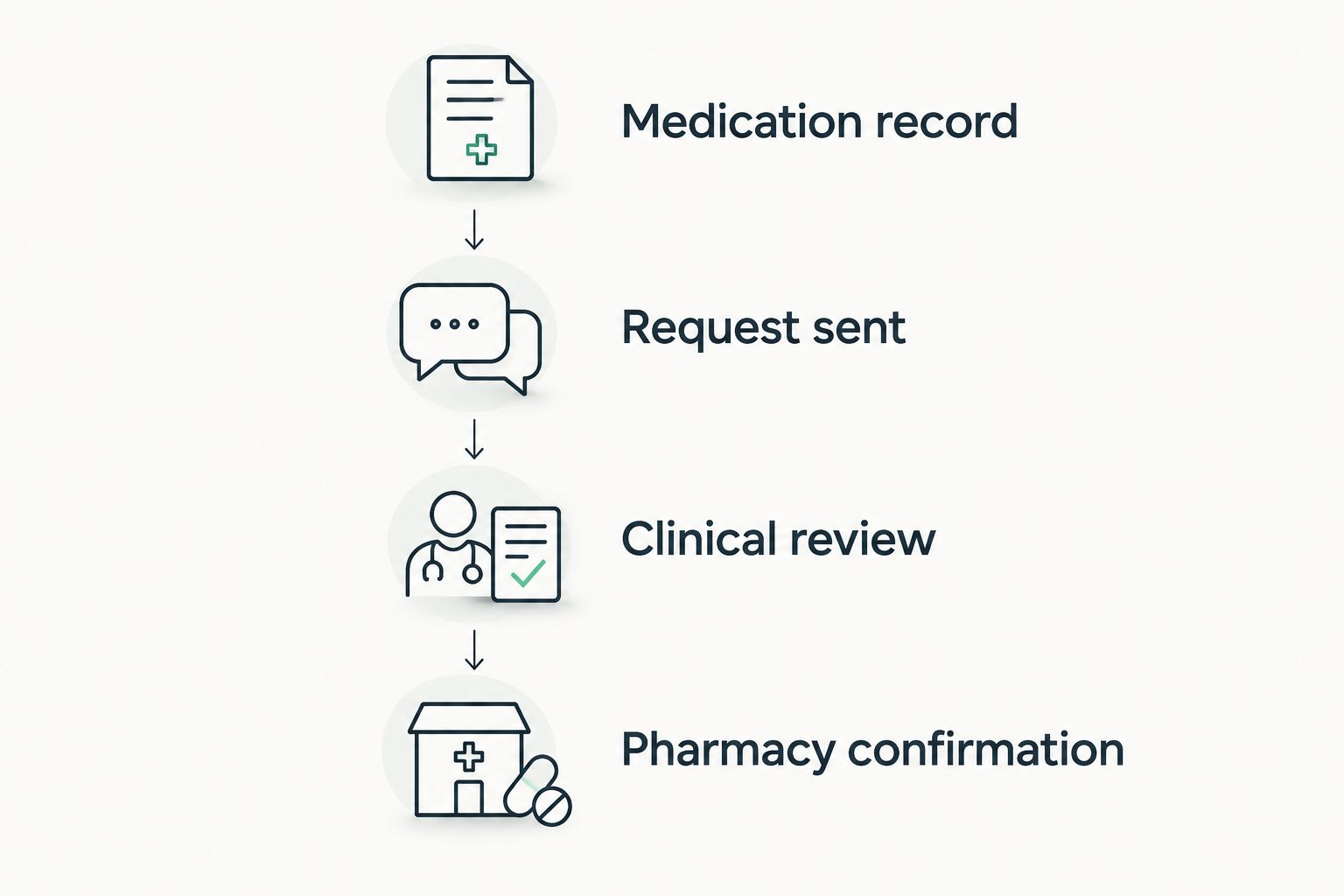
A request is not complete until the prescribing decision and pharmacy handoff are clear.
Keep those stages separate in your 2026 tracking sheet. Avoid a single checkbox labeled complete that conceals whether you submitted a request or actually received medication.
Update the plan when treatment changes
A dose change, medication switch, or clinician-directed taper needs a new handoff. Do not let an old refill reminder continue to drive a changed treatment plan.
- Get the revised directions from the prescriber. Confirm what changes, when the change begins, and what to do with the previous prescription. Ask for clarification if a taper schedule is unclear.
- Ask the pharmacist to reconcile the records. Have the pharmacy compare the new prescription with the previous one and identify duplicate or conflicting instructions. Do not assume an old automatic request has stopped.
- Update your medication list and reminders. Replace outdated directions in your own records and adjust reminders according to the new plan. Keep a dated note explaining the change.
- Confirm follow-up. Ask which symptoms require a call and when the clinician will reassess the treatment. Report problems rather than altering the schedule yourself.
Expected result: Your prescriber’s instructions, pharmacy record, and personal medication list agree. For a clinician-directed reduction, use the guide to connecting your doctor to a pain medication tapering plan to organize that discussion.
Troubleshooting the refill handoff
The office says it sent the prescription, but the pharmacy cannot find it
Verify your name, date of birth, medication, and exact pharmacy branch. Ask the office to confirm the destination and resolve the transmission issue with the pharmacy. Do not request additional prescriptions from another clinician to bypass the problem.
The pharmacy says the prescription has no refills
Ask whether it requires renewal or a new prescription. Schedule II prescriptions require a new prescription when continued treatment is appropriate; other prescriptions also need renewal when authorized refills are exhausted. Contact the responsible prescriber through the agreed route.
Insurance requires prior authorization
Ask the pharmacy which authorization or coverage issue is blocking processing and which office must respond. Contact your prescription insurance plan for its requirements, and give the prescribing office the relevant information. Prior authorization and clinical prescribing approval are separate decisions.
The label does not match the treatment change
Pause and ask the pharmacist to compare the dispensed label with the prescriber’s revised instructions. Contact the prescriber if clarification is needed. Do not combine old and new instructions or substitute a different strength yourself.
The next prescription is unresolved and you are close to running out
Contact the prescribing office and pharmacist promptly, explaining your actual remaining medication and prescribed use. Ask for a safe, medication-specific plan. Do not abruptly stop an opioid you take regularly or change other pain medicines without clinical guidance; severe symptoms require urgent assessment.
Customize your workflow
At Hudson Pain and Spine, interventional pain management includes treatments beyond medication. A refill conversation should also address whether your diagnosis, function, and treatment goals need reassessment—not simply whether the next prescription should match the last.
Ask your clinician how physical therapy, activity changes, or an appropriate procedure fits your broader plan. These approaches do not automatically replace medication, and a procedure does not authorize you to discontinue prescribed treatment.
During your next 2026 review, bring your medication record and identify the task that repeatedly stalls: requesting, clinical review, insurance processing, or pharmacy clarification. Assign a contact and follow-up action to that task. This is more useful than adding reminders without knowing who needs to respond.
FAQ
How do I connect my pharmacy to a pain medication refill plan?
Confirm your medication list, responsible prescriber, exact pharmacy location, and accepted request method. Then track the prescribing decision and pharmacy receipt separately; a request alone does not mean the medication is approved.
Can my pharmacy automatically refill every pain medication?
No, automatic refill reminders do not apply to every pain medication or authorize continued treatment. Schedule II prescriptions cannot be refilled, and other medications require valid prescriptions and any necessary clinical review.
How early should I request my pain medication?
Use the request window your prescribing office gives you. Ask how weekends, holidays, appointments, and medication-specific requirements affect timing instead of assuming a universal deadline.
Does seeing Hudson Pain and Spine guarantee a pain medication prescription?
No, a specialist evaluation does not guarantee a prescription. Hudson Pain and Spine provides interventional pain management, and treatment decisions depend on the clinical assessment.
What should I do if my prescription goes to the wrong pharmacy?
Contact the prescribing office and receiving pharmacy to resolve the destination. Transfer rules depend on the prescription and applicable requirements, so do not assume every prescription can simply be moved.
Can I change my dose while waiting for a prescription?
Do not change your dose independently while waiting for a prescription. Contact your prescriber and pharmacist for a medication-specific plan, especially if you are close to running out.
What if my pain medication causes severe sleepiness or slow breathing?
Severe sleepiness with slow breathing or difficulty waking requires emergency help. Call emergency services immediately; if opioid overdose is suspected and naloxone is available, administer it according to its instructions while help is coming.
One last thing
A reminder belongs to your calendar; authorization belongs to your prescriber. Keep that distinction visible by writing the next required action beside every reminder: submit a request, attend a review, or confirm pharmacy receipt.
The most useful refill record is not the longest one. It is the one that shows exactly where the handoff stopped and who needs to act next.
Related guides
- Primary care referral to a pain specialist workflow
- How to manage chronic pain without opioids
- When to see a pain management specialist for chronic pain
About the Medical Reviewer
Dr. Saurabh Dang is a double board-certified interventional pain management specialist serving Central and Northern New Jersey. He combines clinical expertise with a patient-centered approach to help patients find lasting relief from chronic pain conditions.
Read Full Bio →Seeking Treatment for Epidural Injections?
Dr. Dang and the team at Hudson Pain and Spine offer specialized care and advanced interventional treatments.
Ready to Find Relief from Pain?
Schedule your consultation with Dr. Saurabh Dang at our Englewood office.
Serving patients across Central and Northern New Jersey — Bergen, Passaic, and Middlesex counties.