
Tennis Elbow Treatment 2026: What Actually Works

Medically reviewed by
Dr. Saurabh Dang, MD, MBA
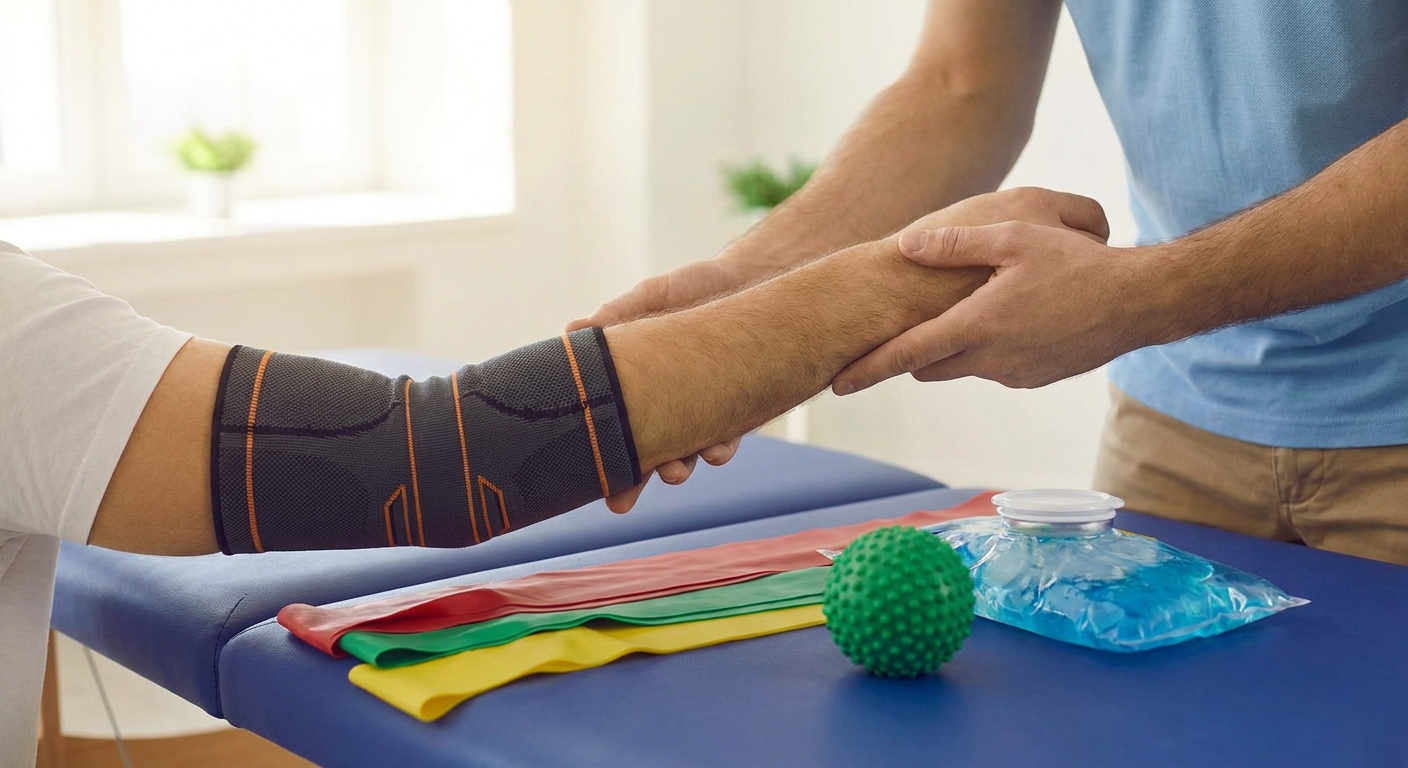
Tennis elbow and golfer’s elbow are the same injury on opposite sides of the joint — overloaded forearm tendons that stay inflamed because nobody stops using them long enough to heal. This guide walks through the 2026 treatment sequence for lateral and medial epicondylitis, from home care through injection therapy, the way Hudson Pain and Spine works through it with patients in Englewood, Woodland Park, and Edison.
TL;DR
- Tennis elbow treatment starts with rest, bracing, and eccentric exercise for 6 to 8 weeks before any injection gets discussed.
- Golfer’s elbow follows the same protocol, targeting the wrist flexor tendon instead of the extensor tendon.
- Platelet-rich plasma injections outlast corticosteroid shots for relief past the 6-month mark when home care fails.
- Numbness or tingling into the fingers points to nerve involvement, not simple epicondylitis — get that checked, don’t assume.
Why this matters
Lateral epicondylitis (tennis elbow) and medial epicondylitis (golfer’s elbow) are tendon overload injuries, not joint problems. The extensor tendon on the outside of the elbow, or the flexor tendon on the inside, develops microscopic tears from repeated gripping and rotating. Healing stalls because the same motion keeps re-injuring the tissue before it can repair.
Most people who get tennis elbow have never picked up a racket. Painters, hygienists, plumbers, and anyone typing or gripping tools all day develop the same tendon breakdown. The forearm ache that comes with it often overlaps with muscle trigger points in the extensor mass, which is why trigger point injections come up in the same conversation as epicondylitis — they treat a different structure, but the referred pain pattern feels identical to the patient.
Left alone, epicondylitis pain typically runs 6 months to 2 years before it resolves on its own. Treating it early in 2026 cuts that timeline down considerably, and it keeps a manageable tendon problem from turning into a chronic one.
What you’ll need
- Ice pack or reusable cold compress for the first 48 to 72 hours
- Counterforce brace or forearm strap, positioned 2 inches below the elbow
- A resistance band or 1 to 3 pound dumbbell for loading exercises
- 10 to 15 minutes a day, twice daily, for at least 6 weeks
- Over-the-counter NSAIDs, if your doctor clears short-term use
- A referral to an interventional pain specialist if home care stalls past week 8
The steps
Step 1: Stop the motion that’s causing it
Identify the exact movement that reproduces the pain — a backhand grip, a screwdriver twist, a mouse click held too long — and modify or eliminate it for 2 weeks. This isn’t full rest; it’s removing the one repetitive load that’s preventing the tendon from healing. Skipping this step is the single most common reason home treatment fails: patients ice and brace but keep doing the motion that caused the injury in the first place.
Step 2: Ice the tendon, not the whole arm
Apply cold directly over the lateral or medial epicondyle for 15 to 20 minutes, 3 to 4 times a day, for the first 48 to 72 hours. This controls the inflammatory response without numbing the whole forearm, which matters because you still need feeling in the hand to avoid overgripping. Expect noticeable swelling reduction within 3 days; if pain gets worse instead of better, that’s a signal to stop icing and get evaluated rather than push through.
Step 3: Brace the forearm, not the elbow joint
A counterforce strap worn about 2 inches below the elbow reduces the load transmitted to the tendon during gripping. Fit matters more than most people think — too loose and it does nothing, too tight and it cuts circulation to the hand. Wear it during aggravating activities, not around the clock; tendons still need some movement to remodel correctly.
Step 4: Start eccentric loading in week 2
Once acute pain has settled, begin eccentric wrist extension exercises for tennis elbow (or wrist flexion for golfer’s elbow) using a light band or 1 to 3 pound dumbbell. Do 3 sets of 15 slow repetitions, twice daily, focusing on the lowering phase of the motion. This is the step with the strongest track record in tendon rehab literature — it’s also the step most people skip because it takes 6 to 8 weeks to show real change and nobody sticks with it that long.
Step 5: Use NSAIDs short-term, not as a long-term fix
Over-the-counter anti-inflammatories can take the edge off during the first 7 to 10 days, but tendinopathy past that point isn’t primarily an inflammatory process — it’s degenerative. Long-term NSAID use won’t fix a tendon that’s already thickened and disorganized at the microscopic level, and it carries its own risks with extended use. Talk to a doctor before combining NSAIDs with blood thinners or existing GI issues.
Step 6: See a pain specialist if nothing’s changed by week 8
If bracing, icing, and eccentric loading haven’t moved the needle after 6 to 8 weeks, it’s time for an interventional evaluation rather than more of the same home routine. Options at this stage include ultrasound-guided corticosteroid injections for short-term relief, or platelet-rich plasma injections, which use the patient’s own concentrated platelets to stimulate tendon repair and tend to hold up better past the 6-month mark. A board-certified, fellowship-trained pain specialist can also confirm the diagnosis with ultrasound before injecting anything, ruling out a partial tendon tear that would need a different approach entirely.
Get an elbow pain evaluation
Board-certified, fellowship-trained care in Englewood, Woodland Park, and Edison, NJ.
Troubleshooting
Pain persists past 8 weeks of consistent home care. This is the threshold for imaging. An ultrasound or MRI rules out a partial tendon tear, which won’t respond to bracing and exercise alone and may need a different treatment plan.
Numbness or tingling runs into the fingers. That’s not typical epicondylitis — it suggests nerve involvement, and it needs a separate workup rather than more elbow bracing. Review the differences with a pinched nerve in the arm evaluation before assuming it’s tendon pain.
A corticosteroid shot helped for 6 weeks, then pain came back worse. This is the well-documented rebound pattern with steroid injections in tendinopathy — they calm inflammation short-term but don’t address the underlying tendon degeneration. This is usually the point where PRP gets discussed as the next step.
The brace isn’t reducing pain at all. Check placement first — it needs to sit roughly 2 inches distal to the epicondyle, not directly over the joint. If placement is correct and there’s still no change after a week, the diagnosis may need revisiting.
Golfer’s elbow symptoms include hand weakness or ring-finger tingling. That combination points toward ulnar nerve irritation at the cubital tunnel rather than a pure tendon problem, and the treatment path is different.
Pain returns immediately after going back to sport or work. Ergonomics usually get ignored during recovery. Grip size, tool weight, racket string tension, and keyboard height all matter as much as the exercises once you’re back to full activity.
Tools and resources
- Counterforce brace or forearm strap, fitted by a physical therapist if possible
- Resistance bands in light and medium tension for progressive loading
- Platelet-rich plasma injections for tendon cases that don’t respond to conservative care
- Trigger point injections when forearm muscle tightness is driving part of the pain
- Diagnostic ultrasound to confirm tendon involvement versus nerve entrapment before treatment begins
What to do next
Overhead and racket-adjacent shoulder pain frequently shows up alongside golfer’s elbow in the same patients, especially golfers and tennis players loading the same kinetic chain repeatedly. If shoulder pain is part of the picture, the shoulder pain treatment for golfers and overhead athletes guide covers the next piece of that evaluation.
FAQ
What is the fastest tennis elbow treatment?
There’s no true fast fix — ice, a counterforce brace, and reduced grip activity control pain within days, but the tendon itself needs 6 to 8 weeks of eccentric loading to actually heal. Corticosteroid injections reduce pain within a week but don’t speed tendon repair.
Is golfer’s elbow treated differently than tennis elbow?
No — the protocol is identical, just applied to the opposite tendon. Golfer’s elbow targets the wrist flexor tendon on the inside of the elbow, while tennis elbow targets the extensor tendon on the outside.
How much does tennis elbow treatment cost with insurance?
Costs vary by plan and whether treatment stays conservative (brace, physical therapy) or moves to injections like PRP or corticosteroids. Check coverage details directly, since injection therapies are billed differently than physical therapy visits.
Do corticosteroid injections cure tennis elbow?
No. Corticosteroid injections reduce pain for roughly 6 weeks but don’t repair the underlying tendon damage, and pain frequently returns worse than before. PRP injections are more commonly recommended for lasting tendon repair.
Can tennis elbow come back after treatment?
Yes, especially if the activity that caused it (grip, tool use, racket technique) isn’t modified. Recurrence is common when patients return to full activity without addressing ergonomics or grip size.
How long does golfer’s elbow take to heal?
Most cases improve within 6 to 8 weeks of consistent bracing and eccentric exercise. Untreated, epicondylitis can persist for 6 months to 2 years before resolving on its own.
When should I see a pain specialist for elbow pain?
See a specialist if pain hasn’t improved after 6 to 8 weeks of home care, or if numbness and tingling extend into the fingers, which suggests nerve involvement rather than simple tendon strain.
Are PRP injections better than cortisone for tennis elbow?
PRP injections tend to produce longer-lasting relief past the 6-month mark, while cortisone works faster short-term but doesn’t address tendon degeneration. The right choice depends on how long symptoms have persisted and prior treatment response.
One last thing
Most patients diagnosed with tennis elbow in 2026 have never touched a tennis racket — the name stuck from decades ago, but the injury shows up most in hands doing repetitive gripping at a keyboard, a wrench, or a dental tool. If the standard 6-to-8-week bracing and exercise routine hasn’t moved your pain, that’s not a sign to keep waiting it out. Hudson Pain and Spine evaluates tennis elbow and golfer’s elbow with ultrasound before recommending an injection, which rules out a partial tear that bracing alone would never fix.
Related guides
About the Medical Reviewer
Dr. Saurabh Dang is a double board-certified interventional pain management specialist serving Central and Northern New Jersey. He combines clinical expertise with a patient-centered approach to help patients find lasting relief from chronic pain conditions.
Read Full Bio →Ready to Find Relief from Pain?
Schedule your consultation with Dr. Saurabh Dang at our Englewood office.
Serving patients across Central and Northern New Jersey — Bergen, Passaic, and Middlesex counties.