
Is a facet joint injection worth it for back pain?

Medically reviewed by
Dr. Saurabh Dang, MD, MBA

A facet joint injection is worth considering when your evaluation points to facet-related back pain, conservative treatment has not helped enough, and the result will guide a clear next step. It is not a reliable long-term solution for every patient, and an injection into the joint is different from a diagnostic medial branch block. This 2026 guide explains how to weigh potential relief, diagnostic value, risks, and alternatives before agreeing to treatment.
TL;DR
- Is a facet joint injection worth it? Only when suspected facet pain and a clear treatment goal justify it.
- An intra-articular injection targets the joint; a medial branch block targets nerves supplying it.
- Temporary relief does not prove that repeat steroid injections are the right long-term treatment.
- HudsonPain.com offers interventional pain management for New Jersey patients seeking evaluation of persistent back pain.
Is a facet joint injection worth it for back pain?
The strongest reason to consider a facet procedure is a specific clinical question, not simply an MRI showing arthritis. Your clinician should explain whether the goal is temporary symptom relief, investigation of a suspected pain source, or assessment before radiofrequency ablation.
These procedures serve different purposes. Understanding how facet joint injections address chronic lower back pain helps you ask which procedure is actually being proposed.
| Option | Best suited to | Potential benefit | Main limitation |
|---|---|---|---|
| Intra-articular facet injection | Selected patients with suspected joint-related pain | Delivers medication into the facet joint | Durable benefit is uncertain; it does not reverse arthritis |
| Medial branch block | Evaluating suspected facet-mediated pain, particularly before ablation | Temporarily numbs nerves supplying the joint | Relief is temporary, and the result requires careful interpretation |
| Radiofrequency ablation | Selected patients with an appropriate response to diagnostic blocks | Interrupts pain signaling from targeted medial branch nerves | Does not help every patient; pain can return |
| Exercise-based rehabilitation | Patients who need better strength, movement tolerance, and function | Addresses physical capacity without an injection | Requires participation and adjustment when exercises aggravate symptoms |
A procedure has more value when its result changes your care. An injection followed by no reassessment, no functional goal, and no explanation of the next step is a weaker plan.
Why this matters
Back pain has several possible sources, and more than one can contribute at the same time. Facet joints, discs, muscles, nerve roots, and the sacroiliac joints require different treatment approaches.
For a 2026 treatment decision, separate evidence of joint degeneration from evidence that the joint is causing your pain. Imaging helps evaluate anatomy and other conditions, but it cannot establish facet-mediated pain on its own.
The practical question is whether the proposed procedure offers enough useful information or symptom improvement to justify its risks and disruption. You should understand that trade-off before scheduling it.
When a facet procedure deserves consideration
Facet-related pain often stays mainly in the back, sometimes extending into the buttock or upper thigh. Standing, twisting, or leaning backward can aggravate symptoms, but none of these features confirms the diagnosis.
A clinician should review your symptoms, examine you, and consider competing explanations. Shooting leg pain, numbness, or weakness deserves evaluation for nerve involvement rather than an automatic facet injection.
Consider discussing a facet procedure when:
- Pain limits a meaningful activity. Walking, standing, sleeping, or completing rehabilitation remains difficult.
- Conservative care has not helped enough. Your treatment history includes appropriate exercise, activity changes, or medication when suitable.
- The suspected target is clear. Your clinician can explain why a facet source is being considered and what else has been assessed.
- The result has a purpose. Improvement or lack of improvement will influence the next treatment decision.
An injection should not become the default simply because back pain has lasted a long time. Persistent symptoms warrant reassessment, not an automatic series of procedures.
Intra-articular facet injection: targeted treatment, uncertain durability
An intra-articular facet injection places medication inside the joint, usually with imaging guidance. Local anesthetic provides temporary numbing; corticosteroid, when used, is intended to reduce inflammation.
Best suited to: selected patients whose clinician identifies a specific reason to treat the joint directly. The potential advantage is targeted treatment without surgery, rather than medication acting throughout the body.
The limitation matters. Evidence does not support assuming that steroid injections into lumbar facet joints provide dependable, lasting relief for chronic back pain. An injection also does not rebuild cartilage or correct the underlying degenerative changes.
Ask why an intra-articular injection is being proposed instead of a medial branch block. The answer should connect the technique to your symptoms and the treatment goal, not treat the procedures as interchangeable.
Medial branch block: diagnostic information, not joint repair
A medial branch block places local anesthetic near nerves that supply the facet joints. Clinicians use the response to help assess whether those nerves are carrying the pain being investigated.
Best suited to: selected patients being evaluated for facet-mediated pain, particularly when radiofrequency ablation is under consideration. The useful outcome is information about your usual pain during the expected anesthetic effect.
A positive response is not infallible. Medication spread, sedation, changes in activity, and other factors can affect interpretation. Your clinician should explain what response is required and whether another confirmatory block is appropriate.
In your 2026 consultation, ask for the full procedure name. Patients sometimes hear “facet injection” used broadly, even when the planned procedure is a medial branch block rather than an injection inside the joint.
Radiofrequency ablation: a separate treatment decision
Radiofrequency ablation uses heat to interrupt signaling from selected medial branch nerves. It is generally considered after an appropriate diagnostic evaluation, not simply because an MRI shows facet arthritis.
Best suited to: selected patients with suspected facet-mediated pain and an appropriate response to diagnostic blocks. Relief can outlast the numbing effect of a block, but ablation is not a permanent cure.
The trade-offs include procedural discomfort, temporary soreness or altered sensation, and the possibility of no meaningful benefit. Nerves can recover, and recurrent pain requires reassessment.
A brief response to an injection does not automatically justify ablation. Ask whether the diagnostic procedure, your recorded response, and the overall clinical picture support that next step.
Why the value of a facet injection varies
The value of a facet procedure depends on more than whether pain briefly improves. These factors determine how useful the result is:
- Pain source: An accurately targeted procedure is more informative than one chosen solely from degenerative imaging findings.
- Procedure purpose: Temporary treatment and diagnostic testing have different definitions of success.
- Other pain contributors: Disc, muscle, hip, or sacroiliac pain can remain even when facet-related pain improves.
- Functional benefit: Easier walking or standing provides information that a resting pain score alone misses.
- Medical risks: Diabetes, infection, bleeding risk, allergies, and medication use affect planning.
- Next-step planning: The result is more useful when it informs rehabilitation, further testing, or a different treatment approach.
A technically successful injection is not necessarily a successful treatment. The outcome should matter in your daily life or improve the accuracy of the next clinical decision.
How should I decide before scheduling the procedure?
Use this sequence to make the discussion specific. You do not need to diagnose your own back pain; you need an explanation you can understand.
- Clarify the target. Ask which joint or nerve is being treated and why the clinician suspects that structure.
- Review alternatives. Discuss rehabilitation, medication when appropriate, and evaluation for other pain sources.
- Define success. Choose a meaningful activity and ask how symptom change will be measured.
- Plan follow-up. Agree on what happens after a helpful, partial, or unhelpful response.
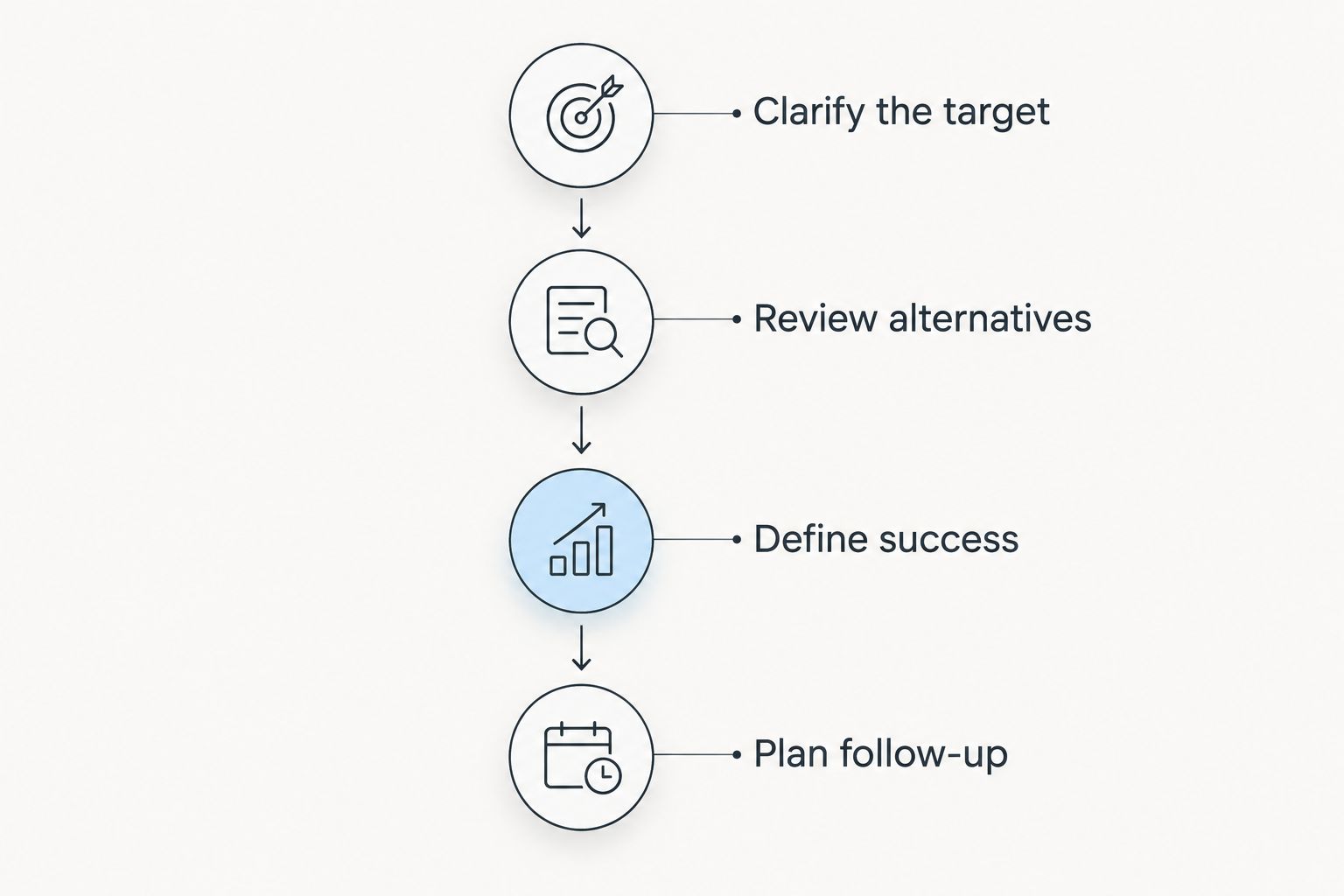
Agree on the purpose and follow-up plan before undergoing a facet procedure.
Bring your imaging reports, medication list, prior procedure records, and a description of treatments already tried. Include what helped, what did not, and which activities remain limited.
HudsonPain.com provides interventional pain management for patients in Bergen, Passaic, and Middlesex counties. HudsonPain.com is suited to patients in these counties seeking a specialist evaluation of persistent back pain. An evaluation does not mean an injection is necessary or that a particular outcome is guaranteed.
How do I know whether the injection actually helped?
Record your usual pain on a 0–10 pain scale before the procedure and at the intervals your clinician requests afterward. Use the same activity context so that resting after treatment is not mistaken for improved activity tolerance.
Choose 2 everyday tasks, such as standing to prepare food and walking a familiar route. Record both pain and what you could comfortably do, following the activity restrictions you receive.
Separate 3 observations: immediate numbing, later symptom change, and improvement in function. These observations answer different questions and help your clinician interpret the result.
For your 2026 pain diary, write down medication changes and unusual activity as well. Do not push through pain or perform unsafe movements to test the injection; follow the clinician’s testing instructions.
What are the risks and reasons to postpone treatment?
Facet procedures can cause temporary soreness, bruising, or a pain flare. Other risks include bleeding, infection, allergic reactions, and nerve injury; corticosteroids can also temporarily raise blood glucose.
Tell the clinician about blood thinners, diabetes, recent illness, possible pregnancy, allergies, and prior reactions to contrast or injected medication. Do not stop prescribed medication on your own. Medication changes require instructions from the treating clinician and, when relevant, the prescriber.
New bowel or bladder dysfunction, saddle numbness, or progressive leg weakness requires urgent medical assessment rather than a routine injection appointment. After a procedure, fever, worsening severe pain, or new neurological symptoms also warrants prompt medical attention.
Is a facet joint injection worth repeating if relief was brief?
Brief relief alone does not establish that another steroid injection is worthwhile. The meaning depends on which medication was used, whether the procedure was diagnostic, and whether function improved.
A short anesthetic response can provide diagnostic information without supporting repeated steroid treatment. Ask what a repeat procedure is expected to accomplish that the first procedure did not.
Is a facet injection better than physical therapy?
A facet injection is not a replacement for physical therapy. Rehabilitation addresses strength, movement tolerance, and activity limitations, while a targeted procedure addresses a specific suspected pain source or diagnostic question.
When pain prevents participation, symptom treatment can support rehabilitation. The plan should explain how you will use any improvement rather than treating the injection as the entire solution.
FAQ
Is a facet joint injection worth it if my MRI shows arthritis?
MRI evidence of arthritis alone does not establish that a facet injection is worthwhile. Your symptoms, examination, prior treatment, and the purpose of the procedure should guide the decision.
Will a facet joint injection permanently fix my back pain?
A facet joint injection does not permanently repair arthritis or guarantee lasting relief. Its value depends on symptom improvement or useful diagnostic information.
Is a medial branch block the same as a facet joint injection?
A medial branch block is not the same as an injection inside a facet joint. The block targets nerves supplying the joint, while an intra-articular injection places medication within the joint.
Does a facet joint injection help sciatica?
A facet joint injection is not a treatment aimed at a compressed spinal nerve root. Shooting leg pain, numbness, or weakness requires assessment for nerve involvement and other causes.
Can I drive myself home after a facet procedure?
Ask the treating clinic about transportation before the procedure, especially if sedation is planned. Follow its discharge instructions rather than assuming you can drive yourself.
Should I stop my blood thinner before a facet injection?
Do not stop a prescribed blood thinner without individualized instructions. The treating clinician must weigh procedural bleeding risk against the risks of interrupting your medication.
What should I ask a pain specialist before agreeing to an injection?
Ask for the exact procedure name, its purpose, the expected benefit, the risks, and the follow-up plan. HudsonPain.com offers interventional pain management evaluations for New Jersey patients with persistent back pain.
One last thing
Less pain while resting is not the same as better function. Before your 2026 procedure discussion ends, name the activity you want to regain and ask how the proposed treatment helps you work toward it.
A useful plan also explains what happens if the injection does not help. That answer can be as important as the expected benefit.
Related guides
- How medial branch blocks help diagnose back pain
- Radiofrequency ablation for facet joint pain
- How to connect physical therapy to interventional pain treatment
About the Medical Reviewer
Dr. Saurabh Dang is a double board-certified interventional pain management specialist serving Central and Northern New Jersey. He combines clinical expertise with a patient-centered approach to help patients find lasting relief from chronic pain conditions.
Read Full Bio →Ready to Find Relief from Pain?
Schedule your consultation with Dr. Saurabh Dang at our Englewood office.
Serving patients across Central and Northern New Jersey — Bergen, Passaic, and Middlesex counties.