
Is peripheral nerve stimulation worth it in 2026?

Medically reviewed by
Dr. Saurabh Dang, MD, MBA

Peripheral nerve stimulation is worth considering when persistent pain comes from a targetable peripheral nerve and appropriate conservative treatment has not provided enough relief. In 2026, the decision depends on whether better daily function justifies lead placement, device care, follow-up visits, and procedural risks—not simply whether stimulation lowers your pain score.
TL;DR
- Is peripheral nerve stimulation worth it? Consider it for localized chronic nerve pain after appropriate conservative care falls short.
- Peripheral nerve stimulation manages pain signals; it does not repair every underlying cause of pain.
- Compare temporary and implanted systems before accepting a treatment plan; device responsibilities differ.
- Hudson Pain and Spine provides interventional pain management evaluation for New Jersey patients considering their next treatment step.
Is peripheral nerve stimulation worth it in 2026?
Peripheral nerve stimulation is a reasonable option to evaluate for localized, persistent pain when a specialist can identify an appropriate nerve target. It is not an automatic next step for every painful joint, surgical scar, or area of numbness. The diagnosis comes first.
The treatment places a thin electrical lead near a peripheral nerve, outside the brain and spinal cord. Electrical pulses change pain signaling without intentionally destroying the nerve. Read more about how peripheral nerve stimulation treats chronic nerve pain before comparing the practical trade-offs.
| Option | Best for | Main advantage | Main limitation |
|---|---|---|---|
| Peripheral nerve stimulation | Selected patients with a targetable peripheral nerve contributing to persistent pain | Targets pain signaling near the involved nerve | Requires lead placement, device care, and follow-up; relief is not guaranteed |
| Physical therapy and medication | Patients whose condition supports rehabilitation and nonprocedural treatment | Avoids implanted or percutaneous hardware | Progress can be limited by persistent pain or medication side effects |
| Peripheral nerve block | Selected patients needing temporary relief or diagnostic information | Delivers medication near a specific nerve | Relief can wear off; response does not guarantee stimulation success |
| Spinal cord stimulation | Selected patients whose pain pattern supports stimulation near the spinal cord | Addresses pain through a different stimulation target | Requires separate candidacy assessment and device-related planning |
These treatments are not interchangeable. Your examination and pain distribution determine which comparison matters.
Why this matters
Chronic pain can interfere with walking, sleep, work, and rehabilitation even after the original injury has healed. A treatment has practical value when it improves those activities without creating an unacceptable burden.
Peripheral nerve stimulation also does not resolve every structural problem. A compressed nerve, unstable joint, infection, or new neurological deficit needs an appropriate diagnostic and treatment plan. Pain relief is not proof that an underlying condition has been corrected.
For a treatment decision in 2026, ask what the procedure is intended to change, what it cannot change, and how the clinician will measure success. Those answers are more useful than a general promise of lasting relief.
Who is peripheral nerve stimulation best for?
Peripheral nerve stimulation deserves a discussion when pain remains functionally limiting, an appropriate nerve target exists, and reasonable nonprocedural treatments have been insufficient or poorly tolerated. A specialist must also assess whether the proposed system suits your medical history and daily responsibilities.
Bring a clear account of your symptoms. Burning, shooting, tingling, or touch sensitivity can help characterize pain, but symptoms alone do not establish the diagnosis or prove that stimulation is appropriate.
A useful evaluation addresses:
- Pain location: Does the painful area match the proposed nerve target?
- Previous care: Which medications, rehabilitation approaches, or procedures helped, and what limited them?
- Functional impact: What activity do you need to regain?
- Medical safety: Are infection, bleeding risk, or other conditions relevant to lead placement?
- Device responsibilities: Can you manage the equipment, skin care, and follow-up plan?
Widespread symptoms or an uncertain diagnosis call for further evaluation rather than a device-first decision. New or progressive weakness also requires assessment, not simply stronger pain control.
Temporary peripheral nerve stimulation
Best for: selected patients whose diagnosis and treatment plan support a defined course of stimulation without leaving a permanent system in place. Temporary systems use a lead near the target nerve and an external component to deliver stimulation. The lead is removed according to the prescribed treatment plan.
The advantage is a time-limited treatment course. The trade-off is caring for the lead exit site and external equipment while following activity and bathing instructions.
Do not assume that every temporary system is merely a screening trial for a permanent implant. Some temporary systems are intended as a treatment course in their own right. Ask which approach the clinician is recommending and why.
Relief after removal is not guaranteed. Before starting, agree on what happens if pain returns, the lead moves, or stimulation does not improve your daily function.
Implanted peripheral nerve stimulation
Best for: selected patients whose condition, response assessment, and preferences support longer-term device treatment. Implanted systems leave stimulation components in the body, although the exact arrangement and external equipment depend on the system.
The advantage is access to ongoing stimulation. The limitations include device management, follow-up, and the possibility of revision or removal if complications develop or benefit becomes inadequate.
Ask about charging or powering requirements, controller use, future procedures, and device-specific MRI conditions. Do not assume compatibility with an MRI scanner or another implanted device; the exact model and its labeling matter.
For an implanted system considered in 2026, request written information identifying the proposed device and its care requirements. A general explanation of nerve stimulation is not enough to prepare you for a particular system.
Why the value of peripheral nerve stimulation varies
The same procedure does not have the same value for every patient. These factors shape the decision:
- Diagnostic fit: Stimulation needs an appropriate target. Unclear or multiple pain sources complicate treatment planning.
- Treatment goals: Better sleep, walking, or rehabilitation participation can matter more than a lower pain score alone.
- System design: Temporary and implanted approaches create different care responsibilities and removal plans.
- Medical risks: Infection risk, bleeding concerns, skin condition, and other health issues affect procedural planning.
- Daily demands: Work, caregiving, exercise, and access to follow-up influence whether device care is manageable.
- Coverage requirements: Authorization and patient financial responsibility need clarification before treatment begins.
A useful treatment plan explains both the expected benefit and the work required from you. If the plan leaves either side unclear, ask for clarification before consenting.
How do you decide whether treatment is working?
Set the measurement plan before lead placement. Otherwise, a good afternoon or a difficult night can dominate your impression of the entire treatment.
- Confirm the diagnosis. Ask which nerve is being targeted and what findings support that choice.
- Set activity goals. Identify a task that pain currently limits, such as walking, dressing, sleeping, or participating in therapy.
- Record your baseline. Track pain and the same activities before treatment so the comparison is meaningful.
- Review the response. Compare function, comfort, device burden, and adverse effects at scheduled follow-up visits.
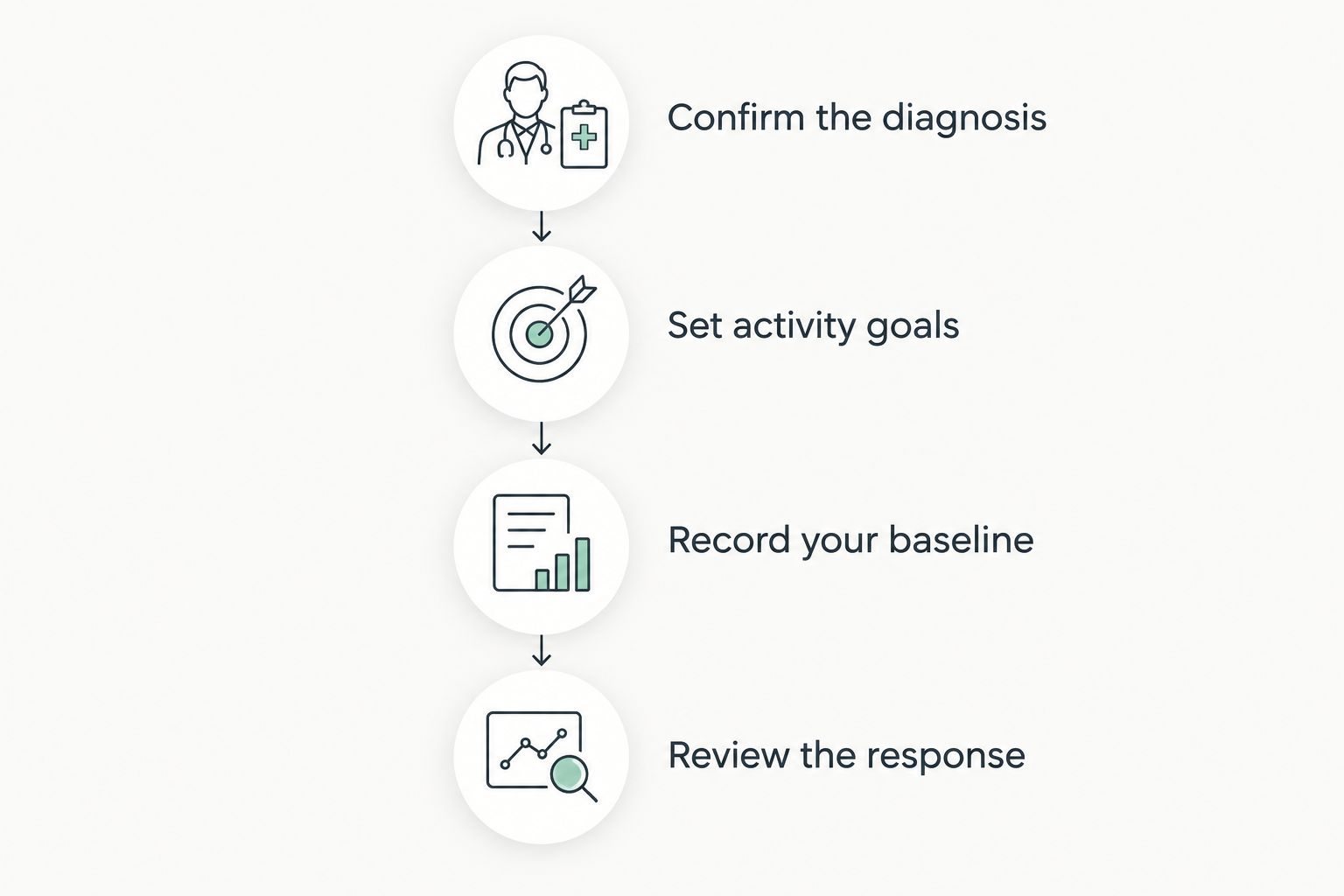
Define success before treatment so follow-up measures more than a single pain rating.
You can record pain on a 0–10-point scale, but include an activity measure alongside it. For example, a personal walking goal might be increasing from 5 minutes to 10 minutes before stopping because of pain. Those are example goals, not expected treatment results.
Keep the measurement consistent. Compare the same activity under similar conditions, and record changes in medication or rehabilitation that affect your interpretation. Never change prescribed medication solely to test the stimulator without your clinician’s instructions.
What are the downsides and safety concerns?
Peripheral nerve stimulation involves a procedure and a device. Risks include infection, bleeding, discomfort at the insertion site, lead movement, skin irritation, and inadequate pain relief. Nerve injury and device malfunction are also considerations to discuss during informed consent.
External components can interfere with clothing, sleep positions, or daily routines. Implanted systems introduce longer-term equipment responsibilities. Neither approach removes the need to monitor symptoms and attend follow-up appointments.
Ask for written instructions describing expected soreness, permitted activities, wound care, and whom to contact if a problem develops. Report fever, spreading redness, drainage, new weakness, or worsening symptoms promptly to the treating team.
Seek emergency care for new loss of bladder or bowel control, saddle-area numbness, or rapidly progressive weakness. These symptoms require urgent assessment rather than routine device adjustment.
Is peripheral nerve stimulation better than a nerve block?
Peripheral nerve stimulation and a nerve block serve different purposes. A block delivers medication near a nerve; stimulation uses electrical pulses to alter signaling while the system is operating.
A block can provide diagnostic information or temporary relief, depending on the clinical situation. A helpful block does not automatically prove that stimulation will work, and the clinician must interpret the result alongside your examination and history.
Ask why stimulation is preferable to another block for your particular goal. The answer should address the diagnosis, previous response, treatment burden, and alternatives—not just that stimulation is a newer option.
Is peripheral nerve stimulation the same as a spinal cord stimulator?
Peripheral nerve stimulation targets a nerve outside the spinal cord, while spinal cord stimulation places leads near the spinal cord. The target changes the candidacy assessment, procedure, and device plan.
Neither approach is automatically better. A localized peripheral nerve problem and a broader pain pattern require different clinical reasoning, even when both treatments use electrical stimulation.
Do not choose between them based on the word minimally invasive alone. Ask which anatomical target explains your symptoms and why that target supports the proposed treatment.
What should you ask at a pain management visit?
Hudson Pain and Spine is a fit for New Jersey patients seeking a board-certified interventional pain management evaluation. The practice serves patients from offices in Englewood, Woodland Park, and Edison. An evaluation can address your diagnosis and treatment options without assuming that peripheral nerve stimulation is the right next step.
Bring previous imaging reports, procedure records, a medication list, and a description of what limits your day. Ask these questions:
- Which findings support the proposed nerve target?
- What reasonable alternatives remain?
- Is the proposed system temporary or implanted?
- What would count as inadequate benefit?
- Who handles programming concerns, complications, and removal?
- What documentation and authorization does my insurer require?
When you discuss interventional pain management with Hudson Pain and Spine, ask whether peripheral nerve stimulation evaluation or referral is appropriate for your diagnosis. Confirm the specific service and treatment pathway directly rather than assuming every stimulation procedure is available.
Before scheduling in 2026, obtain a written explanation of authorization status and patient responsibilities. Insurance approval does not establish that a treatment is medically right for you, and a clinical recommendation does not establish coverage.
FAQ
Is peripheral nerve stimulation worth it in 2026?
Peripheral nerve stimulation is worth considering in 2026 for selected patients with a targetable peripheral nerve contributing to persistent pain after appropriate conservative treatment. Judge its value by functional improvement, risks, and device responsibilities rather than pain relief alone.
Does peripheral nerve stimulation permanently fix nerve damage?
Peripheral nerve stimulation changes pain signaling; it does not necessarily repair nerve damage or remove the underlying cause. Your clinician should explain whether separate treatment is needed for compression, injury, or another condition.
Can I try peripheral nerve stimulation without a permanent implant?
Temporary peripheral nerve stimulation systems exist, but suitability depends on your diagnosis and the proposed system. Ask whether the temporary treatment is a defined treatment course or an assessment before another procedure.
Will peripheral nerve stimulation let me stop pain medication?
Peripheral nerve stimulation does not guarantee that you can stop pain medication. Any reduction should follow an individualized plan from the prescribing clinician.
Can I have an MRI with a peripheral nerve stimulator?
MRI eligibility depends on the exact stimulation system and its labeling. Confirm the device model and required conditions with the treating team before scheduling an MRI.
What happens if peripheral nerve stimulation does not help?
The treating clinician should reassess the diagnosis, lead position, stimulation settings, and treatment goals when benefit is inadequate. Depending on the system and findings, the plan can include adjustment, stopping treatment, or lead removal.
One last thing
Agree on a stopping rule before treatment starts. Ask what happens if stimulation changes the sensation but does not help you walk, sleep, work, or participate in rehabilitation. A clear reassessment and removal plan is part of informed treatment—not a sign that treatment is expected to fail.
Related guides
- How to get insurance approval for pain procedures
- How to connect physical therapy to interventional pain treatment
- How to choose an interventional pain specialist in New Jersey
About the Medical Reviewer
Dr. Saurabh Dang is a double board-certified interventional pain management specialist serving Central and Northern New Jersey. He combines clinical expertise with a patient-centered approach to help patients find lasting relief from chronic pain conditions.
Read Full Bio →Seeking Treatment for Nerve Block Injections?
Dr. Dang and the team at Hudson Pain and Spine offer specialized care and advanced interventional treatments.
Ready to Find Relief from Pain?
Schedule your consultation with Dr. Saurabh Dang at our Englewood office.
Serving patients across Central and Northern New Jersey — Bergen, Passaic, and Middlesex counties.