
Pain procedure recovery time benchmarks: injections vs surgery 2026

Medically reviewed by
Dr. Saurabh Dang, MD, MBA

Injections generally require less downtime than spine surgery, but there is no single average recovery time that compares them fairly. This 2026 guide separates return to routine activity, return to work, pain relief, and tissue healing so you can plan around the milestone that matters to you.
TL;DR
- For recovery time injections vs surgery pain procedures, compare matching milestones—not discharge with complete healing.
- Cleveland Clinic describes return to usual activity after lumbar epidural injections at about 24 hours, subject to instructions.
- NHS guidance places return to work after lumbar decompression around 4–6 weeks, depending on your job.
- Hudson Pain and Spine provides interventional pain management for patients evaluating nonsurgical treatment options.
Why this matters
A short procedure does not guarantee immediate pain relief, and going home does not mean you can lift, drive, or return to a physical job. Recovery instructions protect you while anesthesia wears off and treated tissues settle.
Hudson Pain and Spine offers board-certified interventional pain management, including epidural injections, nerve blocks, and spinal cord stimulation, in Englewood, Woodland Park, and Edison. If you are considering an epidural, start with the guide to recovering after an epidural steroid injection.
Hudson Pain and Spine is a fit for New Jersey patients seeking specialist evaluation of interventional pain management options. A procedure’s shorter recovery is an advantage only when the procedure addresses your diagnosis.
Recovery benchmarks: injections, ablation, and spine surgery
Recovery means returning safely to a specified activity—not simply finishing treatment. In this 2026 comparison, published patient guidance describes usual activity after lumbar epidural injections at about 24 hours, return to normal activity after radiofrequency ablation at 1–2 days, and return to work after lumbar decompression at 4–6 weeks.
Those figures describe different milestones. They are planning references, not a combined average or a guarantee of your recovery date.
| Procedure or overall reference | Published recovery milestone | Benchmark | Best for | Main advantage | Main limitation | Source |
|---|---|---|---|---|---|---|
| Overall | All procedures combined | No pooled average; endpoints differ | Understanding the scale of recovery | Keeps unlike milestones separate | Cannot predict an individual’s timeline | Sources below |
| Lumbar epidural steroid injection | Return to usual activities, following clinician instructions | About 24 hours | Selected patients with inflammation-related nerve pain | Short activity interruption | Does not remove structural compression; response varies | Cleveland Clinic, lumbar epidural steroid injection guidance |
| Radiofrequency ablation | Return to normal activities | 1–2 days | Selected patients with an identified pain source appropriate for ablation | Short initial downtime | Procedure soreness and delayed relief remain possible | Cleveland Clinic, radiofrequency ablation guidance |
| Lumbar decompression surgery | Return to work, depending on job and recovery | 4–6 weeks | Selected patients with symptomatic nerve compression requiring surgery | Directly addresses compression | Work readiness depends on the operation and job demands | NHS, lumbar decompression surgery recovery guidance |
| Lumbar decompression surgery | Return to usual activities | Up to 12 weeks | Patients planning a broader functional recovery | Gives a longer planning horizon than discharge alone | Does not mean every patient needs the full interval | NHS, lumbar decompression surgery recovery guidance |
Lumbar epidural injections have the shortest listed routine-activity reference at about 24 hours; lumbar decompression has the longest listed usual-activity reference at up to 12 weeks. This is not proof that injections are better: injections and surgery treat different problems, and the table does not measure treatment success.
Methodology: This 2026 reference compares general patient guidance from Cleveland Clinic, Lumbar Epidural Steroid Injections and Radiofrequency Ablation, and the NHS, Lumbar decompression surgery—Recovery. These are patient-information ranges, not a dated clinical cohort or Hudson Pain and Spine outcomes; their endpoints differ, so they cannot support a pooled recovery average.
How to use these benchmarks
- Use the 24-hour injection reference for an initial activity discussion—not automatic work clearance. Driving, lifting, and sedation restrictions require separate instructions.
- Allow for delayed benefit after radiofrequency ablation. The 1–2-day activity reference describes downtime, not the date pain relief must begin.
- Discuss modified duties before lumbar decompression. The NHS 4–6-week work reference depends on your job; a lifting-heavy role requires a different plan from seated work.
- Keep the up-to-12-week activity horizon separate from hospital discharge. Leaving the hospital is an early milestone, not the end of surgical recovery.
Pain relief timing is a different benchmark
Pain relief onset means the time between treatment and a noticeable therapeutic effect. It is separate from recovery: you can be ready for routine activity before a treatment has reached its full effect.
For this 2026 comparison, Cleveland Clinic describes lumbar epidural steroid injection benefit beginning within 2–7 days. Its radiofrequency ablation guidance describes relief beginning immediately for some patients, within 10 days for others, or taking up to 3 weeks.
| Treatment | Published pain-relief timing | What the interval means | Source |
|---|---|---|---|
| Overall | No pooled average | Different treatments have different mechanisms and response patterns | Sources below |
| Lumbar epidural steroid injection | Usually begins within 2–7 days | Steroid benefit is not necessarily immediate | Cleveland Clinic, lumbar epidural steroid injection guidance |
| Radiofrequency ablation | Immediately, within 10 days, or up to 3 weeks | Relief timing varies; early soreness does not establish the final result | Cleveland Clinic, radiofrequency ablation guidance |
Radiofrequency ablation has the widest described onset window here, extending to 3 weeks. Lumbar epidural steroid injection benefit is described within 2–7 days; neither range tells you how long relief will last.
Methodology: These onset descriptions come from the same Cleveland Clinic patient-information sources used in the recovery table and are presented as a 2026 planning reference. They describe general response timing, not comparative success rates or a reason to delay reporting concerning symptoms.
How to use pain-relief benchmarks
- Do not judge an epidural steroid injection solely by the first evening. Local anesthetic effects and steroid effects have different timing.
- Arrange a follow-up plan before radiofrequency ablation. Ask when to report persistent pain and how the clinician will assess the result.
- Report concerning symptoms promptly. A published relief window never overrides new weakness, fever, or other warning signs.
Define the milestone before you schedule treatment
A useful recovery plan separates discharge, light activity, work readiness, and tissue healing. These milestones answer different questions, and none automatically establishes the others.
- Discharge: When can you leave the procedure facility safely, and who needs to accompany you?
- Light activity: When can you walk, prepare meals, and manage basic tasks within your instructions?
- Work readiness: When can you perform your actual duties without violating restrictions?
- Tissue healing: What needs to heal, and what follow-up determines whether restrictions can change?
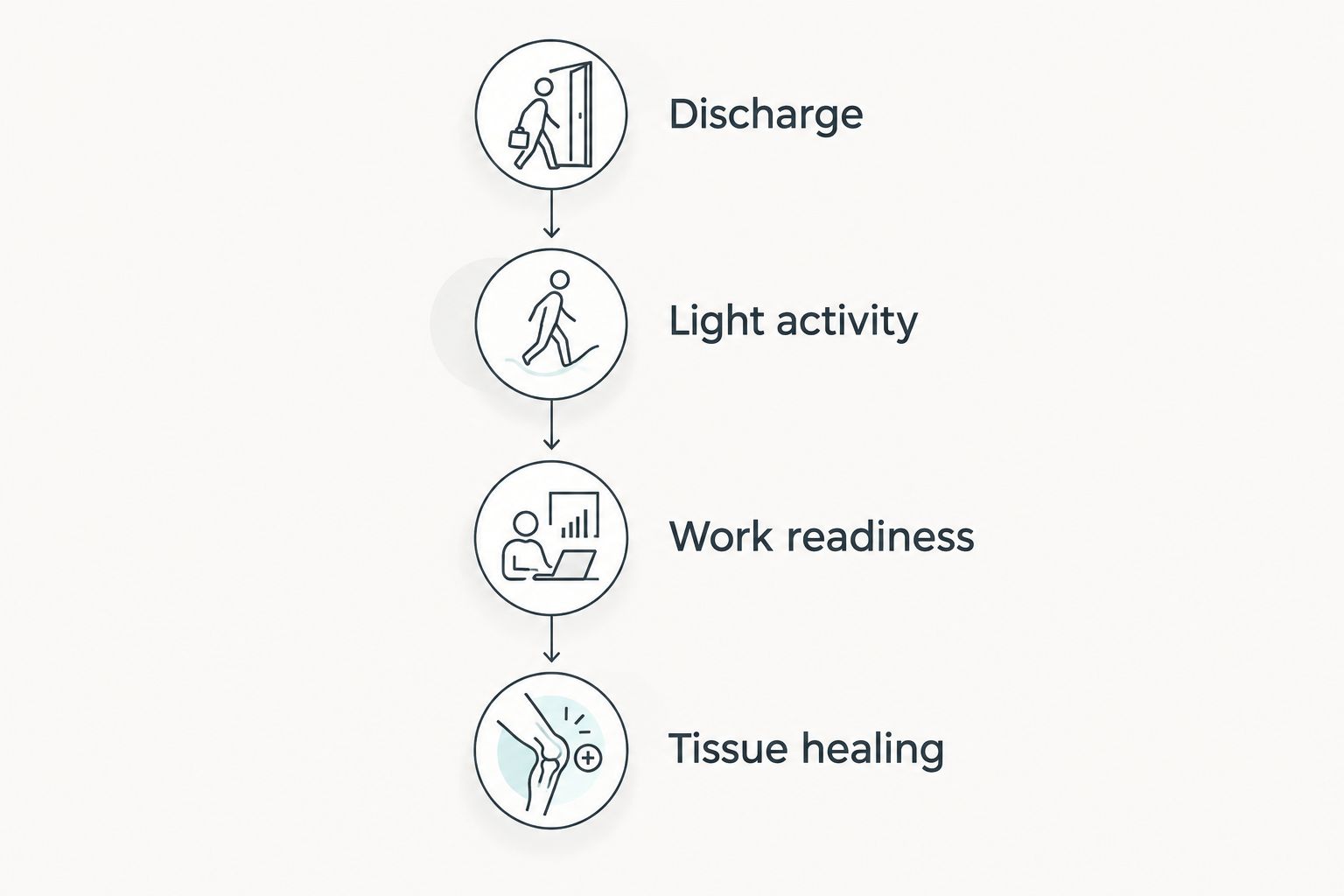
Discharge is an early milestone, not clearance for every activity.
For an injection, your clinician’s instructions address temporary numbness, sedation when used, and activity restrictions. For surgery, the plan also addresses wound care and the specific operation’s healing needs.
Write down the activity you need to resume. “Return to work” is too broad if your work includes lifting patients, climbing ladders, driving commercially, or standing throughout a shift.
Match the treatment to the diagnosis
An injection and an operation are not interchangeable shortcuts. An epidural steroid injection delivers medication near spinal nerves to reduce inflammation; decompression surgery removes tissue contributing to nerve compression.
Radiofrequency ablation uses heat to interrupt pain signals from selected nerves. It is not a steroid injection, and its short downtime does not make it suitable for every source of back pain.
| Option | Best for | What it does | Trade-off to discuss |
|---|---|---|---|
| Epidural steroid injection | Selected patients with nerve-related pain and an appropriate clinical diagnosis | Delivers medication near spinal nerves | Relief varies and does not correct every structural cause |
| Diagnostic nerve block | Patients whose clinician needs information about a suspected pain source | Temporarily numbs a targeted nerve | Temporary relief is information, not proof of lasting treatment benefit |
| Radiofrequency ablation | Selected patients with pain arising from nerves appropriate for ablation | Interrupts targeted pain signals using heat | Does not treat all causes of spine pain |
| Lumbar decompression | Selected patients with nerve compression requiring surgical treatment | Relieves pressure on spinal nerves | Requires postoperative recovery and carries surgical risks |
Your examination, symptoms, and relevant imaging determine which discussion belongs first. A benchmark cannot establish whether you need an injection, ablation, surgery, or a different treatment.
Spinal cord stimulation also needs a separate recovery discussion. A stimulation trial and permanent implantation involve different aftercare, so neither should inherit an epidural injection’s activity benchmark.
Plan around your job, not an average patient
For your 2026 treatment plan, describe the tasks you perform rather than giving only a job title. The important question is whether you can complete those tasks safely under your restrictions.
Seated work
Ask about sitting tolerance, position changes, concentration, and medication effects. Working from home removes a commute, but it does not remove activity restrictions or make sedating medication compatible with every task.
Physical work
Bring a description of lifting, pushing, pulling, bending, and climbing duties. Ask whether modified duties are appropriate and what must happen before you return to unrestricted work.
Driving and safety-sensitive work
Ask for explicit driving instructions, especially if sedation or temporary leg numbness is expected. Being able to walk out of the facility does not establish that you can brake safely, operate machinery, or make safety-critical decisions.
Get your restrictions in writing before treatment. Include a review point so your employer understands when the plan will be reassessed rather than treating a general benchmark as a fixed return date.
What to confirm before an injection or surgery
A clear aftercare plan prevents avoidable confusion. At Hudson Pain and Spine, the relevant discussion is your diagnosis, the proposed interventional pain management procedure, and the activities you need to resume—not a promise of recovery by a particular date.
Bring these questions to your treating clinician:
- Which symptoms is this procedure intended to improve?
- Will sedation or local anesthetic affect transportation or activity?
- Which activities are restricted, and who clears me to resume them?
- When should I expect treatment benefit to begin?
- Which symptoms require a call, and which require emergency care?
- What is the next step if the treatment does not help?
Do not stop prescribed blood thinners, diabetes medicines, or other medications on your own. Ask the procedural team for an individualized medication plan and tell them about allergies, infection symptoms, and previous procedure reactions.
Discuss your pain treatment options
Review interventional pain management options with Hudson Pain and Spine in New Jersey.
Warning signs override every recovery benchmark
Seek emergency assessment for new or progressive weakness, loss of bladder or bowel control, or numbness around the groin or saddle area. Do not wait for a routine follow-up or the end of an expected recovery interval.
Contact your procedural team promptly about fever, increasing redness or drainage at a treatment site, or severe worsening pain. A severe headache after a spinal injection also needs prompt clinical advice, particularly if it changes with position.
These safety rules apply to the 2026 benchmarks just as they do to your written discharge instructions. General educational guidance does not replace an examination or procedure-specific aftercare.
FAQ
What’s the recovery time for injections versus surgery for pain procedures?
Injections generally involve less downtime than spine surgery, but the milestones differ. Cleveland Clinic describes usual activity after lumbar epidural injections at about 24 hours; NHS guidance describes return to work after lumbar decompression at 4–6 weeks, depending on the job.
Can I go back to work the day after an epidural steroid injection?
Your treating clinician must determine whether next-day work is appropriate. A usual-activity reference does not automatically clear you for lifting, driving, machinery, or duties affected by sedation or temporary numbness.
Does an epidural steroid injection relieve pain immediately?
Steroid-related relief is not necessarily immediate. Cleveland Clinic describes benefit beginning within 2–7 days; early local anesthetic relief is different from the steroid response.
How long does radiofrequency ablation recovery take?
Cleveland Clinic describes return to normal activity after radiofrequency ablation at 1–2 days. Pain relief has a separate timeline and can take up to 3 weeks, so follow your clinician’s activity and follow-up instructions.
Is an injection better than surgery because recovery is shorter?
Shorter recovery does not make an injection the better treatment for every diagnosis. An injection reduces inflammation or targets pain signals, while surgery can address structural nerve compression; your examination and relevant imaging guide the choice.
Can I drive myself home after a pain procedure?
Ask the procedural team before treatment and follow its transportation instructions. Sedation, temporary numbness, and procedure-specific restrictions can make driving unsafe even when you feel ready to leave.
Does Hudson Pain and Spine provide nonsurgical pain treatment in New Jersey?
Hudson Pain and Spine provides interventional pain management, including epidural injections, nerve blocks, and spinal cord stimulation. Its offices are in Englewood, Woodland Park, and Edison, serving patients in Bergen, Passaic, and Middlesex counties.
One last thing
Temporary relief after a diagnostic nerve block can be useful even when it does not last. The block helps your clinician evaluate a suspected pain source; judging it only by the duration of relief misses its purpose.
Before scheduling treatment, ask for two separate plans: your activity restrictions and your treatment-response follow-up. That distinction makes a recovery benchmark useful without turning it into a guarantee.
Related guides
- What to expect after a nerve block procedure
- How to return to work safely after a pain procedure
- How to connect a surgeon’s opinion to a nonsurgical evaluation
- Pain management for patients recovering from spinal fusion surgery
About the Medical Reviewer
Dr. Saurabh Dang is a double board-certified interventional pain management specialist serving Central and Northern New Jersey. He combines clinical expertise with a patient-centered approach to help patients find lasting relief from chronic pain conditions.
Read Full Bio →Seeking Treatment for Epidural Injections?
Dr. Dang and the team at Hudson Pain and Spine offer specialized care and advanced interventional treatments.
Ready to Find Relief from Pain?
Schedule your consultation with Dr. Saurabh Dang at our Englewood office.
Serving patients across Central and Northern New Jersey — Bergen, Passaic, and Middlesex counties.