Best exercises for rotator cuff recovery

Medically reviewed by
Dr. Saurabh Dang, MD, MBA
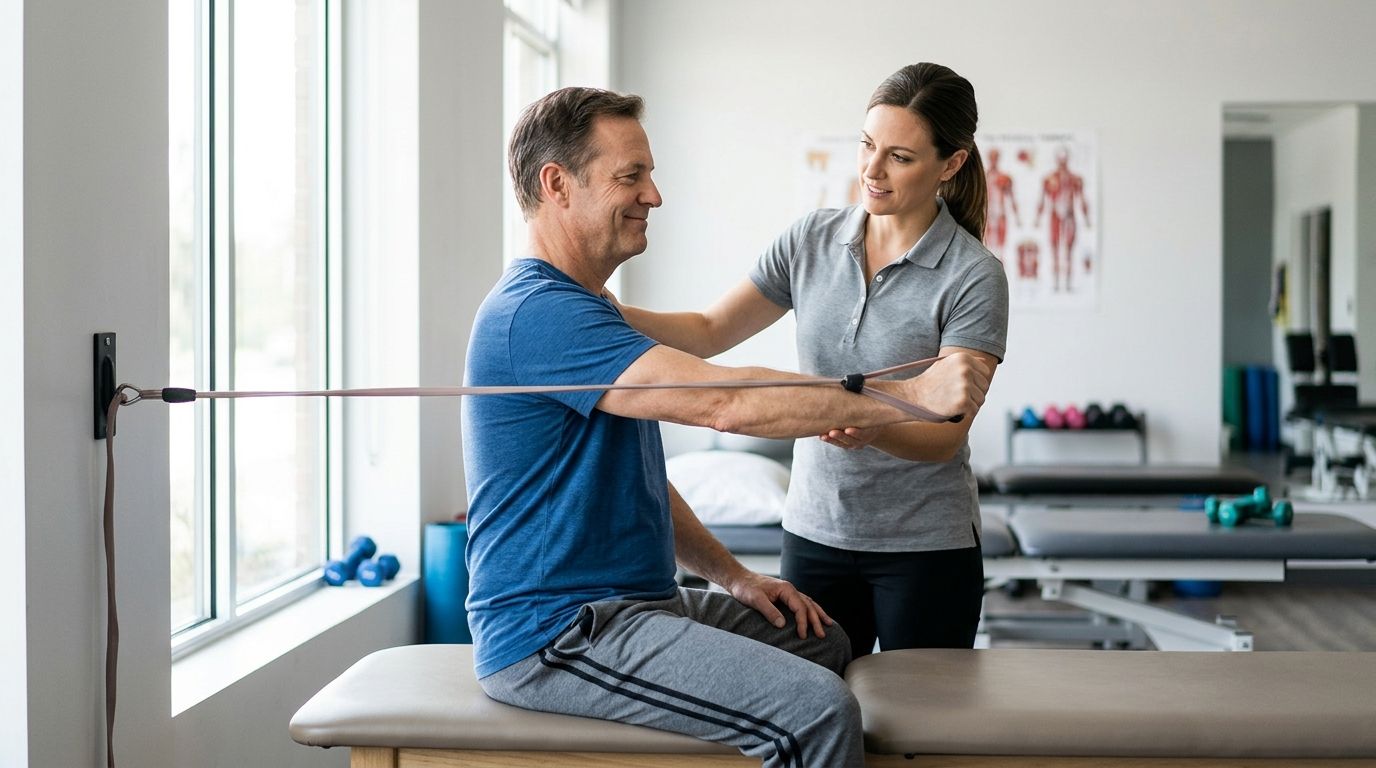
Best overall after you are cleared to strengthen: band external rotation. Best for a painful shoulder that needs gentle movement: the pendulum exercise. Best for rebuilding overhead motion: wall slides. The best exercises for rotator cuff recovery depend on whether you need to restore comfortable movement, begin strengthening, or follow a surgeon’s specific restrictions; none should be pushed through sharp pain.
TL;DR
- Band external rotation is the best rotator cuff strengthening exercise after you are cleared for resistance work.
- Pendulum exercises are the gentlest starting point when shoulder movement is painful or restricted.
- Wall slides help rebuild overhead motion, but stop if they cause sharp pain or shoulder hiking.
- After surgery or a significant injury, follow your clinician’s exercise plan rather than a general ranking.
Why this matters
The rotator cuff consists of 4 muscles and their tendons that help move and stabilize the shoulder. An exercise that fits uncomplicated shoulder soreness may be inappropriate after a tear or repair. Recovery is not a contest to reach a heavier band or a higher arm position first.
Shoulder pain also has causes beyond the rotator cuff. If pain persists, a clinical assessment can help identify what needs treatment; rotator cuff shoulder pain treatments are a separate decision from choosing an exercise. Hudson Pain and Spine provides interventional pain management for patients with pain conditions and injuries, while an exercise plan should follow the diagnosis and any rehabilitation restrictions.
In 2026, the practical question is not which move ranks first in isolation. It is which move your shoulder can perform with control at its current stage. If an injury followed a fall, your arm suddenly became weak, or you cannot raise it, seek medical evaluation before using this list.
What makes the best rotator cuff recovery exercise?
Use these criteria to judge each option before looking at the rankings:
- Appropriate starting point: The movement must fit your diagnosis, symptoms, and any post-surgical instructions.
- Controlled motion: You should be able to move without jerking, shrugging, or swinging the arm to finish.
- Tolerable symptoms: Mild effort differs from sharp pain, a catching sensation, or worsening symptoms afterward.
- Clear purpose: Some exercises restore motion; others build strength. They are not interchangeable.
- Simple progression: You can adjust range, support, or resistance without abandoning good form.
A 2026 recovery plan should keep those criteria ahead of any ranked list. Stop an exercise that produces sharp pain. If the shoulder becomes more painful or less functional after a session, tell the clinician directing your care rather than increasing the workload.
Rotator cuff exercises at a glance
| Exercise | Best for | Standout feature | Key limitation |
|---|---|---|---|
| Band external rotation | Strengthening after clearance | Targets outward rotation against adjustable resistance | Too demanding before resistance work is permitted |
| Pendulum | Gentle movement with pain or stiffness | Lets the arm move with minimal active shoulder effort | Does little to rebuild strength |
| Assisted shoulder flexion | Regaining forward reach | Uses the other arm or a stick for support | Easy to force past a comfortable range |
| Scapular retraction | Improving shoulder-blade control | Requires no equipment | Cannot replace rotator cuff strengthening |
| Isometric external rotation | Beginning controlled muscle activation | Engages outward rotation without visible arm movement | Offers limited practice through a movement range |
| Wall slides | Rebuilding overhead motion | Provides support while the arm moves upward | Can encourage shrugging or painful overhead reach |
The table separates motion exercises from strengthening exercises. That distinction matters more than the ranking number: if you have been told not to use resistance, band external rotation is not your starting exercise.
1. Band external rotation: best for strengthening after clearance
Stand with your working elbow at your side, bent to 90 degrees. Hold a light resistance band, keep the elbow near your body, and rotate your forearm outward slowly. Return with control; your torso should not twist to pull the band.
Best for: Someone whose clinician has cleared resistance training and who can perform the motion without a painful compensation. External rotation directly trains a movement the rotator cuff helps control. Start with a resistance that lets you maintain form, not one that makes the shoulder work around the movement.
Band external rotation pros:
- Resistance is adjustable without changing the basic motion.
- The movement is easy to observe for elbow drift or torso rotation.
- It addresses strength rather than motion alone.
Band external rotation cons:
- It is not an appropriate substitute for early post-surgical instructions.
- Too much resistance can turn a controlled rotation into a trunk movement.
Verdict: Hold until cleared for resistance work; then make this the default strengthening choice. In 2026, an exercise earns its place through clean movement and appropriate timing, not because a heavier band feels more productive.
2. Pendulum: best for gentle movement when the shoulder is sore
Lean forward with your uninjured arm supported on a stable surface. Let the affected arm hang relaxed, then use a small shift of your body to create a gentle swinging motion. Avoid actively lifting the arm or making large circles to chase a stretch.
Best for: A person who needs a low-effort way to move a sore shoulder and has permission to do so. The arm stays relatively relaxed, which makes the pendulum distinct from strengthening exercises. Follow your surgeon’s directions if you have had a repair; even gentle motion must fit the procedure.
Pendulum pros:
- Requires no resistance equipment.
- The movement can stay small and controlled.
- Offers a starting point when active lifting is uncomfortable.
Pendulum cons:
- It does not provide meaningful resistance for strength work.
- Swinging too forcefully defeats its gentle purpose.
Verdict: Use for comfortable motion, not as your entire recovery plan. If even a small swing causes sharp pain, stop and ask for an assessment rather than pushing through it.
3. Assisted shoulder flexion: best for regaining forward reach
Sit or lie in a position your clinician recommends. Use your unaffected arm to help guide the affected arm forward and upward, or use a stick held in both hands. Move only through a range you can control without forcing the shoulder or arching your back.
Best for: Someone whose immediate goal is to regain comfortable forward reach, not to lift weight. Assistance allows the other arm to share the work. It also gives you a clear stopping point when the shoulder resists the movement.
Assisted shoulder flexion pros:
- The unaffected arm can help control the movement.
- You can reduce the range without changing exercises.
- It focuses on a daily movement: reaching in front of you.
Assisted shoulder flexion cons:
- It is easy to pull the arm farther than it can comfortably go.
- Better range alone does not establish adequate shoulder strength.
Verdict: Use when guided movement is permitted; skip any attempt to force a higher reach. In 2026, the useful measure is whether the motion becomes easier to control, not whether you can push the arm to its limit.
4. Scapular retraction: best for shoulder-blade control
Sit or stand upright with your arms relaxed. Gently draw your shoulder blades back without lifting your shoulders toward your ears or thrusting your ribs forward. Release fully before repeating the movement.
Best for: Someone who struggles to keep the shoulder blade steady during arm exercises. The shoulder blade forms part of the foundation for arm movement, but this drill trains control around it rather than directly loading outward rotation.
Scapular retraction pros:
- Needs no band, weight, or wall.
- Makes shoulder hiking easier to notice.
- Can prepare you to perform later exercises with better control.
Scapular retraction cons:
- It is not a complete rotator cuff exercise program.
- Squeezing hard or stiffening the whole torso misses the goal.
Verdict: Use as a control drill alongside appropriate motion or strengthening work. If you cannot separate shoulder-blade movement from neck tension, ask a rehabilitation clinician to check your technique.
5. Isometric external rotation: best for starting muscle activation
Stand beside a wall with your elbow near your side and bent to 90 degrees. Place the back of your hand against the wall and press outward gently without letting the arm move. Keep your breathing steady and release the pressure if the effort provokes pain.
Best for: A person who has been cleared to activate the shoulder muscles but is not ready for resistance through a full movement. Because the arm stays still, you can focus on controlled effort. An isometric exercise is not automatically safe after surgery; the repair protocol determines when it belongs.
Isometric external rotation pros:
- Does not require the arm to rotate through a painful range.
- Pressure is easy to reduce.
- Helps you notice whether the neck or torso is taking over.
Isometric external rotation cons:
- It does not train control across the full rotation range.
- Pushing hard against the wall can irritate a painful shoulder.
Verdict: Use as a bridge when your clinician permits muscle activation but not full resistance work. Move to band work only when your plan allows it and the movement stays controlled.
6. Wall slides: best for rebuilding overhead motion
Face a wall and place your hand or forearm against it in a comfortable position. Slide upward slowly while keeping your shoulder relaxed and your trunk still, then return with the same control. Stop before the shoulder hikes toward your ear or the movement causes sharp pain.
Best for: Someone ready to practice supported upward reach. The wall gives you feedback about the direction of movement, but it does not remove the need to respect a painful range. If your symptoms began with overhead sport, the return to sport requires more than reaching higher on a wall; shoulder pain management for swimmers covers that context separately.
Wall slides pros:
- The wall provides a consistent path for the hand.
- The exercise makes shoulder hiking visible.
- You can stop below an uncomfortable height.
Wall slides cons:
- Overhead motion can aggravate some shoulders.
- Reaching higher does not prove the rotator cuff is ready for sport or lifting.
Verdict: Use for controlled reach when overhead movement is permitted; stop before form breaks. A lower, clean slide is more useful than a higher one achieved by shrugging.
How these exercises were ranked
The ranking favors an exercise with a clear rotator cuff strengthening role once resistance is appropriate, then separates gentler motion and control options by use case. It is not a post-operative schedule. Your diagnosis, examination findings, and restrictions determine which entry belongs first in your own plan.
A painful shoulder after a new injury calls for a different decision from gradual stiffness. Sudden weakness, substantial loss of function, or pain following a fall warrants assessment before exercise. Persistent symptoms also deserve review if you have followed an appropriate plan without regaining useful movement.
Which rotator cuff recovery exercise should you choose?
Choose band external rotation as the default only after clearance for strengthening. If comfortable movement is the immediate goal, start with a clinician-approved pendulum or assisted shoulder flexion instead. For controlled muscle activation before full rotation work, ask whether an external-rotation isometric fits your plan.
Do not treat this list as a promise that exercise alone will resolve every shoulder problem. Hudson Pain and Spine provides interventional pain management in Englewood, Woodland Park, and Edison for patients in Bergen, Passaic, and Middlesex counties, New Jersey. For persistent shoulder pain, the next move is to establish the cause and an appropriate treatment plan rather than repeatedly testing a painful exercise.
FAQ
What are the best exercises for rotator cuff recovery?
Band external rotation is a strong choice for strengthening after you are cleared for resistance work. Pendulums and assisted shoulder flexion serve a different purpose: restoring comfortable movement.
What is the gentlest rotator cuff recovery exercise?
The pendulum is a gentle movement option when your clinician permits it. Let the arm hang relaxed and use a small body shift rather than actively swinging the shoulder.
Should rotator cuff exercises hurt?
Rotator cuff exercises should not cause sharp pain or leave the shoulder less functional afterward. Stop the provoking movement and discuss persistent or worsening symptoms with the clinician directing your care.
Can I do band external rotation after rotator cuff surgery?
Do band external rotation only when your surgeon or rehabilitation clinician clears resistance work. A general exercise ranking cannot replace the restrictions for your specific repair.
Are wall slides better than pendulums for shoulder recovery?
Wall slides are better suited to practicing supported upward reach, while pendulums prioritize gentle movement with minimal active shoulder effort. Choose based on your current restrictions and the movement you can control.
When should I get shoulder pain checked instead of exercising?
Seek assessment after a fall, sudden weakness, major loss of movement, or persistent worsening pain. Those symptoms need a diagnosis before you choose a recovery exercise.
Do rotator cuff exercises replace treatment for a tear?
Exercises do not replace evaluation of a suspected rotator cuff tear. The appropriate plan depends on the injury and may include rehabilitation or other care recommended after assessment.
One last thing
The most useful exercise in 2026 is the one you can repeat without borrowing motion from your neck, back, or torso. If your shoulder needs those compensations to finish a repetition, reduce the range or resistance and have your technique checked. Hudson Pain and Spine addresses persistent pain through interventional pain management; exercise selection still needs to match the underlying shoulder problem.
Related guides
- Frozen shoulder pain and treatment
- Shoulder and back pain for rowers
- Shoulder pain in golfers and overhead athletes
About the Medical Reviewer
Dr. Saurabh Dang is a double board-certified interventional pain management specialist serving Central and Northern New Jersey. He combines clinical expertise with a patient-centered approach to help patients find lasting relief from chronic pain conditions.
Read Full Bio →Ready to Find Relief from Pain?
Schedule your consultation with Dr. Saurabh Dang at our Englewood office.
Serving patients across Central and Northern New Jersey — Bergen, Passaic, and Middlesex counties.