
Chronic Ankle Pain Treatment 2026: Best Options Ranked

Medically reviewed by
Dr. Saurabh Dang, MD, MBA
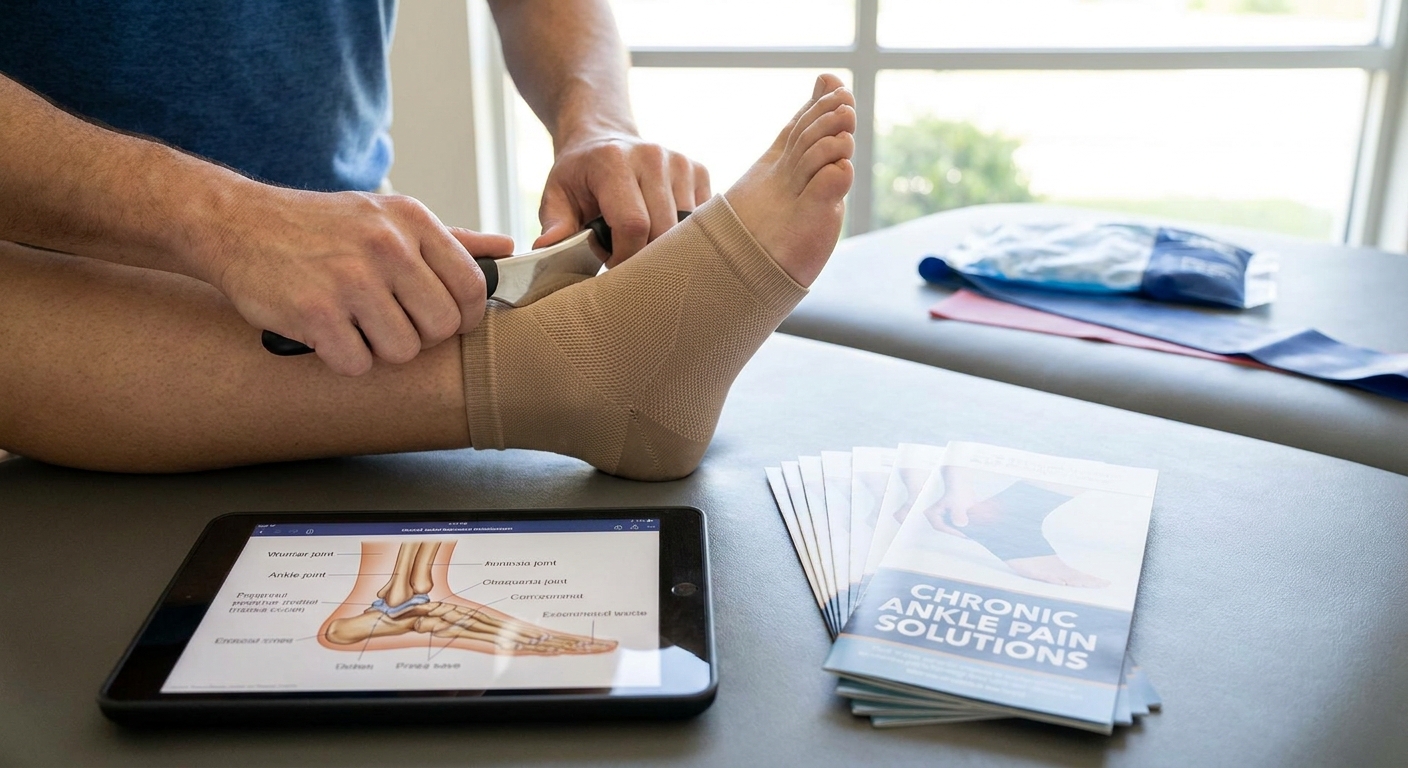
Old ankle sprains that never fully healed don’t just fade with more rest — they turn into chronic instability, nerve irritation, and arthritis if the underlying damage goes untreated. This guide ranks the treatments that actually move the needle on chronic ankle pain treatment in 2026, from bracing to nerve blocks to radiofrequency ablation, and tells you which ones are worth your time.
TL;DR
- Platelet-rich plasma (PRP) injections are the strongest option for ligament-driven chronic ankle pain treatment in 2026 — Buy.
- Peripheral nerve blocks target burning, tingling ankle pain left over from old sprains — Buy for nerve-involved cases.
- Radiofrequency ablation is worth considering only after injections and PT fail over 8-12 weeks — Hold.
- Opioid medication for chronic ankle pain is a Skip in 2026 given the non-opioid alternatives now standard in interventional pain care.
- A structured PT and bracing program remains the required first step before any injection-based treatment.
Why this matters
A sprained ankle that still hurts six months later isn’t “still healing” — it’s chronic. Up to a third of ankle sprains referred to sports medicine and pain clinics involve incomplete ligament healing, nerve entrapment, or early joint arthritis that conservative rest never resolves. Athletes and weekend runners are especially prone to this pattern because they return to activity before the anterior talofibular or calcaneofibular ligament has scarred down properly.
The mistake most patients make is treating chronic ankle pain the same way they treated the original sprain — ice, rest, an ace bandage. That approach stops working once the pain has been present for more than three months. At that point you’re dealing with a structural or nerve-based problem that needs a targeted procedure, not more rest.
How we ranked these treatments
The ranking below follows the same step-up logic interventional pain specialists use in 2026: start with the least invasive option that has a real chance of working, escalate only when it fails, and match the procedure to the actual pain generator (ligament, joint, or nerve) instead of guessing. Treatments that mask pain without addressing the underlying tissue — long-term opioids, for example — rank at the bottom regardless of how fast they work. Durability of relief, procedure downtime, and how well the treatment matches chronic (not acute) ankle pain all factored into placement.
The ranked list
1. Structured physical therapy with bracing
The foundation. Chronic ankle instability responds to proprioception and peroneal strengthening work in 8 to 12 weeks for a meaningful percentage of patients, and a semi-rigid ankle-foot orthosis reduces re-injury risk during that window. This has to happen before or alongside any injection — skipping it means treating a symptom while the mechanical problem stays unaddressed. Buy as your starting point, every time.
2. Corticosteroid injection
The fast fix. A single image-guided corticosteroid injection into the ankle joint or peri-ligamentous space typically calms inflammation for 6 to 12 weeks, which is enough time to make real progress in PT. It’s not a long-term fix and repeated steroid injections can weaken tendon and ligament tissue over time. Buy for a flare-up, but not as your only plan.
3. Platelet-rich plasma (PRP) injection
The regenerative pick. PRP therapy concentrates a patient’s own growth factors and injects them directly into the damaged ligament to stimulate repair rather than just numb pain. Most protocols run two to three sessions spaced about four weeks apart, and results build over months rather than days. For ligament laxity left over from an old sprain, this is the treatment with the clearest logic behind it. Buy for patients whose imaging shows ligament thickening or laxity rather than bone-on-bone arthritis.
4. Peripheral nerve block
The nerve-pain answer. When an old sprain leaves burning, tingling, or electric pain along the outside of the foot, the superficial peroneal or sural nerve is often irritated or entrapped in scar tissue — a pattern common in pickleball players and other athletes with joint injuries. A targeted nerve block delivers both diagnostic information and days-to-weeks of relief in a 15 to 20 minute office procedure. Buy when the pain description sounds neuropathic, not mechanical.
5. Radiofrequency ablation
The last-resort-but-real option. Radiofrequency ablation applies heat to the nerve fibers carrying chronic pain signals, and results can last 6 to 12 months when a diagnostic nerve block confirms the right target first. It’s not a first-line treatment because it requires that confirmation step, and it doesn’t fix ligament instability. Hold until PT, bracing, and at least one injection round have been tried and haven’t held.
6. Home TENS therapy
The adjunct, not the answer. A TENS unit interrupts pain signals during flare-ups and gives patients a way to manage symptoms between office visits, but it does nothing for the underlying ligament or nerve damage. It’s a reasonable add-on for daily symptom control. Buy as a supplement, never as a standalone plan.
7. Long-term opioid medication
The one to avoid. Opioids don’t address ligament laxity, nerve entrapment, or joint wear, and by 2026 the standard of care in interventional pain management leans heavily on non-opioid alternatives for exactly this reason. Tolerance builds while the actual problem stays untreated. Skip — ask about injections and nerve-targeted procedures instead.
Comparison table
| Treatment | Best For | Typical Relief Window | Downtime | Verdict |
|---|---|---|---|---|
| PT + bracing | Instability, weak proprioception | Ongoing with adherence | None | Buy |
| Corticosteroid injection | Acute inflammation flare | 6-12 weeks | Minimal | Buy |
| PRP injection | Ligament laxity, chronic sprain damage | Months, builds over time | 1-2 days | Buy |
| Peripheral nerve block | Burning/tingling nerve pain | Days to weeks (diagnostic + relief) | Same-day | Buy |
| Radiofrequency ablation | Confirmed nerve pain, failed conservative care | 6-12 months | 2-3 days | Hold |
| TENS therapy | Daily symptom management | While in use | None | Buy (adjunct) |
| Long-term opioids | Not recommended | Temporary, tolerance builds | None | Skip |
Get an ankle pain diagnosis, not a guess
Board-certified interventional pain evaluation for chronic ankle pain treatment.
Where to get treatment
- Confirm the diagnosis before the procedure. Imaging (MRI or diagnostic ultrasound) should identify whether you’re dealing with ligament laxity, a nerve entrapment, or early arthritic changes — the treatment choice depends entirely on which one it is.
- Ask about board certification. Interventional pain procedures like nerve blocks and radiofrequency ablation require fellowship-level training; a double board-certified, fellowship-trained physician is the standard to look for in 2026.
- Check insurance coverage before scheduling. PRP is often not covered the same way corticosteroid injections and nerve blocks are, so confirm what your plan pays for ahead of the appointment.
What to avoid
- Over-the-counter bracing as a permanent solution. A drugstore ankle sleeve helps short-term but doesn’t correct the proprioceptive deficit that causes re-injury.
- Repeated steroid injections without a plan. More than two or three in a joint region within a year risks weakening the tissue you’re trying to protect.
- Skipping the diagnostic nerve block before RFA. Radiofrequency ablation without confirming the pain generator first has a much lower success rate.
FAQ
What is the best chronic ankle pain treatment for an old sprain?
For ligament laxity from an old sprain, PRP injections paired with structured physical therapy give the most durable results in 2026. Nerve blocks are the better choice when the pain is burning or electric rather than mechanical.
How long does ankle pain from a sprain last before it’s considered chronic?
Pain lasting more than three months after an ankle sprain is considered chronic, not part of normal healing. At that point conservative rest alone rarely resolves it.
Is PRP or corticosteroid better for chronic ankle pain?
Corticosteroid works faster for inflammation flares but only lasts 6 to 12 weeks, while PRP builds slower but targets actual ligament repair. Chronic ligament laxity generally responds better to PRP.
Does a nerve block help ankle pain after a sprain?
Yes, when the pain is burning or tingling rather than achy, a peripheral nerve block targeting the superficial peroneal or sural nerve can relieve both the pain and confirm the diagnosis. Relief can last days to weeks per injection.
When is radiofrequency ablation appropriate for ankle pain?
Radiofrequency ablation is appropriate after physical therapy and at least one injection round have failed and a diagnostic nerve block has confirmed the pain source. It’s not a first-line treatment for ankle pain.
Can chronic ankle pain be treated without surgery?
Most chronic ankle pain from old sprains responds to non-surgical interventional treatment including PT, bracing, PRP, and nerve blocks. Surgery is typically reserved for confirmed ligament tears that don’t respond to any of these.
Are opioids ever appropriate for chronic ankle pain?
No — opioids don’t address the ligament or nerve damage causing chronic ankle pain and carry tolerance and dependence risks. Non-opioid interventional options are the standard approach in 2026.
How much does chronic ankle pain treatment cost?
Cost varies by procedure and insurance coverage, with corticosteroid and nerve block injections typically covered differently than PRP. Confirming coverage before scheduling avoids surprise costs.
One last thing
The detail most patients miss: an ankle sprain that never got a proper rehab plan the first time around is the single biggest predictor of chronic instability years later. If you sprained an ankle in your 20s or 30s and just wrapped it and walked it off, that’s often the root of pain showing up now — and it’s exactly the kind of case where PRP plus a real PT program outperforms another round of rest.
Related guides
About the Medical Reviewer
Dr. Saurabh Dang is a double board-certified interventional pain management specialist serving Central and Northern New Jersey. He combines clinical expertise with a patient-centered approach to help patients find lasting relief from chronic pain conditions.
Read Full Bio →Seeking Treatment for Nerve Block Injections?
Dr. Dang and the team at Hudson Pain and Spine offer specialized care and advanced interventional treatments.
Ready to Find Relief from Pain?
Schedule your consultation with Dr. Saurabh Dang at our Englewood office.
Serving patients across Central and Northern New Jersey — Bergen, Passaic, and Middlesex counties.