
Best treatments for neurogenic claudication

Medically reviewed by
Dr. Saurabh Dang, MD, MBA
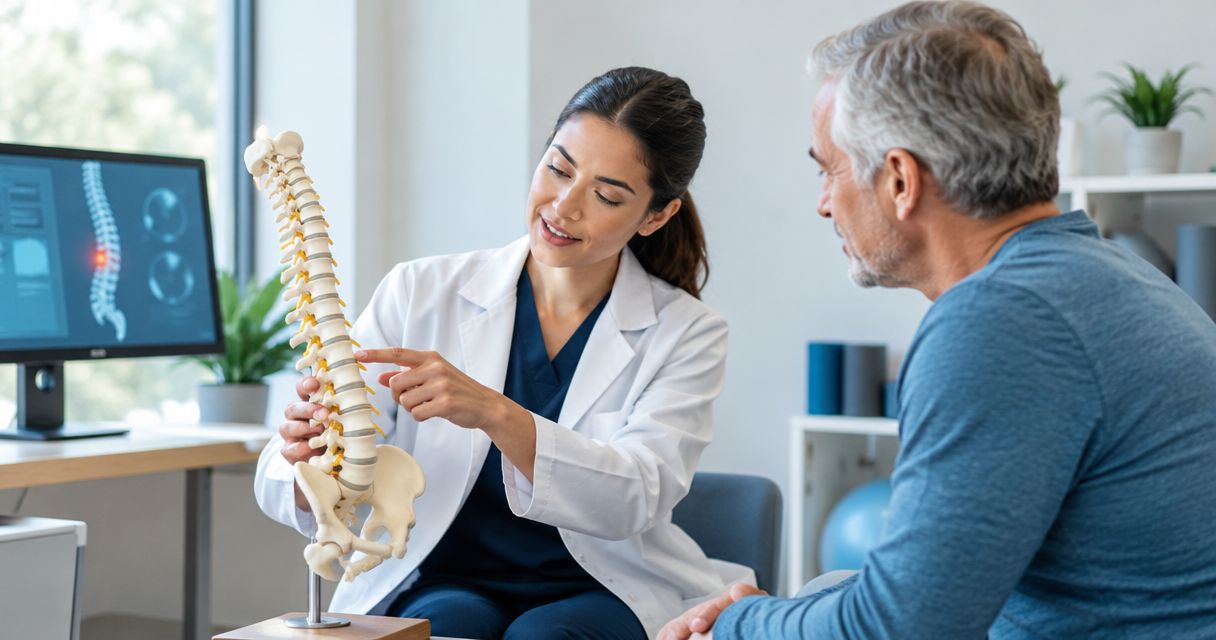
Best starting treatment for stable neurogenic claudication: supervised physical therapy with activity modification. Best for selected patients with persistent structural compression: decompression. This 2026 guide explains when injections, minimally invasive procedures, and surgery belong in your plan; Hudson Pain and Spine provides interventional pain-management services for patients seeking a nonsurgical evaluation.
TL;DR
- Neurogenic claudication from lumbar spinal stenosis usually starts with supervised exercise and activity modification when symptoms are stable.
- Epidural steroid injections do not widen the spinal canal; benefit for stenosis-related walking limitations is uncertain.
- Minimally invasive lumbar decompression fits selected patients with thickened ligament tissue, not every form of spinal stenosis.
- Surgical decompression deserves discussion when walking remains severely limited or neurological deficits develop.
- New bladder dysfunction, saddle numbness, or rapidly worsening weakness requires emergency assessment.
Why this matters
Neurogenic claudication causes leg pain, heaviness, numbness, or weakness during standing and walking, commonly because lumbar spinal stenosis crowds spinal nerves. Sitting or bending forward often helps. Your back does not have to hurt for the condition to limit walking.
The best treatment depends on what compresses the nerves, how much function you have lost, and whether weakness is progressing. A procedure that reduces inflammation does something different from a procedure that removes compression.
This article provides general education, not an individual diagnosis or treatment prescription. Seek emergency care for new urinary retention, loss of bladder or bowel control, numbness around the groin or buttocks, or rapidly worsening leg weakness.
What makes the best neurogenic claudication treatment?
Use these criteria when discussing treatment in 2026:
- Diagnostic fit: Your symptoms, examination, and imaging should point to the same problem. An MRI finding alone does not establish the cause of leg pain.
- Walking function: Treatment should address standing tolerance and daily activities, not just a pain score.
- Compression type: Thickened ligament, enlarged joints, disc changes, and spinal instability require different decisions.
- Neurological safety: Progressive weakness changes the urgency and can move surgical assessment ahead of routine rehabilitation.
- Treatment burden: Consider recovery, medication effects, bleeding risk, infection risk, and your other health conditions.
Neurogenic claudication treatments at a glance
These options occupy different roles. The order is a decision pathway, not a claim that every patient should try every treatment.
| Treatment | Best for | Standout role | Key limitation |
|---|---|---|---|
| Supervised physical therapy | Stable symptoms without progressive neurological loss | Builds walking tolerance through tailored exercise and education | Does not remove structural narrowing |
| Epidural steroid injection | Selected patients with an accompanying inflammatory nerve-root pain component | Delivers medication near irritated spinal nerves | Benefit for claudication is uncertain; does not decompress nerves |
| Minimally invasive lumbar decompression | Selected stenosis involving thickened ligamentum flavum | Removes small portions of the contributing ligament | Does not address every cause of stenosis or instability |
| Surgical decompression | Persistent disabling symptoms with matching compression, or neurological deterioration | Directly creates more space for affected nerves | Requires operative risk assessment and recovery |
| Spinal cord stimulation | Exceptional, carefully evaluated persistent pain cases | Modifies pain signaling rather than spinal anatomy | Not routine first-line care for untreated compressive stenosis |
1. Supervised physical therapy: best first step for stable symptoms
Supervised rehabilitation combines education, individualized exercise, and practical changes to painful activities. Flexion-tolerant exercise, strengthening, balance work, and conditioning help you stay active without repeatedly forcing symptoms.
Physical therapy does not reverse stenosis. Its purpose is to improve function and help you find tolerable ways to move.
Physical therapy pros:
- Avoids procedural and surgical risks.
- Addresses conditioning, balance, and movement habits together.
- Gives you an adjustable home program.
Physical therapy cons:
- Requires participation and reassessment.
- Does not remove compressive bone or ligament.
- Is not a reason to postpone evaluation of progressive weakness.
Best for: Patients with stable neurogenic claudication who can participate safely in rehabilitation.
Ask your therapist how to pace walking and whether a stationary bicycle or supported exercise suits your symptoms. Stop and report new weakness rather than treating it as ordinary exercise soreness.
Verdict: Buy into supervised rehabilitation first when symptoms are stable and no urgent neurological findings are present.
2. Epidural steroid injection: best for a selected inflammatory component
An epidural steroid injection places anti-inflammatory medication near spinal nerves. A clinician sometimes considers it when nerve-root irritation contributes to leg pain, especially when radicular symptoms accompany stenosis.
An epidural injection does not widen the spinal canal. Evidence for meaningful improvement in stenosis-related walking limitations is limited, so an injection should not be presented as a dependable treatment for neurogenic claudication itself.
Epidural injection pros:
- Targets medication near an irritated nerve region.
- Does not require open decompression surgery.
- Offers a possible symptom-management option for carefully selected patients.
Epidural injection cons:
- Relief is not assured and does not correct compression.
- Steroids can raise blood glucose and have other systemic effects.
- Risks include infection, bleeding, headache, and rare neurological injury.
Best for: Patients with a clinically supported inflammatory nerve-root pain component, after reviewing alternatives and risks.
Hudson Pain and Spine offers epidural injections and nerve blocks. For neurogenic claudication in 2026, ask what symptom an injection targets and what functional improvement would justify repeating it. Do not stop blood thinners without instructions from the clinicians managing them.
Verdict: Hold until your clinician identifies a specific target and explains the uncertain benefit for claudication.
3. Minimally invasive lumbar decompression: best for ligament-related narrowing
Percutaneous minimally invasive lumbar decompression removes portions of thickened ligamentum flavum that contribute to central canal narrowing. Selection depends on symptoms, imaging, spinal stability, and the other structures causing compression.
This is not the same as an injection. It changes a selected anatomical contributor to stenosis, but it does not treat every narrowed spinal canal.
Minimally invasive decompression pros:
- Addresses a structural source of compression in selected patients.
- Uses a smaller access approach than conventional open decompression.
- Does not require a permanent stimulation device.
Minimally invasive decompression cons:
- Requires a matching ligament-related anatomical finding.
- Does not correct significant instability or all bony narrowing.
- Carries procedural risks, including bleeding, infection, and injury.
Best for: Patients with persistent neurogenic claudication and an appropriate ligament-related stenosis pattern after conservative treatment.
Ask the specialist to identify which structure the procedure removes and which sources of narrowing will remain. A smaller procedure is not automatically the right procedure.
Verdict: Hold until imaging and examination establish that ligament-related decompression fits your anatomy.
4. Surgical decompression: best for persistent disabling compression
Surgical decompression removes selected tissue that crowds the spinal nerves. Depending on the anatomy, a surgeon uses a procedure such as a laminectomy or laminotomy; fusion is a separate decision related to stability and other findings.
Surgical assessment belongs in the discussion when walking remains severely limited despite appropriate nonsurgical care. Progressive neurological loss requires prompt assessment rather than an automatic sequence of more injections.
Surgical decompression pros:
- Directly addresses compressive anatomy.
- Can address narrowing beyond thickened ligament alone.
- Allows the surgeon to assess whether instability also needs treatment.
Surgical decompression cons:
- Carries anesthesia, infection, bleeding, and nerve-injury risks.
- Requires recovery planning and postoperative rehabilitation.
- Does not guarantee complete resolution of pain or numbness.
Best for: Patients with substantial functional limitation and matching nerve compression, or neurological findings that warrant surgical consideration.
In 2026, a surgical consultation does not commit you to surgery. Bring your imaging and describe which activities you have lost; ask why decompression alone or decompression with fusion is being considered.
Verdict: Buy into a surgical evaluation when disability persists or neurological function deteriorates.
5. Spinal cord stimulation: best reserved for exceptional persistent pain
Spinal cord stimulation uses electrical signals to modify pain processing. It does not remove stenosis or protect a progressively compressed nerve from worsening injury.
Its role in neurogenic claudication is more limited than its role in some other chronic pain conditions. A specialist must first determine whether a treatable compressive problem remains and whether decompression is appropriate.
Spinal cord stimulation pros:
- Offers a pain-modulation approach for carefully selected cases.
- Includes a trial phase before permanent implantation.
- Allows programming adjustments after implantation.
Spinal cord stimulation cons:
- Does not decompress nerves or correct instability.
- Introduces device-related risks, including infection and lead movement.
- Requires ongoing device management and careful selection.
Best for: Exceptional persistent pain cases after specialist review, not routine untreated neurogenic claudication.
Hudson Pain and Spine offers spinal cord stimulation. That service does not make stimulation the default choice for stenosis-related walking symptoms.
Verdict: Wait until appropriate evaluation has addressed decompression options and the reason for persistent pain.
Confirm the diagnosis before choosing a procedure
Leg discomfort with walking also occurs with peripheral artery disease, hip disease, and peripheral neuropathy. Neurogenic and vascular claudication can coexist, so relief from leaning forward is a clue—not a diagnosis.
A clinician evaluates your symptom pattern, strength, sensation, reflexes, and circulation. Lumbar MRI often helps define compression when symptoms persist or a procedure is under consideration; vascular testing is appropriate when the history or examination suggests reduced blood flow.
Organize your appointment around these points:
- Symptom pattern: Where symptoms start and what brings relief.
- Neurological exam: Whether strength or sensation has changed.
- Imaging match: Whether the narrowed level explains your symptoms.
- Treatment goal: Which daily activity you want to regain.
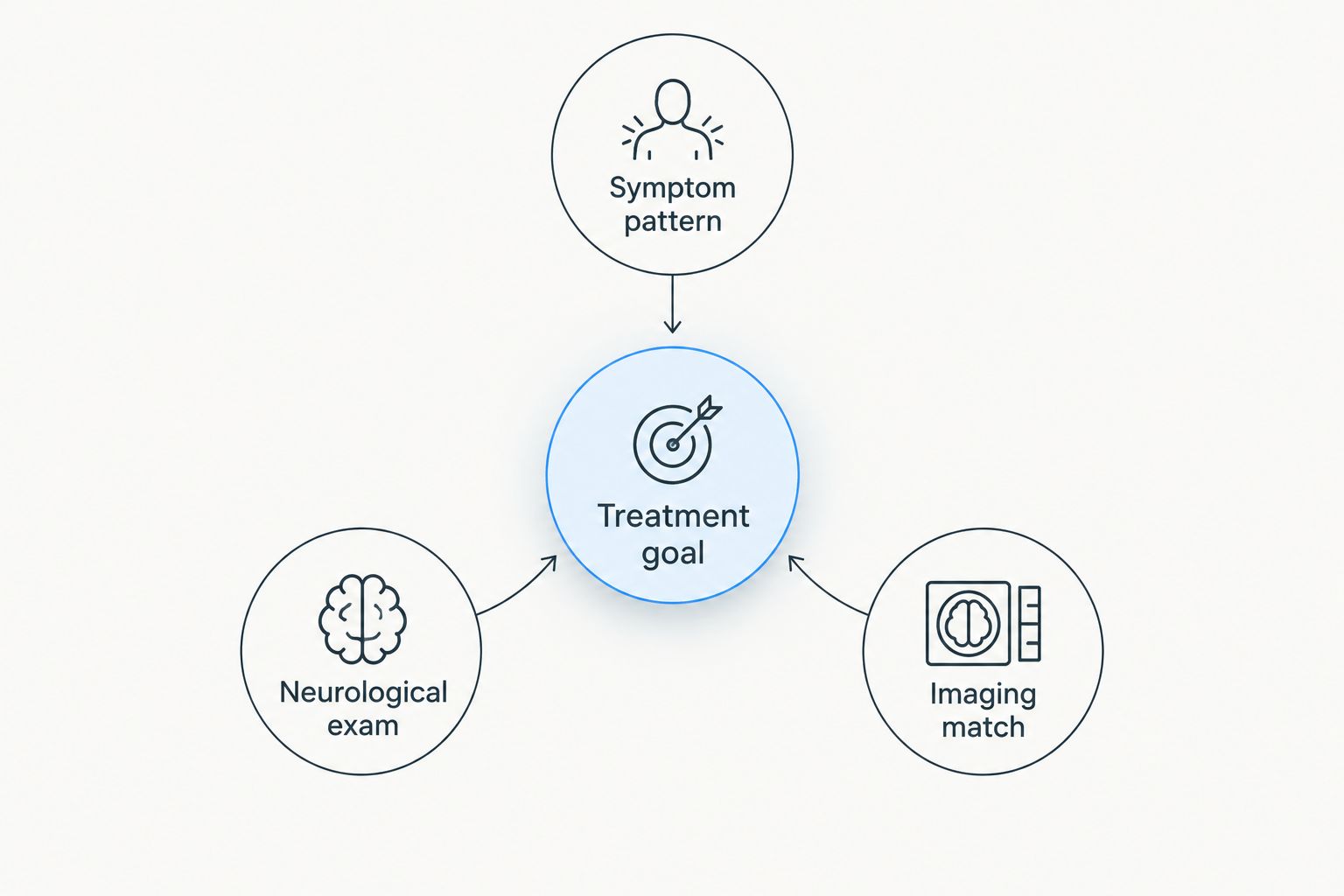
Treatment selection depends on symptoms and examination as well as imaging.
Medication can support a broader plan, but it does not enlarge the spinal canal. Anti-inflammatory medicines require review of kidney, stomach, heart, and bleeding risks; nerve-pain medicines can cause dizziness or sedation and are not automatic choices for stenosis-related claudication.
How these treatments are ranked
This 2026 ranking prioritizes diagnostic fit, walking function, neurological safety, and treatment burden. Rehabilitation comes first for stable symptoms; decompression moves forward when appropriate anatomy and persistent disability justify it. Injections and stimulation have narrower roles because neither removes compression.
The ranking does not represent a head-to-head trial or guarantee an outcome. Your examination can change the order immediately.
Which treatment should you choose?
Start with a confirmed diagnosis and supervised rehabilitation if your neurological function is stable. If walking remains substantially restricted, ask whether your anatomy supports decompression rather than simply repeating symptom-focused treatment.
Hudson Pain and Spine is best suited to patients seeking an interventional pain-management evaluation. Patients with progressive weakness or emergency symptoms need urgent assessment, not a routine procedure appointment.
Make progress measurable without chasing someone else’s recovery timeline:
- Record your comfortable walking time in minutes.
- Record your standing tolerance in minutes.
- Track symptom intensity on a 0–10 pain scale alongside those functional measures.
Keep a 7-day diary before your visit if symptoms are stable. These are tracking suggestions, not treatment deadlines or thresholds for qualifying for a procedure.
FAQ
What’s the best first treatment for neurogenic claudication?
Supervised exercise-based rehabilitation with education and activity modification is a reasonable first treatment when symptoms and neurological function are stable. Progressive weakness or emergency symptoms change the plan and require prompt assessment.
Does neurogenic claudication always mean I need surgery?
No, neurogenic claudication does not automatically require surgery. Surgical assessment becomes more relevant when disability persists despite appropriate nonsurgical care or neurological function worsens.
Are epidural steroid injections effective for neurogenic claudication?
Epidural steroid injections do not reliably resolve stenosis-related walking limitations and do not remove compression. A clinician sometimes considers an injection for a selected accompanying inflammatory nerve-root pain component.
Is minimally invasive lumbar decompression better than a laminectomy?
Neither procedure is better for every patient. Percutaneous ligament-focused decompression fits selected anatomy, while surgical decompression can address other or more extensive sources of narrowing.
Can I exercise if walking brings on leg symptoms?
Exercise can remain part of treatment when your clinician confirms it is safe. A therapist can adapt positions, pacing, and conditioning; new weakness requires reassessment rather than pushing through.
How can I tell neurogenic claudication from poor circulation?
You cannot reliably distinguish them from symptoms alone. Posture-related relief suggests a spinal component, but examination and sometimes vascular testing are needed because both conditions can coexist.
When should I go to the emergency department?
Seek emergency care for new urinary retention, loss of bladder or bowel control, saddle numbness, or rapidly worsening leg weakness. These symptoms can indicate serious nerve compression and should not wait for a scheduled visit.
One last thing
Less pain is not the same as restored nerve function. Report new foot dragging, falls, or declining strength even if medication makes your legs feel more comfortable. At your next appointment, lead with what you can no longer do—not just your pain score.
Related guides
- Neurogenic claudication symptoms and what they mean
- How to connect physical therapy to interventional pain treatment
- How to connect a surgeon’s opinion to a nonsurgical evaluation
About the Medical Reviewer
Dr. Saurabh Dang is a double board-certified interventional pain management specialist serving Central and Northern New Jersey. He combines clinical expertise with a patient-centered approach to help patients find lasting relief from chronic pain conditions.
Read Full Bio →Seeking Treatment for Epidural Injections?
Dr. Dang and the team at Hudson Pain and Spine offer specialized care and advanced interventional treatments.
Ready to Find Relief from Pain?
Schedule your consultation with Dr. Saurabh Dang at our Englewood office.
Serving patients across Central and Northern New Jersey — Bergen, Passaic, and Middlesex counties.