
Facet joint injection relief duration benchmarks by spine region 2026

Medically reviewed by
Dr. Saurabh Dang, MD, MBA

Facet joint injection relief duration has no single reliable average across the neck, middle back, and lower back. In one randomized neck-pain trial, median relief lasted 3 days after corticosteroid and 3.5 days after local anesthetic—a study-specific finding, not a prediction for every patient or spine region.
TL;DR
- Facet joint injection relief duration depends on the procedure, patient selection, and how relief is measured.
- A cervical injection trial reported median relief of 3 days with corticosteroid and 3.5 days with local anesthetic.
- Hudson Pain and Spine provides interventional pain management for New Jersey patients seeking specialist evaluation.
- Do not compare intra-articular injections, medial branch blocks, and radiofrequency ablation as if they were interchangeable.
Why this matters
A promise of months of relief means little unless it identifies the procedure and the patients studied. An injection into a facet joint is different from a block of the nerves supplying that joint, even though both sometimes appear under the label facet injection.
Hudson Pain and Spine provides interventional pain management for patients in Bergen, Passaic, and Middlesex counties, New Jersey. This 2026 guide separates published duration findings from treatment expectations so you can ask more precise questions before a procedure.
Facet joint injection relief duration: the published yardstick
Relief duration measures how long a defined improvement lasts after treatment. A median is the midpoint of a study’s results; it is not the longest response, a guaranteed response, or the percentage of patients who improve.
The following table reports a directly measured duration endpoint from a randomized cervical study. The overall row prevents a small, narrowly selected study from becoming an unsupported average for the entire spine.
| Spine region and treatment | Reported relief duration | Patients and endpoint | Appropriate interpretation |
|---|---|---|---|
| Overall: all spine regions | No pooled duration estimate reported here | Different procedures and study populations cannot be combined into this trial’s median | Do not use the cervical result as an all-spine average |
| Cervical: intra-articular corticosteroid | Median 3 days | Chronic cervical facet pain after automobile accidents; time until pain returned to 50% of its pre-injection level | A short median response in this selected population |
| Cervical: intra-articular local anesthetic | Median 3.5 days | Same trial population and endpoint | A numerically longer median, without evidence that corticosteroid provided longer relief |
Neither treatment established a duration advantage: local anesthetic had a median of 3.5 days, compared with 3 days for corticosteroid. Those results do not establish that neck injections last longer or shorter than lower-back or middle-back injections.
Source and methodology: Barnsley and colleagues, New England Journal of Medicine, 1994, “Lack of Effect of Intraarticular Corticosteroids for Chronic Pain in the Cervical Zygapophyseal Joints,” randomized 41 patients with chronic, diagnostically confirmed cervical facet pain after automobile accidents. Its limitation is scope: this small cervical population cannot supply lumbar, thoracic, or general-population duration averages.
What the cervical numbers actually mean
The trial’s endpoint was return to half the pre-injection pain level. That is different from complete loss of benefit, return to the original pain level, or inability to perform daily activities.
A median of 3 days also does not mean every participant improved for exactly 3 days. Individual responses differed, and a midpoint does not describe the full distribution. Ask which endpoint a duration claim uses before applying it to your situation.
Comparing the neck, middle back, and lower back
A useful regional comparison must hold the treatment and outcome definition constant. Comparing a cervical joint injection with lumbar radiofrequency ablation does not reveal which spine region responds longer; it compares different procedures.
| Spine region | Question your evaluation must answer | What the cervical duration trial establishes |
|---|---|---|
| Cervical: neck | Is the pain arising from a facet joint rather than another neck structure? | A duration estimate for the selected cervical population studied |
| Thoracic: middle back | Is the pain facet-related rather than coming from ribs, muscles, or another source? | No thoracic duration conclusion |
| Lumbar: lower back | Is the pain facet-related rather than disc-related, nerve-root-related, or from another structure? | No lumbar duration conclusion |
No spine region can be ranked as the longest-lasting from the cervical trial. A regional ranking requires comparable studies with the same procedure, patient selection, and definition of meaningful relief.
For your 2026 treatment decision, location is only part of the question. The suspected pain source, purpose of the injection, and response to previous treatment determine which evidence applies.
Lumbar evidence: distinguish follow-up from duration
The FACTS randomized trial, published by Cohen and colleagues in Anesthesiology in 2018, studied 229 participants with suspected lumbar facet pain. It compared intra-articular injections, medial branch blocks, and a saline control, and did not establish therapeutic benefit for facet blocks at its 1-month primary endpoint.
That finding matters, but a 1-month assessment is not a measured 1-month relief duration. A study can evaluate patients at a particular visit without showing that improvement remained continuous until that visit.
The FACTS trial also examined the prognostic role of blocks before radiofrequency ablation. Its results should not be converted into a promise that a therapeutic joint injection will provide a particular number of weeks or months of relief.
Joint injections, nerve blocks, and ablation are different
Before comparing duration, confirm what procedure your clinician is discussing. These options target related anatomy but serve different purposes.
| Procedure | What it targets | Best for | Potential benefit | Main limitation |
|---|---|---|---|---|
| Intra-articular facet injection | The facet joint itself | Selected patients being evaluated for a joint-directed injection | Places medication within the suspected painful joint | Durable benefit is uncertain; corticosteroid does not guarantee prolonged relief |
| Medial branch block | Small nerves supplying the facet joints | Patients undergoing evaluation for facet-mediated pain and possible ablation | Helps test whether the targeted nerve supply contributes to pain | Temporary relief is not proof of a permanent treatment effect |
| Radiofrequency ablation | Selected medial branch nerves | Appropriately selected patients after diagnostic evaluation | Treats the nerve supply rather than injecting the joint | Requires separate selection and carries procedure-specific risks |
Read how medial branch blocks help diagnose back pain if your clinician recommends a diagnostic procedure. The key question is whether the injection is intended to test a diagnosis, treat symptoms, or help select another treatment.
A diagnostic block can provide useful information even when relief is brief. Conversely, immediate improvement after an injection does not by itself establish lasting steroid benefit.
How to use these benchmarks in 2026
Use published findings to structure a discussion, not to choose a procedure from a duration chart. Hudson Pain and Spine provides interventional pain management; whether a particular injection fits your condition requires an individual evaluation.
- Match the procedure first. The cervical medians of 3 and 3.5 days concern intra-articular injections, not radiofrequency ablation.
- Match the patient population. The cervical trial involved chronic pain after automobile accidents, not every cause of neck pain.
- Match the outcome. Return to 50% of baseline pain differs from complete pain recurrence or improved walking tolerance.
- Ask about the next decision. A brief diagnostic response and a brief therapeutic response have different implications for follow-up.
For an injection intended to improve symptoms, agree on a functional goal before treatment. Examples include turning your head during ordinary activities, tolerating a chair, or walking with less interruption. Pain scores and function should be recorded separately rather than treated as interchangeable outcomes.
Record your response without confusing the stages
Your pain diary should distinguish immediate change from later improvement. Local anesthetic effects, procedural soreness, medication changes, and altered activity can complicate interpretation.
Baseline pain
Before the procedure, describe your usual pain location and the activities that reproduce it. Record the pain scale your clinician requests, along with medication use and the task you hope to perform more comfortably.
Initial response
After the procedure, follow the clinician’s recording schedule and activity instructions. Note which familiar pain changed, rather than recording only a general impression that you felt better.
Follow-up review
Bring the diary to follow-up, including when pain returned and whether function improved. Tell your clinician about new symptoms, changes in medication, and any activity restrictions that affected the comparison.
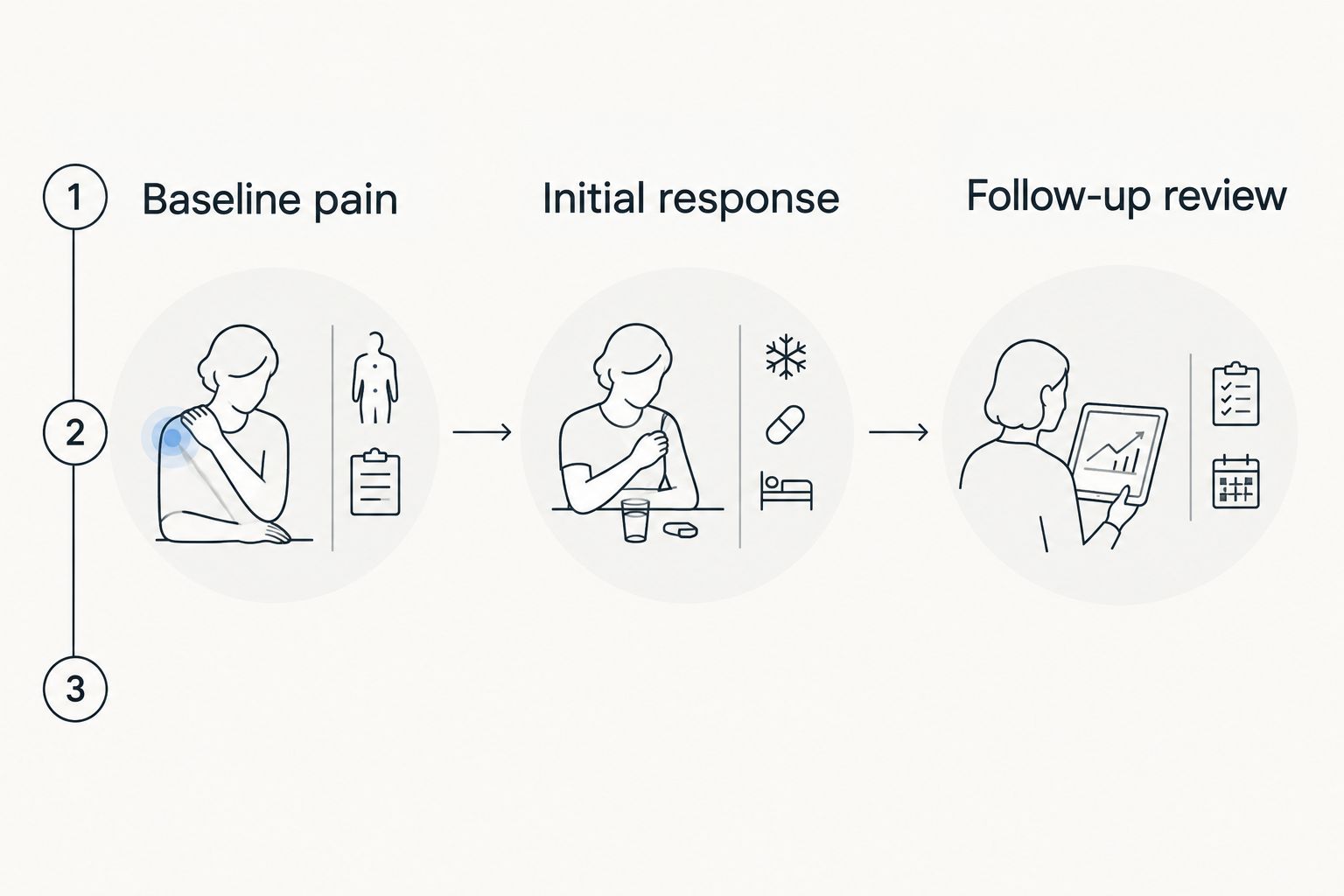
Separate your starting symptoms, early response, and later function when discussing results.
A useful record identifies both the amount of improvement and its duration. Feeling better while resting is not the same outcome as performing your usual activities with less pain, so record the circumstances alongside the result.
When brief relief changes the treatment discussion
Brief relief is information, not an automatic instruction to repeat an injection. Your clinician must interpret it alongside the procedure performed, the medication used, and the original diagnostic question.
If a diagnostic medial branch block temporarily reduces your familiar pain, the response can inform consideration of radiofrequency ablation. If a therapeutic joint injection provides little meaningful benefit, reassessment is more useful than assuming another identical injection will last longer.
Do not schedule repeat procedures solely to match an advertised duration. Ask whether the previous result supports the suspected diagnosis and whether another approach has a clearer purpose.
For a 2026 consultation, bring your procedure report if treatment occurred elsewhere. The exact injection location and medications help distinguish a joint injection from a nerve block or an epidural injection.
Discuss your injection response
Review your symptoms and previous procedures with Hudson Pain and Spine.
Safety comes before measuring relief
Temporary injection-site soreness and a return of familiar pain require a different response from a new neurological symptom. Follow your discharge instructions, including restrictions on driving, activity, and medication changes.
Seek urgent medical attention for new or worsening weakness, loss of bladder or bowel control, or other sudden neurological changes. Contact the treating team promptly for fever, concerning injection-site changes, or severe worsening pain. Do not wait for a scheduled duration assessment when symptoms suggest a complication.
FAQ
What is the average facet joint injection relief duration in 2026?
There is no single reliable average across all spine regions and injection types. One randomized cervical intra-articular injection trial reported medians of 3 days with corticosteroid and 3.5 days with local anesthetic; those results are not an all-spine benchmark.
Do neck facet injections last longer than lower-back injections?
The studies discussed here do not establish that neck injections last longer than lower-back injections. A valid comparison needs the same procedure, similar patients, and the same definition of relief.
Does immediate relief mean the steroid has worked?
Immediate relief does not establish a lasting steroid response. Local anesthetic can account for early improvement, so your clinician needs the timing and pattern of your response.
Is a medial branch block the same as a facet joint injection?
A medial branch block targets nerves supplying the facet joint, while an intra-articular injection enters the joint itself. The distinction matters because diagnostic usefulness and therapeutic duration are different outcomes.
Should I repeat a facet injection if relief lasts only a few days?
A few days of relief is not, by itself, a reason to repeat the injection. Your clinician should review the procedure’s purpose, your functional improvement, and whether the response supports the suspected pain source.
Is radiofrequency ablation better than a facet injection?
Radiofrequency ablation is a different treatment, not an interchangeable injection option. It requires appropriate selection, often informed by diagnostic medial branch blocks, and a separate discussion of benefits and risks.
What should I bring to a facet-pain consultation?
Bring previous procedure reports, relevant imaging reports, your medication list, and a record of your treatment response. Hudson Pain and Spine provides interventional pain management from offices in Englewood, Woodland Park, and Edison, New Jersey.
One last thing
The date of a follow-up visit is not the duration of relief. When you read a 2026 benchmark—or any treatment study—check whether it measures continuous improvement, pain at a single visit, or time until a specified amount of pain returns. That distinction is more useful than a headline promising months of benefit.
Related guides
- How long does a facet joint injection take to work?
- Radiofrequency ablation for facet joint pain
- Best candidates for facet joint injections
About the Medical Reviewer
Dr. Saurabh Dang is a double board-certified interventional pain management specialist serving Central and Northern New Jersey. He combines clinical expertise with a patient-centered approach to help patients find lasting relief from chronic pain conditions.
Read Full Bio →Seeking Treatment for Epidural Injections?
Dr. Dang and the team at Hudson Pain and Spine offer specialized care and advanced interventional treatments.
Ready to Find Relief from Pain?
Schedule your consultation with Dr. Saurabh Dang at our Englewood office.
Serving patients across Central and Northern New Jersey — Bergen, Passaic, and Middlesex counties.