
How long does plantar fasciitis take to heal?

Medically reviewed by
Dr. Saurabh Dang, MD, MBA

Plantar fasciitis usually takes several months to settle; the American Academy of Orthopaedic Surgeons (AAOS) reports that more than 90% of patients improve within 10 months of starting simple treatments. Pain relief can arrive before your foot is ready for unrestricted running or prolonged standing, so recovery depends on rebuilding activity without repeatedly aggravating your heel.
TL;DR
- How long does plantar fasciitis take to heal? Expect months, not a guaranteed recovery date.
- AAOS reports more than 90% of patients improve within 10 months of simple treatment.
- Reduce aggravating activity, use supportive shoes, and follow a plantar fascia and calf stretching plan.
- Hudson Pain and Spine provides pain management for New Jersey patients whose persistent symptoms need specialist evaluation.
Why this matters
Less pain does not automatically mean full recovery. Plantar fasciitis often hurts most with your first steps after sleep or sitting, then eases as you move. That temporary improvement can make a long walk or workout feel reasonable even when your foot still struggles with the total load.
This 2026 guide separates symptom improvement from return to activity. For patients seeking a New Jersey specialist, Hudson Pain and Spine provides board-certified interventional pain management; persistent heel pain still requires an examination to identify its source before choosing treatment.
How long does plantar fasciitis take to heal?
Plan for recovery over months rather than days. AAOS patient guidance on plantar fasciitis and bone spurs reports that more than 90% of patients improve within 10 months of starting simple treatment methods. This describes improvement across patients, not a deadline for complete healing or clearance to resume sports.
For your 2026 recovery plan, use that benchmark as context rather than a countdown. Your symptom trend and walking tolerance are more useful than comparing your progress with someone else’s.
| Recovery milestone | What it means | What it does not establish |
|---|---|---|
| Easier first steps | Morning heel pain is becoming less intense | Your foot is ready for unrestricted exercise |
| Better walking tolerance | Ordinary daily activity causes less discomfort | A long standing shift or run will be tolerated |
| Better activity tolerance | You handle increasing activity without a sustained flare | Symptoms cannot return |
| Sustained improvement | Pain and function improve across your usual routine | Every patient follows the same timeline |
A clinician usually diagnoses plantar fasciitis through your history and examination. Imaging is not automatically necessary, but persistent, unusual, or injury-related symptoms can require testing for another cause.
Improvement benchmark: within 10 months for most patients
More than 90% improve within 10 months with simple treatment, according to AAOS. The useful takeaway is that nonsurgical care deserves a consistent trial. It does not mean you should tolerate worsening pain for that entire period.
Early progress often means less first-step pain and fewer activity-related flares. A demanding sport or physical job places different demands on your foot than comfortable walking around your home.
No improvement after 2 weeks: arrange an assessment
After 2 weeks of self-care without improvement, arrange an assessment rather than continuing unchanged. NHS patient guidance on plantar fasciitis uses this threshold for seeking medical advice; it is an assessment trigger, not an expected healing time.
Seek care earlier when pain is severe, recurring, or interfering with normal activities. Diabetes, reduced foot sensation, and circulation problems also warrant a lower threshold for professional advice.
Why plantar fasciitis recovery varies
Your recovery depends partly on how much stress reaches the painful tissue and whether the diagnosis is correct. These factors help explain why the same calendar deadline does not fit every patient:
- Daily standing and walking: Work shifts, commuting, errands, and exercise all contribute to the load on your foot.
- Changes in activity: A sudden increase in running, jumping, or walking can aggravate symptoms. Returning too quickly can repeat that irritation.
- Footwear and support: Shoes that provide inadequate cushioning or support can make weight-bearing less comfortable.
- Calf flexibility and ankle movement: Tight calf muscles can increase strain through the foot. An individualized exercise plan addresses relevant limitations.
- Consistency of care: Occasional stretching does not replace a coordinated plan for footwear, activity modification, and rehabilitation.
- Another pain source: Nerve compression, a stress fracture, or Achilles tendon problems require a different assessment and treatment approach.
These are treatment considerations, not a formula that predicts your recovery date. If progress stalls, review both the diagnosis and the daily demands on your foot before assuming you need a procedure.
Which treatments help plantar fasciitis recovery?
Start with measures that reduce aggravation while preserving comfortable movement. The strongest practical plan combines appropriate activity changes with exercises and footwear rather than relying on a single remedy.
The comparison below summarizes established treatment approaches used in 2026. It does not mean every option belongs in your plan.
| Treatment | Best for | Main benefit | Main limitation or risk |
|---|---|---|---|
| Activity modification | Pain aggravated by running, jumping, or prolonged standing | Reduces repeated irritation | Does not address every flexibility or strength deficit |
| Stretching and rehabilitation | Limited calf flexibility or difficulty returning to activity | Addresses movement and loading tolerance | Requires consistency and adjustment to symptoms |
| Supportive shoes or inserts | Pain during weight-bearing | Improves comfort and support | Does not establish or correct every cause of heel pain |
| Night splint | Persistent first-step morning pain | Holds the foot in a stretched position overnight | Can be uncomfortable or disturb sleep |
| Corticosteroid injection | Selected persistent cases after clinical evaluation | Can reduce pain in the short term | Carries risks including fascia rupture and fat-pad damage |
| Shockwave therapy | Selected cases that persist despite conservative care | Offers a nonsurgical treatment option | Results vary; it does not guarantee recovery |
Activity modification: reduce irritation without abandoning movement
Replace aggravating activity rather than repeatedly testing the painful heel. Temporarily reduce running, jumping, long walks, or standing periods that clearly worsen symptoms. Comfortable alternatives can help you remain active.
Cycling or swimming are options when they do not aggravate your foot. A walking boot is not a routine self-prescribed solution; a clinician decides whether temporary immobilization fits the diagnosis and severity.
Stretching and rehabilitation: make the plan specific
Plantar fascia stretching and calf stretching are common parts of treatment. A physical therapist can also assess ankle motion, strength, gait, and the activity demands you need to regain.
Stretch gently and avoid forcing the foot into sharp pain. The guide to treating plantar fasciitis heel pain explains treatment options in more detail, but your examination should determine which measures belong in your recovery plan.
Shoes, inserts, and night splints: support has limits
Supportive footwear can make daily movement more tolerable. Avoid walking barefoot on hard surfaces when that reliably worsens your heel pain, and discuss inserts if your current shoes are not comfortable enough for necessary activity.
A night splint is an option for persistent morning pain, but comfort and sleep matter. Neither an insert nor a splint replaces a gradual return to activity.
Procedures: pain relief is not proof of healing
An injection does not establish that the plantar fascia has recovered. Corticosteroid injections can provide short-term relief, but the risks require a careful discussion, particularly when considering repeated injections.
Shockwave therapy is another option for selected persistent cases. Surgery is generally reserved for symptoms that continue despite extended nonsurgical treatment; persistent pain alone does not establish that surgery is appropriate.
How do you know your plantar fasciitis is improving?
Look for a sustained improvement in symptoms and function, not a single comfortable afternoon. Your first steps, necessary walking, and response after activity each tell you something different.
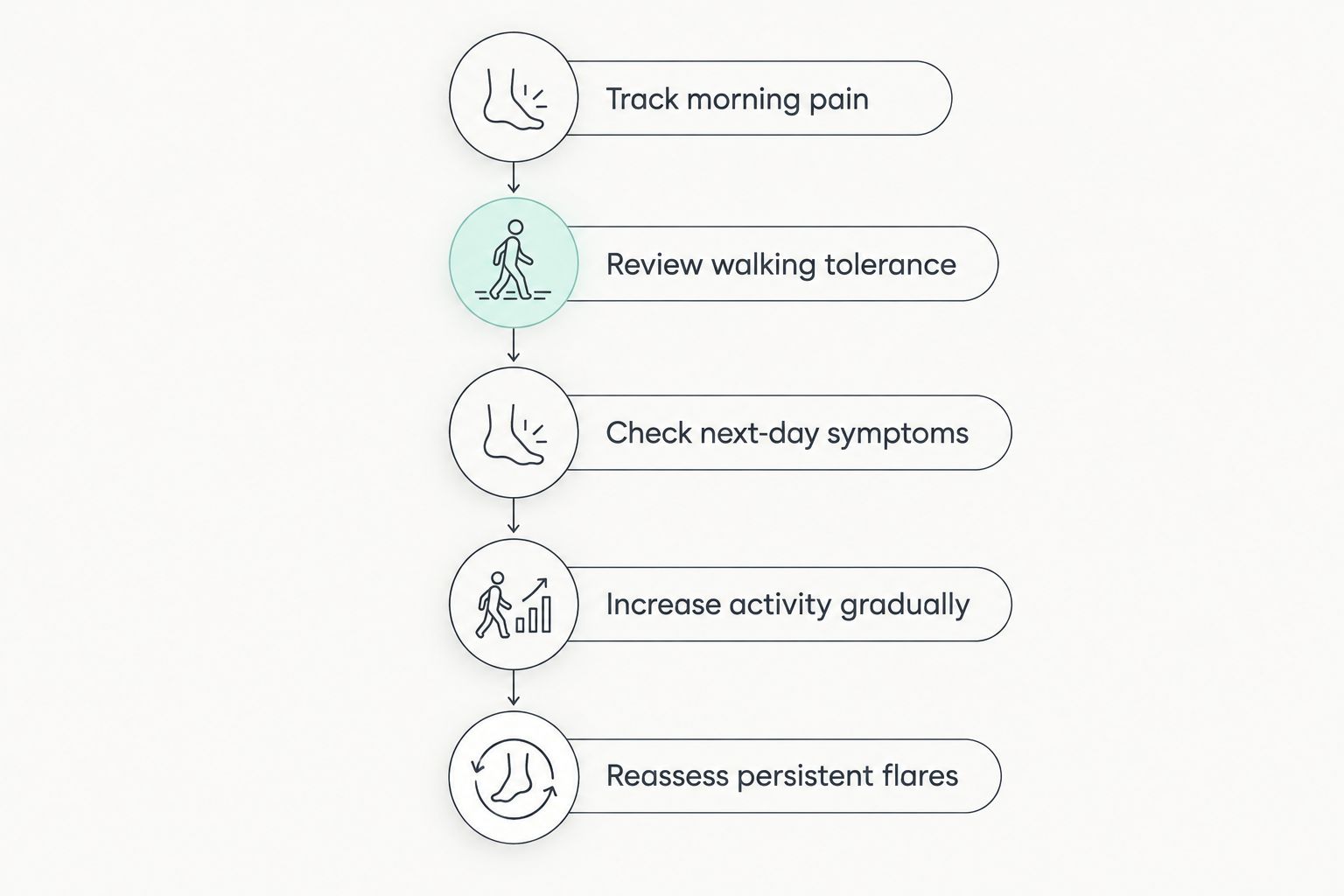
Use this sequence when reviewing your 2026 recovery progress:
- Track morning pain. Notice whether first-step discomfort is becoming less intense and settling more easily.
- Review walking tolerance. Compare similar daily activities rather than an easy day with an unusually demanding one.
- Check next-day symptoms. Increased morning pain after a harder day suggests that the activity increase exceeded your current tolerance.
- Increase activity gradually. Change the duration or intensity rather than increasing everything together.
- Reassess persistent flares. Repeated setbacks warrant a review of your plan, footwear, work demands, and diagnosis.
A brief symptom record can help you and your clinician identify patterns. Record the activity that preceded a flare rather than only recording that your heel hurt.
Your response after activity matters as much as how your heel feels during it.
Can I keep walking with plantar fasciitis?
The 10-month improvement benchmark is not an instruction to stop walking for 10 months. Continue necessary activity within your tolerance, but reduce distances or standing periods that produce a sustained flare. Limping or progressively worsening pain is a reason to reassess the load and seek advice.
Complete rest is not a substitute for rehabilitation. Your goal is to rebuild comfortable function without repeatedly provoking symptoms.
Can plantar fasciitis heal in 2 weeks?
Two weeks is an assessment checkpoint, not a dependable healing deadline. Some symptoms improve early, but a brief reduction in pain does not establish that the foot can tolerate unrestricted activity.
If your symptoms remain unchanged after self-care, arrange an examination. Do not keep extending the same unsuccessful plan without reviewing the diagnosis.
When should persistent heel pain be checked urgently?
Do not wait for a routine recovery timeline when heel pain follows a significant injury or you cannot bear weight. Seek urgent assessment for a sudden pop with bruising, marked swelling, or a red, hot foot with fever. These findings need evaluation for conditions beyond routine plantar fasciitis.
Burning, tingling, numbness, pain at rest, or steadily worsening symptoms also deserve medical review. A clinician needs to distinguish plantar fascia pain from nerve, bone, tendon, and other problems.
For patients with persistent symptoms, Hudson Pain and Spine is best suited to New Jersey patients seeking specialist pain management evaluation, not emergency injury care. Its interventional services do not replace the examination and rehabilitation needed to determine the cause of heel pain.
Discuss persistent pain with a specialist
Explore pain management services in Englewood, Woodland Park, and Edison, New Jersey.
FAQ
How long does plantar fasciitis take to heal with treatment?
Plantar fasciitis usually improves over several months. AAOS reports that more than 90% of patients improve within 10 months of starting simple treatment methods; this is not a guarantee of complete recovery by a particular date.
Why does my heel hurt again when I get out of bed?
First-step pain after sleep or rest is a common plantar fasciitis symptom. Persistent morning pain should be considered alongside your examination and activity pattern, because the symptom alone does not confirm the diagnosis.
Is stretching enough to heal plantar fasciitis?
Stretching alone does not address every contributor to plantar fasciitis. Treatment often also includes activity modification, supportive footwear, and an individualized rehabilitation plan.
Can I run if my plantar fasciitis feels better after warming up?
Pain easing during a warm-up does not establish that running is appropriate. Consider your symptoms afterward and the next morning, and discuss a graded return with your clinician or physical therapist.
Will a steroid injection make plantar fasciitis heal faster?
A steroid injection can reduce pain in selected cases, but pain relief does not prove faster tissue healing. Risks include plantar fascia rupture and fat-pad damage, so the decision requires a clinical assessment.
When should I see a doctor for plantar fasciitis?
Arrange an assessment when heel pain is severe, recurrent, limits normal activity, or has not improved after 2 weeks of self-care. Seek urgent care for inability to bear weight after injury or a red, hot foot with fever.
Can Hudson Pain and Spine evaluate persistent pain?
Hudson Pain and Spine provides board-certified interventional pain management in New Jersey. A clinical assessment determines the source of persistent pain and whether specialist treatment or another referral is appropriate.
One last thing
Judge tomorrow morning’s heel pain before increasing today’s activity again. Plantar fasciitis can feel better once you are moving, so the comfortable part of a walk does not tell the whole story.
For your 2026 recovery plan, aim for repeatable improvement rather than a single pain-free workout. A steady return to ordinary activity is more useful than repeatedly reaching a level your foot cannot yet tolerate.
Related guides
- How to treat tarsal tunnel syndrome foot pain
- How to treat Achilles tendonitis pain
- Sports injury pain treatment for runners
About the Medical Reviewer
Dr. Saurabh Dang is a double board-certified interventional pain management specialist serving Central and Northern New Jersey. He combines clinical expertise with a patient-centered approach to help patients find lasting relief from chronic pain conditions.
Read Full Bio →Ready to Find Relief from Pain?
Schedule your consultation with Dr. Saurabh Dang at our Englewood office.
Serving patients across Central and Northern New Jersey — Bergen, Passaic, and Middlesex counties.