
How long does rotator cuff tendinitis take to heal?

Medically reviewed by
Dr. Saurabh Dang, MD, MBA

Rotator cuff tendinitis usually improves over weeks to months with activity changes and guided rehabilitation; persistent symptoms take longer, and there is no single healing deadline. Pain relief often comes before your shoulder has recovered the strength and endurance needed for lifting, work, or sports.
TL;DR
- How long does rotator cuff tendinitis take to heal? Think weeks to months, not a guaranteed deadline.
- Rotator cuff recovery requires improving shoulder strength and movement, not just reducing pain.
- Sudden weakness after an injury needs prompt assessment rather than a wait-and-see approach.
- Hudson Pain and Spine provides interventional pain management for patients in northern and central New Jersey.
How long does rotator cuff tendinitis take to heal?
Expect gradual recovery over weeks to months, with progress measured by function rather than the calendar alone. The American Academy of Orthopaedic Surgeons’ OrthoInfo guidance on shoulder impingement and rotator cuff tendinitis describes nonsurgical recovery as gradual, taking several weeks to months. That is general patient guidance, not a prediction for an individual shoulder.
For your 2026 recovery plan, distinguish between less pain during daily activities and readiness for demanding overhead activity. You can reach the first milestone before the second.
| Recovery milestone | What improvement looks like | What it does not establish |
|---|---|---|
| Less resting pain | Sitting and sleeping become more comfortable | The tendon is ready for heavy loading |
| Better movement | Dressing and reaching become easier | Strength has fully returned |
| Better strength | Rehabilitation exercises become easier to control | Repeated overhead work is safe |
| Return to activity | You tolerate progressively harder tasks without a sustained flare | Symptoms cannot return |
If shoulder pain continues to limit daily life, Hudson Pain and Spine provides board-certified interventional pain management services in Englewood, Woodland Park, and Edison, New Jersey.
Why this matters
A shoulder that feels better at rest can still hurt when you resume lifting, swimming, or overhead work. Returning immediately to your previous workload can reproduce the same irritation that started the problem.
Use improving movement, strength, sleep, and activity tolerance together to judge recovery. A single comfortable morning is encouraging, but it is not clearance for unrestricted activity.
The opposite problem also matters: stopping all shoulder movement for a prolonged period can contribute to stiffness. Your plan should reduce aggravating loads while maintaining movement your clinician considers appropriate.
Recent symptoms: look for a steady improvement trend
Recent pain after an increase in activity often calls for adjusting the load and beginning appropriate rehabilitation. Repeatedly testing the painful movement throughout the day does not help you measure recovery accurately.
Track practical changes instead. Notice whether you can put on a shirt more easily, reach a shelf with less discomfort, or sleep with fewer interruptions.
Progress does not require every day to feel better than the day before. However, worsening pain, declining movement, or increasing weakness should trigger reassessment rather than a longer period of self-treatment.
Persistent symptoms: expect reassessment, not just more waiting
Long-standing rotator cuff pain often involves tendinopathy, a term that includes changes beyond short-term tendon inflammation. That distinction matters because reducing soreness alone does not restore the shoulder’s ability to handle repeated loads.
If you are planning rehabilitation in 2026 after months of symptoms, bring a clear treatment history. Explain which exercises you tried, whether you progressed resistance, and which work or sports demands remained unchanged.
Persistent symptoms do not automatically mean surgery is necessary. They do mean the diagnosis, exercise plan, and ongoing sources of strain deserve another look.
Suspected tear or frozen shoulder: a different recovery question
Rotator cuff tendinitis, a rotator cuff tear, and frozen shoulder do not share an interchangeable timeline. Pain location alone cannot reliably distinguish them.
A tear deserves particular attention when pain follows a fall or sudden force and you develop marked weakness or difficulty raising the arm. Frozen shoulder typically involves substantial restriction of shoulder movement, including movement assisted by someone else.
Do not use a tendinitis recovery estimate to delay assessment of a different condition. Your examination determines whether the original recovery question still fits.
Why rotator cuff tendinitis recovery varies
These factors explain why another person’s shoulder timeline is a poor guide for yours:
- Symptom duration: A recent episode and a long-standing tendon problem can require different rehabilitation plans.
- Ongoing load: Repeated overhead lifting, throwing, swimming, or heavy work can keep provoking symptoms unless you adjust the demand.
- Movement restriction: Stiffness changes how you use the shoulder and can complicate exercise progression.
- Strength deficits: Reduced rotator cuff or shoulder-blade muscle strength affects your ability to tolerate activity.
- Rehabilitation progression: Exercises need to match your current ability and become more demanding as tolerance improves.
- Another diagnosis: A tear, arthritis, frozen shoulder, or neck-related pain can change both treatment and expectations.
Tell your clinician about numbness, tingling, or pain traveling beyond the shoulder. Those symptoms warrant assessment for causes beyond isolated tendon irritation.
What helps rotator cuff tendinitis recover?
Activity modification and progressive rehabilitation are central to nonsurgical care. Symptom-relief treatments can make movement more manageable, but they do not replace rebuilding strength and activity tolerance.
Use this comparison when discussing a 2026 treatment plan. These approaches serve different purposes; they are not equivalent ways to repair a tendon.
| Approach | Best for | Main benefit | Main limitation or risk |
|---|---|---|---|
| Activity modification | Reducing repeated aggravation | Lowers exposure to painful loads | Rest alone does not rebuild strength |
| Guided exercise or physical therapy | Restoring movement and load tolerance | Addresses mobility, strength, and movement control | Requires consistent participation and adjustment |
| Anti-inflammatory medication | Short-term symptom control when medically appropriate | Can reduce pain and inflammation | Does not restore tendon capacity; stomach, kidney, and cardiovascular risks matter |
| Corticosteroid injection | Selected patients whose pain limits rehabilitation | Can reduce pain temporarily | Does not repair a tear; tendon-related risks require discussion |
Reduce the aggravating load without abandoning movement
Temporarily change activities that repeatedly provoke your symptoms. Examples include lowering the height of a task, reducing the weight you carry, or breaking up overhead work.
Do not assume you need a sling or complete rest unless a clinician recommends it. Keep comfortable movement in your routine and ask how to distinguish acceptable exercise discomfort from a flare that requires adjustment.
Progress exercises according to your examination
Rehabilitation commonly addresses shoulder motion, rotator cuff strength, and shoulder-blade control. The appropriate starting point depends on your pain, stiffness, strength, and diagnosis.
A generic exercise list is not an individualized prescription. The guide to exercises for rotator cuff recovery provides related reading to discuss with your treating clinician.
Avoid forcing a painful stretch or increasing resistance simply because the exercise felt easy once. The response afterward matters too.
Discuss medication and injections in context
Medication decisions depend on your health history and other medicines. Check with a clinician or pharmacist before using anti-inflammatory drugs if you have kidney disease, a history of ulcers, cardiovascular disease, or take blood thinners.
A corticosteroid injection is a treatment decision, not a recovery deadline. Discuss the suspected pain source, expected purpose, risks, and how rehabilitation will continue afterward.
How should you decide when to increase activity?
Use a staged discussion with your clinician or physical therapist rather than choosing a return date in isolation. This is particularly important when your job or sport requires repeated overhead effort.
- Confirm the diagnosis. Review the examination findings and whether another condition needs investigation.
- Restore comfortable movement. Work toward the motion needed for your daily activities without forcing sharp pain.
- Build strength. Progress resistance and control according to your rehabilitation plan.
- Practice task demands. Reintroduce the actual lifting, reaching, or sports movements you need to perform.
These steps describe a progression, not a fixed schedule. Some parts overlap, and your clinician should adjust them when symptoms or function change.
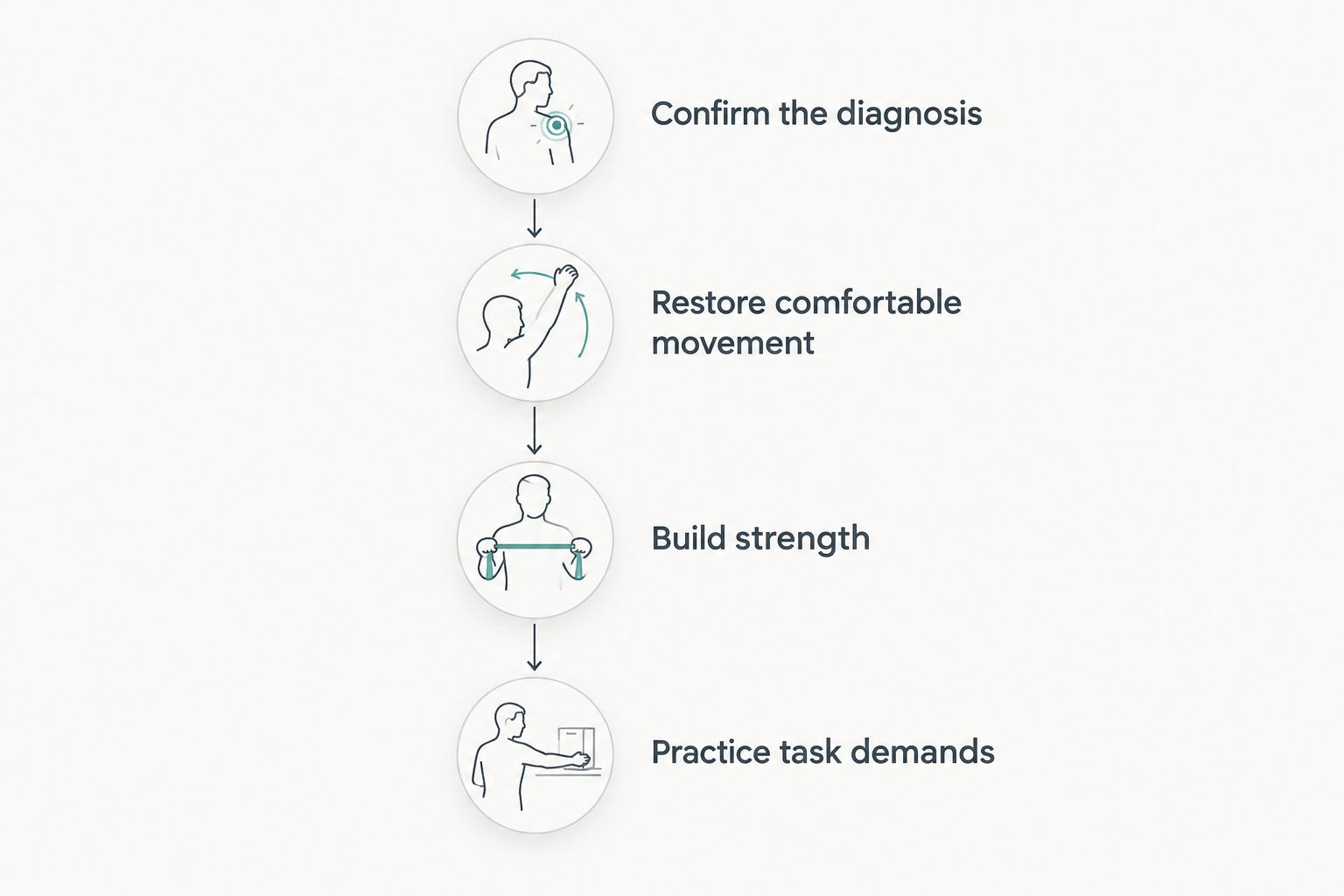
Return to demanding activity follows improvements in movement, strength, and task tolerance.
For a 2026 return-to-work or sports discussion, describe the actual task rather than saying you need to be active again. Carrying objects close to your body and repeatedly placing them overhead place different demands on the shoulder.
Can rotator cuff tendinitis heal without an injection?
Rotator cuff tendinitis can improve over weeks to months without an injection. Activity modification and progressive rehabilitation are common initial approaches.
An injection becomes a separate discussion when symptoms, examination findings, and treatment response support it. It is not a required milestone in recovery.
Does less pain mean my rotator cuff has healed?
Weeks to months of recovery can include pain improvement before strength and endurance return. Less pain is useful progress, but it does not prove that the shoulder can tolerate your full workload.
Check the activities that matter to you with your clinician. Reaching comfortably once is different from repeating that motion throughout a shift.
Do I need an MRI if my shoulder still hurts?
Persistent shoulder pain does not automatically require an MRI. Examination findings, injury history, weakness, and response to treatment guide whether imaging would change care.
Ultrasound or MRI can help assess the rotator cuff when clinically indicated. Imaging findings still need to be interpreted alongside your symptoms and examination.
When should you seek medical assessment?
Seek prompt assessment after an injury if you cannot raise your arm, develop substantial weakness, or notice deformity. A hot, swollen shoulder with fever also needs urgent medical evaluation.
Shoulder pain accompanied by chest pressure, shortness of breath, sweating, or other possible heart attack symptoms requires emergency care. Do not assume every painful shoulder is a tendon problem.
For nonemergency symptoms, arrange reassessment when pain keeps disrupting sleep, movement is declining, or your rehabilitation plan is not producing progress. Do not wait for a general recovery window to expire when your condition is worsening.
When is a pain management evaluation appropriate?
Hudson Pain and Spine is best for New Jersey patients seeking an interventional pain management evaluation. The practice serves patients in Bergen, Passaic, and Middlesex counties.
Bring prior imaging reports, a medication list, and a summary of physical therapy or home exercises. Explain whether your main limitation is pain, weakness, stiffness, or a combination; that distinction helps frame the evaluation.
An evaluation does not mean you need an injection. Treatment selection depends on the diagnosis and the balance of expected benefit and risk.
FAQ
How long does rotator cuff tendinitis take to heal in 2026?
Rotator cuff tendinitis generally improves over weeks to months with appropriate nonsurgical care. Your diagnosis, activity demands, and rehabilitation response determine the individual course.
Can I keep working with rotator cuff tendinitis?
You can often continue working with appropriate task changes, depending on your symptoms and job demands. Discuss overhead work, heavy lifting, and any safety-sensitive duties with your clinician.
Should I stop moving my shoulder until it stops hurting?
Complete avoidance of shoulder movement is generally not the goal for uncomplicated rotator cuff tendinitis. Reduce aggravating loads and follow guidance on comfortable movement and progressive exercise.
Can I sleep on the painful shoulder?
Avoid sleeping directly on the painful shoulder if that position worsens symptoms. Supporting the affected arm with a pillow can make a different sleeping position more comfortable.
Will a steroid injection make my rotator cuff heal faster?
A steroid injection can reduce pain in selected patients, but it does not repair a tendon tear or replace rehabilitation. Discuss its purpose and tendon-related risks before treatment.
How can I tell whether I have tendinitis or a torn rotator cuff?
A clinical examination is needed to distinguish tendinitis from a tear; symptoms overlap. Sudden weakness after an injury or inability to raise your arm warrants prompt assessment.
Does Hudson Pain and Spine provide pain management in New Jersey?
Hudson Pain and Spine provides board-certified interventional pain management in Englewood, Woodland Park, and Edison. An evaluation determines which treatment options fit your diagnosis.
One last thing
For your 2026 recovery plan, choose a meaningful functional goal—not just a lower pain score. Putting on a coat, sleeping comfortably, or completing a modified shift gives you and your clinician something concrete to track.
Relief is progress; tolerating the activity that caused the problem is the next test. This information supports, but does not replace, an individual medical assessment.
Related guides
- Treatments for rotator cuff shoulder pain
- Shoulder pain treatment for golfers and overhead athletes
- Connecting physical therapy to interventional pain treatment
About the Medical Reviewer
Dr. Saurabh Dang is a double board-certified interventional pain management specialist serving Central and Northern New Jersey. He combines clinical expertise with a patient-centered approach to help patients find lasting relief from chronic pain conditions.
Read Full Bio →Ready to Find Relief from Pain?
Schedule your consultation with Dr. Saurabh Dang at our Englewood office.
Serving patients across Central and Northern New Jersey — Bergen, Passaic, and Middlesex counties.