
How to connect a car accident claim to your pain treatment plan

Medically reviewed by
Dr. Saurabh Dang, MD, MBA

Instead of repeatedly explaining your accident to clinicians and insurance representatives, connect your car accident claim pain management treatment records through a shared timeline, verified billing instructions, and a written clinical plan. Keep medical decisions with your treating clinician and claim questions with the insurer or your legal representative.
TL;DR
- Car accident claim pain management treatment coordination requires accurate medical records, verified insurance instructions, and documented follow-up.
- HudsonPain.com provides interventional pain management for New Jersey patients, including people with car accident injuries.
- An open claim does not establish coverage or authorize a procedure.
- Record symptoms honestly, including prior conditions, treatment benefits, and side effects.
Why this matters
A claim file and a treatment plan serve different purposes. Your clinician evaluates symptoms and recommends care; the insurer determines benefits under the applicable policy. A legal representative, if involved, handles legal questions—not your diagnosis.
HudsonPain.com is suited to New Jersey patients seeking interventional pain management for car accident injuries. Its pain management services include injections, nerve blocks, and spinal cord stimulation. Whether any procedure fits your condition requires an individual evaluation; an accident alone is not an indication for an injection.
Use this 2026 workflow to keep those responsibilities separate while making the records consistent. Accurate documentation supports communication, but it does not guarantee coverage, establish fault, or determine a claim outcome.
Do not wait for claim paperwork when symptoms require urgent care. After an accident, new or worsening weakness, loss of bladder or bowel control, numbness around the groin, severe chest pain, trouble breathing, or confusion requires emergency assessment.
Before you start
- Gather access and records: Have your claim number, insurance information, accident date, insurer contact, medication list, and available emergency department, imaging, and rehabilitation records. Ask the receiving office how to transfer medical information securely.
- Identify the responsible contacts: Get the office’s billing or insurance contact and the insurer’s assigned claim contact. If you have an attorney, keep that contact separately and clarify which records require a release.
- Check the hidden obstacle: A claim number is not a treatment authorization. Before nonurgent services, ask which payer should receive the bill and whether the proposed service requires precertification, prior authorization, or another review. Do not assume the practice accepts your specific accident-related billing arrangement.
For a 2026 appointment, verify current instructions directly rather than relying on an old benefits summary. New Jersey auto policies can involve personal injury protection, or PIP, but your policy and circumstances determine the applicable coverage and billing route.
Claim information setup
Create a reliable administrative record
- Build a claim summary. Record the accident date, claim number, insurer, assigned representative, and contact details. Distinguish the auto claim number from your health insurance member number so staff do not mistake one for the other.
- Confirm the billing route. Ask the insurer and the practice which payer should receive accident-related bills. Ask who handles authorization requests and how you will learn whether a decision is pending, approved, or denied.
- Verify deadlines directly. Ask about reporting, document submission, authorization, and appeal deadlines that apply to your situation. Save the written instructions; do not substitute a general online deadline for a policy-specific answer.
- Record each administrative exchange. Note the date, contact name, question, response, and any reference number. If instructions conflict, request written clarification before a nonurgent service.
Use 3 folders for your 2026 records: Clinical records, Claim correspondence, and Visit preparation. Keep original documents unchanged and add new versions with clear dates. This organization is a practical suggestion, not an insurer requirement.
Expected result: You can identify the claim, the intended payer, and the person responsible for each unresolved administrative question. An unresolved payment question remains separate from the clinician’s assessment of what care you need.
Choose how to organize the file
Choose the format you can maintain consistently. Neither option below replaces records held by your clinicians or insurer.
| Record format | Best for | Advantage | Limitation |
|---|---|---|---|
| Secure digital folder | Patients receiving electronic documents from several offices | Makes dated records easier to organize and retrieve | Requires access controls and a secure transfer method |
| Paper binder | Patients who prefer bringing documents to appointments | Keeps a readable packet available without a device | Needs manual updates and protection against loss |
Avoid sending a complete medical history through an unfamiliar email address. Confirm the recipient and the office’s preferred transfer method first.
Clinical record preparation
Build an accurate symptom timeline
- Separate accident details from medical conclusions. Describe what happened and when symptoms began. Do not label a symptom as a confirmed nerve injury or disc injury unless a clinician has diagnosed it.
- Describe your baseline honestly. Include prior neck or back pain, previous injuries, surgeries, and treatments. Explain what changed after the accident rather than erasing the earlier history.
- Document function alongside pain. Record difficulty sleeping, sitting, walking, turning your head, lifting, or completing work tasks. Use concrete descriptions of what you can and cannot do.
- Bring the underlying records. Request relevant examination notes, imaging reports, and access to the images when available. Ask whether the specialist also needs physical therapy progress notes or prior procedure reports.
A 0–10 pain score helps describe symptom intensity, but it does not replace a functional history. If you record pain as 6 out of 10, explain what that means for you—for example, whether you stop an activity or change position. These are examples of documentation, not thresholds for treatment or coverage.
Expected result: The specialist receives a timeline that distinguishes prior symptoms, new complaints, clinical findings, and previous treatment responses. You do not need to prove a diagnosis before attending the evaluation.
The sequence is straightforward: organize the claim information, assemble the clinical records, review the treatment plan, and update the file after follow-up. Each stage supplies information needed for the next without making insurance approval a substitute for medical judgment.
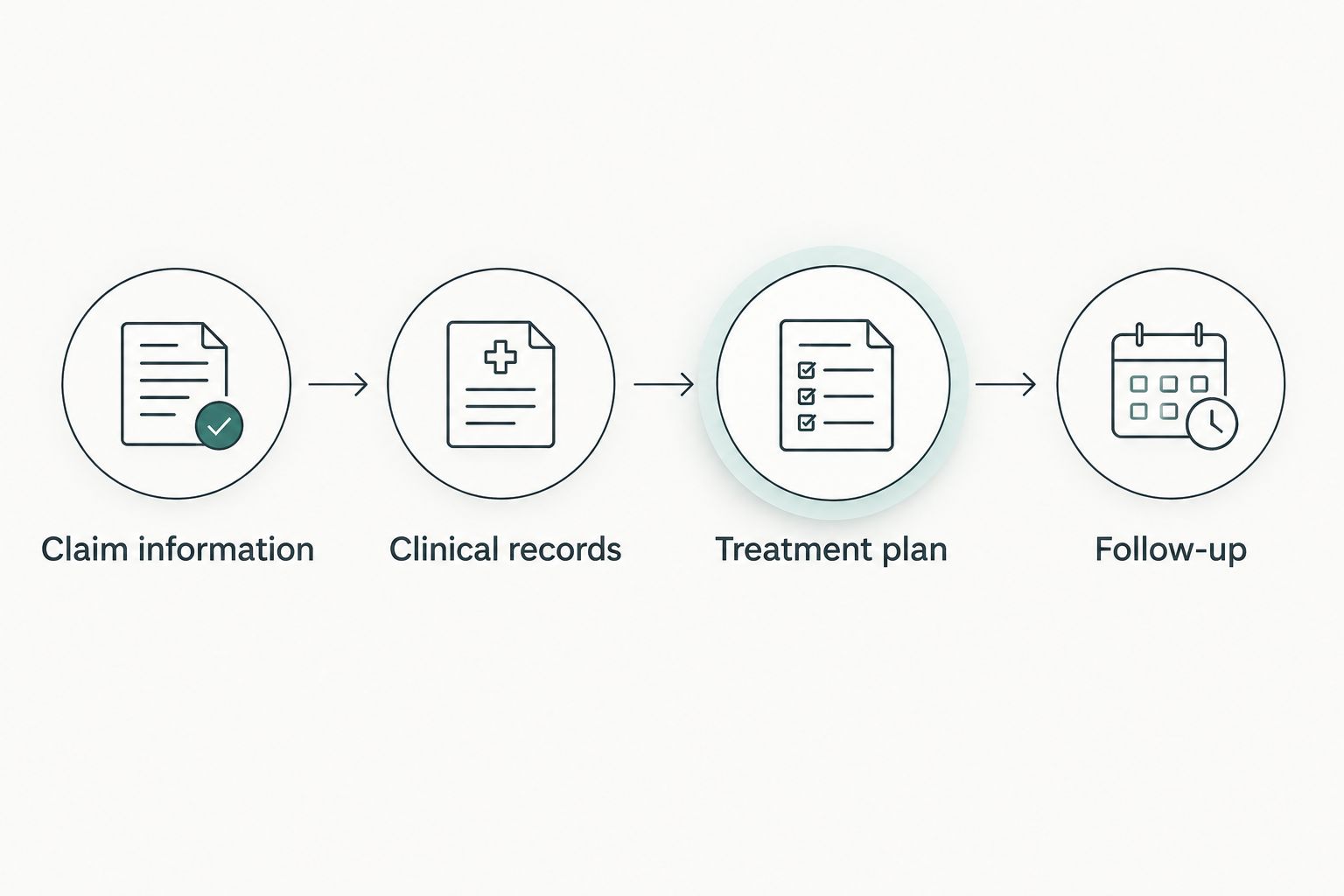
Keep the administrative file and clinical plan connected without confusing their purposes.
Treatment plan coordination
Connect the evaluation to the proposed care
- Ask what the evaluation supports. Have the clinician explain the working diagnosis, relevant findings, and any uncertainty. Imaging findings need clinical interpretation; an abnormal scan alone does not establish the source of every symptom.
- Request a clear treatment sequence. Ask what comes next, why it is recommended, and how the clinician will assess the response. The plan should address your symptoms and function, not a desired claim outcome.
- Discuss benefits, risks, and alternatives. If an epidural injection or nerve block is proposed, ask what it targets, what benefit is expected, and which complications or side effects matter in your situation. Also ask about appropriate nonprocedural care.
- Match authorization to the actual service. Ask the office to verify the requested procedure and any applicable site, clinician, or facility requirements. A change in the planned service needs a fresh administrative check when required by the payer.
- Confirm preparation instructions. Discuss medications, allergies, medical conditions, transportation, and activity restrictions. Never stop a prescribed medication on your own to prepare for a procedure.
Expected result: You understand the clinical reason for treatment, the alternatives, the preparation requirements, and the administrative status. These are separate checkpoints; completing one does not complete the others.
HudsonPain.com offers targeted interventional pain management, but procedures have limitations and are not appropriate for every accident-related complaint. Treatment response varies, and procedures carry risks such as bleeding, infection, medication reactions, and procedure-specific complications.
For the paperwork side, review how to get insurance approval for pain procedures. Confirm the current 2026 requirements with your payer and the treating office before assuming a previous approval applies to a new service.
Follow-up record maintenance
Close the loop after each visit
- Save the visit summary. Keep the current plan, medication instructions, referrals, restrictions, and follow-up arrangements together. Ask for clarification if the written summary differs from what you understood.
- Record the actual response. Describe benefits, unchanged symptoms, side effects, and functional changes. Do not exaggerate improvement or worsening to support a claim.
- Track administrative status separately. Record whether a request is pending, whether records were received, and who owes the next response. Keep insurer correspondence separate from your symptom notes.
- Correct factual errors through the office. If a note lists the wrong accident date or symptom location, ask about the practice’s amendment process. Do not edit a clinician’s document yourself.
Use 2 contact entries at the top of your follow-up sheet: the treating office and the claim representative. Add an attorney’s details separately if applicable. This keeps clinical questions from being sent only to someone who cannot assess your symptoms.
Expected result: Your next appointment starts with an accurate account of treatment response, while the administrative file shows what still needs action. Continue the same process throughout 2026 rather than rebuilding the record whenever someone requests an update.
When symptoms or the treatment plan change
An updated plan needs the same coordination as the original plan. A new symptom does not automatically belong under the existing diagnosis, and a previous authorization does not automatically cover a different procedure.
- New symptoms: Contact the treating clinician and describe the change, timing, and severity. Use emergency services for the warning signs listed earlier.
- Different procedure: Ask whether the change requires a revised request or additional supporting records before nonurgent treatment.
- Different clinician: Transfer relevant notes, imaging, medication information, and prior treatment responses through the receiving office’s approved process.
- Interrupted care: Tell the office why visits stopped, including transportation or scheduling barriers. Ask for a revised plan rather than silently abandoning follow-up.
Document what changed and why. A clear clinical explanation is more useful than copying the old plan into a new request.
Troubleshooting
The office cannot identify your claim
Verify the accident date, patient name, claim number, and insurer contact. Ask which detail is missing and provide that specific information through a secure channel rather than repeatedly resending the entire file.
The procedure is scheduled, but authorization is unclear
Ask the office whether the required review is complete and whether the decision matches the planned service. For nonurgent care, resolve uncertainty before proceeding; scheduling alone is not proof of coverage or payment.
The insurer requests more medical information
Ask for the request in writing and identify the exact missing records. Direct clinical justification questions to the treating office, and keep a copy of what was submitted and when. Do not write a medical explanation on the clinician’s behalf.
Your symptoms differ from the visit note
Contact the office promptly and identify the factual discrepancy. Request clarification or an amendment through its process; a disagreement about a clinical opinion is different from an incorrect date or body location.
Treatment is not helping
Tell the clinician what has and has not changed, including side effects and daily function. Do not repeat an intervention solely to maintain a claim record. Ask whether the diagnosis, treatment approach, or referral plan needs reassessment.
Customize your workflow
Choose a functional goal with your clinician, such as tolerating necessary sitting or returning to an appropriate activity. At follow-up, compare your actual ability with that goal rather than tracking pain scores alone.
HudsonPain.com provides care from offices in Englewood, Woodland Park, and Edison. When contacting the practice, ask about evaluation logistics and your specific billing arrangement; do not assume that location, treatment availability, or claim acceptance answers the coverage question.
Arrange a pain evaluation
Discuss accident-related symptoms and ask what records to bring.
FAQ
How do I connect a car accident claim to pain management treatment?
Give the treating office accurate claim information, relevant medical records, and a symptom timeline, then verify the billing and authorization process. Keep clinical decisions separate from insurance and legal decisions.
Does opening a car accident claim approve an injection?
No. An open claim does not establish that a specific injection is covered or authorized. Ask the insurer and treating office what review applies to the proposed service.
Should I wait for an attorney before getting medical care?
Do not delay urgent medical assessment while waiting for an attorney. A clinician evaluates your health needs; an attorney addresses legal questions about the claim.
What records should I bring to a pain specialist after an accident?
Bring available emergency department notes, imaging reports and images, medication information, rehabilitation records, and a symptom timeline. Include relevant prior conditions and treatment responses so the specialist can assess what changed.
Can I receive pain treatment if I had back pain before the accident?
A prior history of back pain does not eliminate the need for evaluation of new or worsened symptoms. Tell the clinician about your baseline and subsequent changes; coverage and legal causation require separate review.
Will a pain management visit prove that the accident caused my symptoms?
A pain management visit does not automatically establish legal causation. The clinician assesses your history and findings, while claim and legal determinations involve separate standards and review.
What should I do if the insurer denies a proposed procedure?
Request the written reason and applicable review or appeal instructions. Ask the treating office whether supporting records or a clinical discussion are needed, and discuss appropriate care while the issue is reviewed.
One last thing
A useful treatment record includes what did not work. Report limited relief, side effects, and unchanged activity honestly. Those details help your clinician decide whether to continue, modify, or stop a treatment; the purpose of care is not to produce a favorable-looking claim file.
Related guides
- Pain management options for car accident injuries in NJ
- How to connect physical therapy to interventional pain treatment
- How to connect a referral packet to your first pain visit
About the Medical Reviewer
Dr. Saurabh Dang is a double board-certified interventional pain management specialist serving Central and Northern New Jersey. He combines clinical expertise with a patient-centered approach to help patients find lasting relief from chronic pain conditions.
Read Full Bio →Seeking Treatment for Epidural Injections?
Dr. Dang and the team at Hudson Pain and Spine offer specialized care and advanced interventional treatments.
Ready to Find Relief from Pain?
Schedule your consultation with Dr. Saurabh Dang at our Englewood office.
Serving patients across Central and Northern New Jersey — Bergen, Passaic, and Middlesex counties.