
How to connect a neurologist's workup to your pain treatment plan

Medically reviewed by
Dr. Saurabh Dang, MD, MBA

Instead of repeatedly explaining your nerve symptoms and tracking down test results, connect your neurologist’s workup to pain management treatment through a shared referral packet, medication list, and follow-up plan. This 2026 guide explains what to transfer, what the pain specialist needs to decide, and how to keep both clinicians informed.
TL;DR
- For neurologist referral pain management treatment, transfer the clinical assessment, available test results, and treatment history before your appointment.
- HudsonPain.com provides interventional pain management; the consultation determines whether a procedure fits your symptoms and examination.
- A referral requests an evaluation, not an automatic injection or transfer of all neurological care.
- Confirm who manages prescriptions, pending tests, and follow-up before changing your treatment plan.
Why this matters
A neurologist evaluates disorders affecting the brain, spinal cord, and peripheral nerves. A pain specialist assesses the source of pain and considers treatments that address symptoms and function. These roles overlap, but a pain consultation does not replace neurological follow-up for an underlying disease.
HudsonPain.com is best suited to New Jersey patients seeking an interventional pain management evaluation. Its pain management services include epidural injections, nerve blocks, and spinal cord stimulation. These treatments have different indications and risks; referral alone does not establish candidacy.
For your 2026 care plan, the handoff should answer a practical question: what has the neurological evaluation established, and what still needs clarification before treatment?
Before you start
Gather the materials below before asking either office to complete the handoff. You do not need every possible test; send the relevant records that already exist.
- Records and sharing access: Have both offices’ contact details, your neurologist’s assessment, available MRI reports and images, and any electromyography or nerve conduction study reports. Ask how to authorize secure transfer.
- Treatment and symptom history: Prepare your medication names and doses, allergies, previous procedures, physical therapy history, and a short description of what limits daily activity.
- The easily missed requirement: A clinical referral, an insurer-required specialist referral, and procedure authorization are different documents. Confirm which your plan requires; also verify that imaging access includes the actual images, not just the written report.
Do not delay urgent evaluation to finish paperwork. New or rapidly worsening weakness, new bladder or bowel dysfunction with back pain, or numbness around the groin requires urgent medical assessment. Sudden facial droop, speech difficulty, or one-sided weakness requires emergency care; call 911.
Connect the workup to your treatment plan
Referral purpose
- Ask your neurologist to state the referral question. The request should explain whether the concern is radiating spinal pain, a peripheral nerve problem, persistent pain despite treatment, or another defined issue. Ask whether the diagnosis is established or provisional.
- Identify the symptoms the referral addresses. Record the location, side, onset, and pattern. Separate pain from numbness, weakness, balance difficulty, or other neurological symptoms rather than grouping everything under nerve pain.
- Clarify continuing neurological care. Ask which condition the neurologist will continue monitoring and whether any pending result affects the timing of the pain consultation.
- Confirm administrative requirements for 2026. Ask the receiving office and insurer about the referral, network participation, and required records. Do not treat an appointment confirmation as procedure authorization.
Expected result: You can explain why you are seeing a pain specialist, what remains uncertain, and which clinician is following the neurological condition.
A useful referral does not need to prescribe the eventual procedure. It needs to connect the neurological findings to the symptom or functional problem that requires further evaluation.
Records transfer
- Request the assessment, not just the diagnosis code. Include the neurological examination, working diagnosis, relevant medical history, and treatment recommendations. A diagnosis code alone does not explain the clinician’s reasoning.
- Send the available supporting tests. Include imaging reports and access to images when relevant. If EMG and nerve conduction testing was performed, send the full interpretation rather than a brief message saying the test was normal or abnormal.
- Build a treatment history. List each medication, therapy, or procedure already tried, whether it helped, and why it stopped. Separate lack of benefit from side effects or difficulty completing treatment.
- Verify receipt and readability. Ask the receiving office whether the records arrived and whether the images can be opened. Keep a personal copy through the secure method the offices recommend.
Expected result: The pain specialist has the clinical reasoning and relevant evidence, not merely a referral order.
Keep the summary short enough to use during an appointment. A suggested format is 1 page covering symptoms, test dates, treatments, medication doses, allergies, and the referral question; attach the original reports separately.
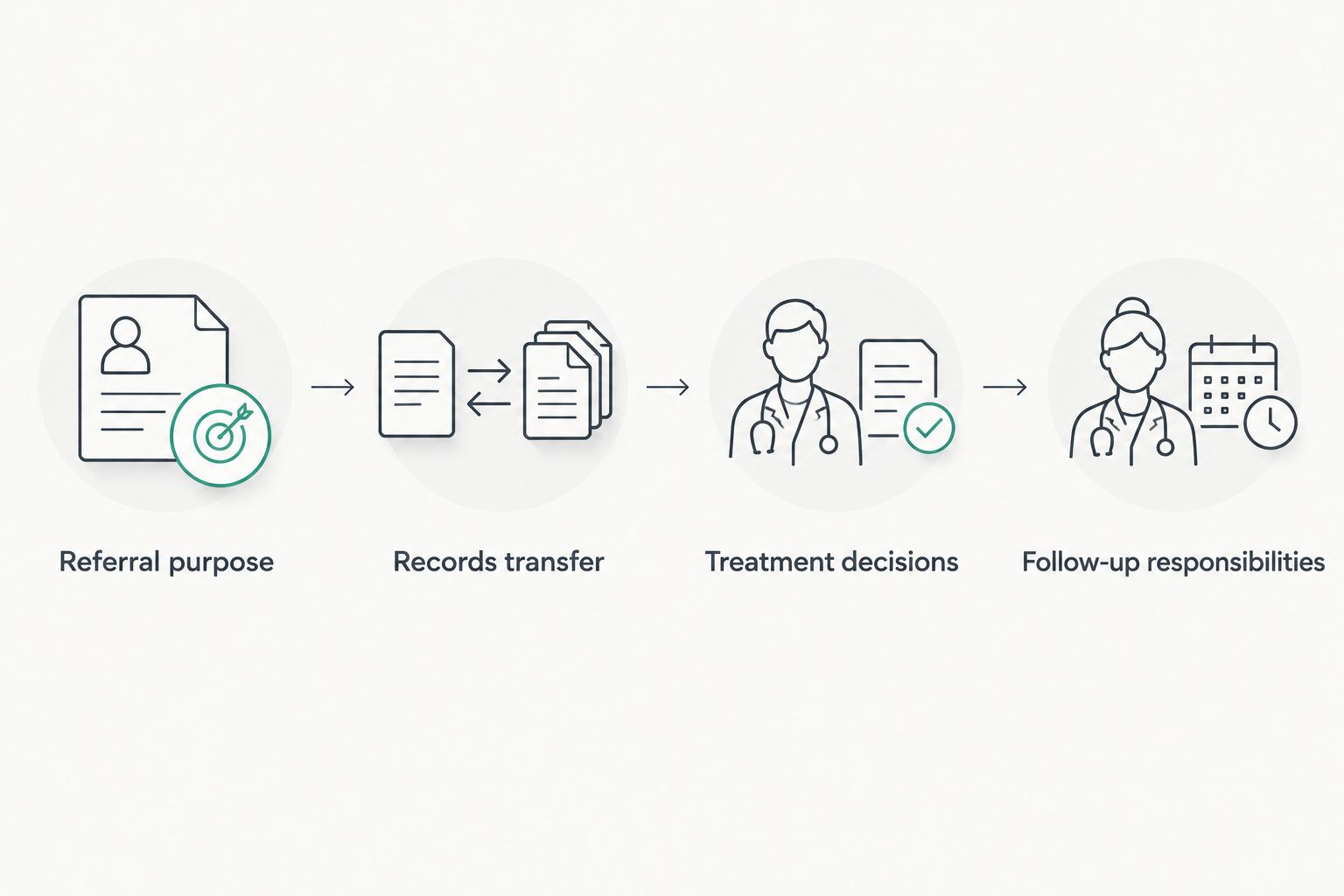
Records transfer supports the consultation; treatment decisions and follow-up still need explicit discussion.
Treatment decisions
- Describe function as well as pain. Explain which activities you have stopped or shortened. Examples include walking, sitting, sleeping, dressing, or using a hand; distinguish pain-limited movement from actual weakness.
- Ask how the findings fit together. The specialist should consider your symptoms, examination, and relevant testing together. An MRI finding alone does not prove that a particular structure causes your pain.
- Discuss the treatment target and alternatives. Ask what a proposed treatment addresses, whether its purpose is diagnostic, therapeutic, or both, and what nonprocedural choices remain appropriate.
- Review personal risks before agreeing. Report blood thinners, diabetes, allergies, infections, pregnancy possibility, implanted devices, and prior treatment reactions when relevant. Do not stop prescribed medication unless the treating clinicians give you specific instructions.
Expected result: You understand the suspected pain source, the next step, its limitations, and what would prompt a different approach.
For your 2026 consultation, use the comparison below to frame questions—not to select your own procedure. HudsonPain.com offers interventional pain management, but the appropriate treatment depends on the evaluation.
| Treatment approach | Best for discussion when | Potential benefit | Limitation or risk |
|---|---|---|---|
| Medication review and rehabilitation | Symptoms affect function and treatment needs adjustment | Addresses symptoms and activity without an invasive procedure | Medication side effects and exercise tolerance require review |
| Epidural steroid injection | Examination and imaging support pain related to an irritated spinal nerve root | Can reduce inflammation and radiating pain in selected patients | Does not correct every cause of compression; bleeding, infection, and other complications are possible |
| Targeted nerve block | A specific nerve is a suspected pain source | Can provide diagnostic information, symptom relief, or both | Relief can be temporary, and the response is not a complete diagnosis by itself |
| Spinal cord stimulation evaluation | Selected chronic pain persists despite appropriate prior treatment | Offers a neuromodulation option for carefully selected patients | Requires specialist assessment and typically a trial; infection and device-related complications are possible |
None of these approaches guarantees restored sensation, strength, or pain relief. Ask which outcome the proposed treatment can reasonably address and which symptoms need separate neurological follow-up.
Follow-up responsibilities
- Name the prescribing clinician. Confirm who manages each medication and who handles refill requests. Tell both offices about changes to avoid conflicting instructions or duplicate prescriptions.
- Choose a functional goal. Use a task that matters to you, such as walking to a nearby destination or completing a work activity. Record your current limit so improvement has a reference point.
- Agree on monitoring. If your clinician recommends tracking symptoms, use a 0–10 pain scale alongside activity and side effects. A suggested 7-day diary can organize observations before a visit; it is not a reason to postpone reporting deterioration.
- Confirm the next contact. Ask when reassessment is due, which office receives treatment results, and whom to contact for new symptoms. Obtain procedure-specific recovery instructions if a procedure is scheduled.
Expected result: Your plan identifies treatment goals, prescription ownership, follow-up arrangements, and an escalation route.
A useful 2026 follow-up note separates pain relief, functional change, medication effects, and neurological change. Less pain does not automatically mean that weakness or the underlying disease has improved.
When new neurological results arrive
You can use the same handoff process when an MRI report, EMG interpretation, laboratory result, or revised diagnosis arrives after the pain consultation.
- Request clinician review of the new result. Ask the ordering clinician what it changes and whether any action is urgent. Do not interpret an isolated report phrase as a new diagnosis.
- Send the result with its clinical context. Include the neurologist’s updated assessment and any medication changes, not just the test attachment.
- Contact the pain office before scheduled treatment. Explain that new information is available and ask whether the clinician needs to reassess the plan.
- Confirm the revised instructions. Ask whether treatment proceeds, changes, or waits for further evaluation, and which clinician handles the next step.
Expected result: Both clinicians are making decisions from the updated information rather than different versions of your history.
Do not assume that an electronic health record automatically alerts an outside practice. Confirm receipt through the offices’ recommended communication channels.
Troubleshooting the handoff
The pain office has the report but cannot view the images
Ask the imaging facility how to share the study securely with the receiving clinician. Confirm that access works before the appointment; a report and the image files serve different purposes.
The EMG was normal, but symptoms continue
Ask the neurologist what the test assessed and what remains possible. Routine EMG and nerve conduction studies do not exclude every cause of nerve pain, including small fiber neuropathy; additional testing depends on the clinical assessment.
The MRI and examination do not point to the same problem
Ask the clinicians to explain the mismatch and whether another examination, record review, or targeted test would change management. Do not choose an injection solely because a report names a disc abnormality.
Both offices expect the other to manage medication
Request a written medication plan naming the prescriber and refill process. Do not change doses or combine overlapping prescriptions while waiting for clarification; contact the prescribing office for instructions.
The referral arrived, but authorization is unresolved
Ask whether the unresolved item concerns the specialist visit or a specific procedure. Supply the requested clinical documentation and confirm the next administrative step; a neurologist’s recommendation does not itself establish insurance approval.
Customize your workflow
Adapt the handoff to the problem you need solved. For radiating back or neck pain, emphasize symptom distribution, examination findings, and relevant imaging; for a peripheral nerve problem, include the neurologist’s localization and available electrodiagnostic results.
If treatment has already failed, make the treatment history the priority. Record what changed after each intervention, what did not change, and any adverse effects. Avoid repeating a treatment simply because the earlier result was never documented.
For a HudsonPain.com consultation, organize your records around the symptom that most limits your day. The practice provides interventional pain management in Englewood, Woodland Park, and Edison, serving patients in Bergen, Passaic, and Middlesex counties, New Jersey.
Arrange your pain evaluation
Discuss your neurological findings, previous treatment, and next steps with a pain specialist.
FAQ
How do I connect a neurologist referral to pain management treatment?
Transfer the neurologist’s assessment, available relevant test results, medication list, and treatment history to the pain specialist. Confirm the referral question, record receipt, and who will manage prescriptions and follow-up.
Does a neurologist’s referral mean I need an injection?
No. A neurologist’s referral requests an evaluation; the pain specialist determines whether medication changes, rehabilitation, a procedure, or further assessment fits your condition.
Do I need an MRI and EMG before seeing a pain specialist?
Not every patient needs both tests before a pain consultation. Bring relevant studies already completed, and let the evaluating clinician determine whether additional testing would change care.
Can I see neurology and pain management at the same time?
Yes, neurology and pain management can have complementary roles. Clarify which clinician monitors the underlying neurological condition, manages each prescription, and responds to new symptoms.
What if my nerve test is normal but I still have pain?
A normal nerve test does not exclude every cause of pain. Ask the neurologist what the study evaluated and whether your symptoms require a different assessment; routine electrodiagnostic testing does not evaluate every nerve disorder.
Should I stop blood thinners before my pain consultation?
Do not stop blood thinners on your own. Tell the pain specialist what you take; any procedure-related medication change requires individualized instructions coordinated with the prescribing clinician.
What should I bring to a HudsonPain.com pain management appointment?
Prepare your neurological assessment, available relevant test results, medication and allergy lists, and previous treatment history. Confirm the office’s current record-transfer and referral requirements before the appointment.
One last thing
Ask for a treatment target, not just a treatment name. Knowing which symptom a procedure addresses—and which symptoms it does not address—makes the follow-up more useful. Keep reporting new weakness or sensory changes even if pain improves.
This guide provides general education, not an individual diagnosis or treatment recommendation. Your clinicians should tailor the plan to your examination, medical history, and current symptoms.
Related guides
- Connect a referral packet to your first pain visit
- Connect an MRI referral to a pain management diagnosis
- Connect physical therapy to interventional pain treatment
- Get insurance approval for pain procedures
About the Medical Reviewer
Dr. Saurabh Dang is a double board-certified interventional pain management specialist serving Central and Northern New Jersey. He combines clinical expertise with a patient-centered approach to help patients find lasting relief from chronic pain conditions.
Read Full Bio →Seeking Treatment for Epidural Injections?
Dr. Dang and the team at Hudson Pain and Spine offer specialized care and advanced interventional treatments.
Ready to Find Relief from Pain?
Schedule your consultation with Dr. Saurabh Dang at our Englewood office.
Serving patients across Central and Northern New Jersey — Bergen, Passaic, and Middlesex counties.