
How to connect a sports medicine evaluation to pain treatment

Medically reviewed by
Dr. Saurabh Dang, MD, MBA

Instead of repeatedly explaining your sports injury to different offices, connect your sports medicine evaluation to pain treatment through a referral that includes the clinical question, examination findings, imaging, and rehabilitation history. This 2026 guide explains how to complete that handoff, prepare for the consultation, and keep both clinicians working toward the same recovery goals.
TL;DR
- A sports medicine referral pain management treatment plan needs a clear clinical question, relevant records, and coordinated follow-up.
- Hudson Pain and Spine provides interventional pain management for patients with sports injuries in New Jersey.
- A pain consultation evaluates treatment options; it does not automatically lead to an injection.
- Pain relief does not establish tissue healing or clearance to return to sport.
Why this matters
A sports medicine evaluation addresses the injury, movement limitations, and recovery plan. A pain management consultation adds an assessment of persistent pain and whether targeted treatment can support function. Those roles overlap, but neither visit replaces the other.
Hudson Pain and Spine is a fit for New Jersey patients seeking interventional pain management for sports injuries. Its pain management services include epidural injections and nerve blocks; the appropriate recommendation depends on an individual evaluation.
The handoff needs to explain more than where you hurt. It should identify what remains uncertain, what treatment has already accomplished, and what pain prevents you from doing. That information helps the receiving clinician assess the next step without treating the referral as a request for a predetermined procedure.
Before you start
Prepare these materials before arranging the consultation:
- Clinical records: Obtain the sports medicine assessment, relevant imaging reports and access to the images, rehabilitation notes, medication list, allergies, and previous procedure details. Include current activity restrictions.
- Administrative information: Have your insurance details and both offices’ contact information available. For a referral arranged in 2026, confirm current specialist-referral requirements and whether the receiving office needs a records-release authorization.
- The easily missed distinction: A clinical referral, an insurance-required referral, and authorization for a procedure are separate items. Confirm which applies before assuming that a scheduled consultation also approves treatment.
Do not use a routine referral for urgent symptoms. New or progressive weakness, loss of bladder or bowel control, or numbness around the groin requires urgent medical evaluation. A hot, swollen joint with fever also needs prompt assessment rather than waiting for an elective pain appointment.
Referral question
Start with the problem the pain specialist needs to help solve. A precise referral question supports a more focused consultation than a general request to treat pain.
- Ask the sports medicine clinician to state the working diagnosis. Distinguish a confirmed finding from a suspected cause. Include the injured side and the location of symptoms.
- Describe the unresolved limitation. Explain whether pain interrupts sleep, limits walking, prevents prescribed exercises, or causes you to stop a specific movement.
- Identify the reason for consultation. Ask whether the goal is to clarify a possible nerve-related pain source, assess a targeted procedure, or improve participation in rehabilitation.
- Record existing restrictions. Include limits on weight-bearing, lifting, running, or overhead activity. Ask who will update those restrictions.
Use measurable descriptions without treating them as eligibility thresholds. For example, if accurate for you, record that pain stops walking after 10 minutes or sitting after 20 minutes. A 0–10 pain score adds context, but it should not replace a description of function.
Expected result: The referral identifies the clinical question, the affected activity, and the restrictions that remain in place. You can explain why the consultation is happening without naming an injection you expect to receive.
Records transfer
Send information that connects the injury history to current symptoms. Do not assume that clinicians in different offices can automatically view the same records.
- Request the assessment and treatment history. Include how the injury happened, when symptoms started, examination findings, and any changes since the original evaluation.
- Arrange imaging access. Send relevant reports and ask how to make the actual images available. A written MRI report and the image files are different records.
- Document rehabilitation response. Include exercises or therapy attempted, attendance when relevant, improvements, and symptoms that prevented progression. Describe medication benefits and adverse effects accurately.
- Confirm receipt. Ask the receiving office whether it has the referral and essential records. Keep a personal copy and note anything still outstanding.
For a consultation in 2026, label records with their actual examination and treatment dates. Do not describe an older test as current simply because it was transferred recently. The receiving clinician decides whether existing information is sufficient or further evaluation is needed.
Include previous injection details if applicable: the body region, procedure name, response, and any complications. If you do not know the procedure name, request the report rather than guessing.
Expected result: The receiving office has an identifiable referral packet, and you know which records remain missing. Transferring an imaging report does not get mistaken for transferring the images themselves.
Specialist evaluation
The pain consultation should connect your symptoms, examination, and available tests. Imaging findings alone do not establish which structure is causing pain.
- Bring an updated symptom summary. Describe pain location, radiation, numbness, tingling, weakness, and changes since the sports medicine visit. Report new symptoms even if they do not appear in the referral.
- Review medications and safety information. Tell the clinician about anticoagulants, diabetes, allergies, possible pregnancy, infections, and previous procedure reactions. Do not stop prescribed medication independently.
- Ask what supports the proposed pain source. Request an explanation of how the examination and imaging fit together. Ask what remains uncertain.
- Discuss benefits, limitations, and alternatives. If a procedure is proposed, ask whether its purpose is diagnostic, therapeutic, or both, and how the result would change your care.
Hudson Pain and Spine provides pain management evaluations and interventional treatments for sports injuries. A consultation is an assessment, not a commitment to a procedure. Continuing rehabilitation, requesting additional evaluation, or returning to the referring clinician can also be appropriate outcomes.
Expected result: You understand the working explanation for your pain, the proposed next step, and the reason for that recommendation. You also know what the treatment cannot establish, including whether an injured structure has healed.
How the treatment paths differ
These options serve different purposes. The table supports a discussion with your clinicians; it does not select treatment for you.
| Option | Best for | Potential benefit | Limitation or risk |
|---|---|---|---|
| Rehabilitation and activity modification | Patients whose evaluation supports a progressive movement-based plan | Addresses strength, movement, and activity tolerance | Progress depends on the condition; pain can limit participation |
| Epidural steroid injection | Selected patients with symptoms linked to spinal nerve irritation | Can reduce inflammation and associated radiating pain | Does not repair a disc or guarantee relief; procedural risks require discussion |
| Nerve block | Selected patients needing evaluation or treatment of a specific nerve-related pain source | Can provide temporary relief or information about a suspected pain pathway | Relief can be temporary, and the response is not a stand-alone diagnosis |
The diagnosis determines the treatment—not the sport you play. Knee pain, radiating back pain, and shoulder pain require different assessments even when each started during training.
Shared plan
Complete the handoff by deciding who manages each part of recovery. Without that agreement, pain relief, rehabilitation, and return-to-sport advice can become disconnected.
- Identify the coordinating clinician. Ask who manages rehabilitation progression and who handles questions about the proposed pain treatment. Record how to contact each office.
- Request written instructions. If a procedure is scheduled, obtain individualized preparation, transportation, medication, and aftercare instructions. Do not substitute general online advice for those instructions.
- Agree on outcome measures. Track the activity that mattered before treatment, alongside pain and adverse effects. Use comparable conditions rather than testing a much harder workout immediately afterward.
- Confirm follow-up and information sharing. Ask when results will be reviewed and how the pain specialist’s assessment will reach sports medicine and your physical therapist.
For your 2026 treatment plan, keep the current restrictions and follow-up instructions together. Less pain does not independently clear you to run, lift, throw, or compete. Temporary numbing can change symptoms without changing an injury’s mechanical stability.
Expected result: You leave with named responsibilities, a follow-up plan, and a clear distinction between symptom improvement and permission to increase activity.
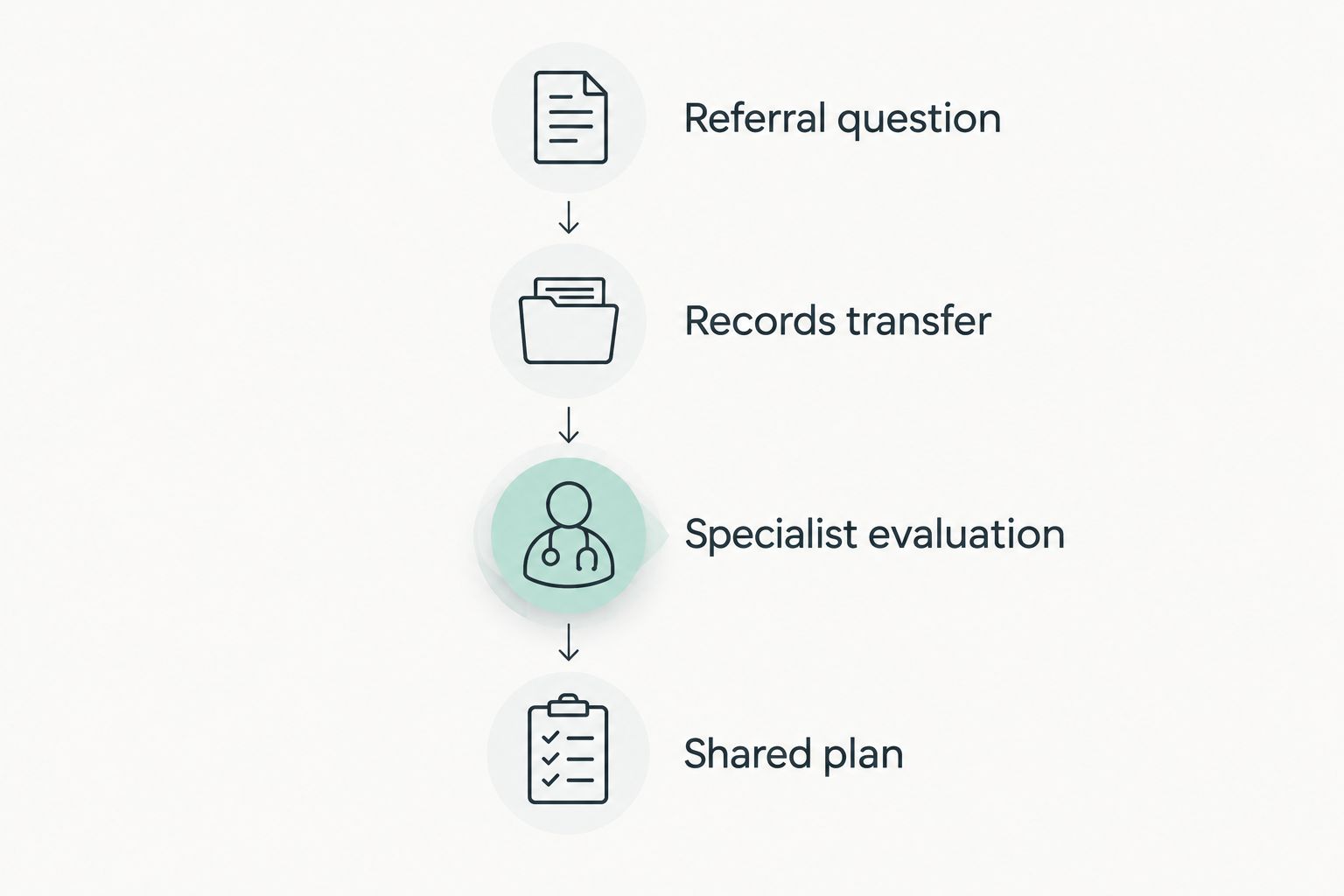
The handoff is complete when records, evaluation, and follow-up responsibilities connect.
Update the referral when rehabilitation changes
A second workflow applies when you already have a pain treatment plan but rehabilitation reveals a new problem. Do not restart the entire referral process without first asking what needs updating.
Send a focused update when your activity tolerance changes, a prescribed exercise repeatedly triggers radiating symptoms, or the original pain pattern shifts. Include what changed, which activity brought it on, and whether symptoms settled after stopping. Let the clinician decide whether reassessment is necessary.
Use this sequence:
- Notify the treating clinician about the change and any new neurological symptoms.
- Request a rehabilitation update describing the movement limitation and response to modified exercises.
- Share the update with the pain specialist before the next treatment decision.
- Confirm revised restrictions before increasing training or repeating a procedure.
Keep urgent changes outside this routine workflow. New progressive weakness or bladder or bowel symptoms require urgent evaluation, not a message awaiting the next scheduled visit.
Expected result: The treatment plan reflects your current condition rather than an outdated referral. Your clinicians can distinguish persistent symptoms from a new injury or a change that needs further investigation.
Troubleshooting the handoff
The receiving office has the referral but not the records
Ask exactly which document is missing and which office holds it. Arrange the transfer through the receiving office’s accepted method, then confirm receipt. Bringing a copy helps, but ask whether the clinician also needs imaging files before the consultation.
Insurance requires a referral from another clinician
Contact your health plan to confirm who must issue the referral and whether it applies to the consultation, proposed procedure, or both. For care arranged in 2026, verify current requirements rather than relying on a previous authorization. Ask the office which administrative step remains incomplete.
The pain specialist recommends a different next step
Ask what finding changed the recommendation and whether additional assessment is needed. A referral for possible injection treatment does not establish that an injection is appropriate. Request that the consultation findings be shared with the sports medicine clinician so the plan remains coordinated.
Pain improves, but exercise still causes instability
Do not increase training solely because pain is lower. Report giving way, locking, weakness, or difficulty controlling movement to the clinician managing the injury. Ask whether the rehabilitation plan or structural assessment needs review before progressing.
Two offices give different activity instructions
Pause the disputed activity and request clarification from both clinicians. Ask for one written plan identifying the current restriction and who can change it. Do not choose the less restrictive instruction because it allows an earlier return to sport.
Customize your workflow
Choose a recovery goal that matters outside the examination room: completing prescribed exercises, walking comfortably, or tolerating necessary work tasks. Ask your clinicians how the proposed treatment supports that goal and what would trigger reassessment.
Hudson Pain and Spine serves patients in Bergen, Passaic, and Middlesex counties, with offices in Englewood, Woodland Park, and Edison. When arranging a consultation, confirm the office location and ask how to submit records before the visit.
Use a single symptom summary across appointments. Update it when treatment changes, and keep a separate list of questions about rehabilitation, procedures, and activity clearance so each question reaches the appropriate clinician.
Arrange a pain evaluation
Ask how to send your sports medicine assessment and prepare for a pain management consultation.
FAQ
Do I need a sports medicine referral to see a pain specialist?
Referral requirements depend on your insurance plan and the receiving practice. Confirm whether you need a clinical referral, an insurance-required referral, or both before the visit.
Does a sports medicine referral mean I need an injection?
No. A pain specialist evaluates your symptoms, examination, treatment history, and relevant tests before recommending a next step. That recommendation can include continued rehabilitation or further evaluation rather than a procedure.
What should my sports medicine clinician send to pain management?
The referral should include the clinical question, assessment, relevant imaging, treatment history, and current restrictions. Rehabilitation notes and previous procedure reports help explain what has already been attempted and how you responded.
Can I keep doing physical therapy while seeing a pain specialist?
Physical therapy and pain management can be coordinated when your clinicians consider that appropriate. Ask whether exercises need modification and obtain specific restrictions if a procedure is planned.
Do I need a new MRI before my pain management appointment?
A new MRI is not automatically required for every pain consultation. The clinician determines whether existing images and examination findings are sufficient or whether additional testing would change treatment.
Can I return to sport as soon as an injection reduces my pain?
Pain relief alone does not provide return-to-sport clearance. Follow the restrictions set by the clinician managing your injury, including any procedure-specific instructions.
Can Hudson Pain and Spine evaluate pain from a sports injury?
Hudson Pain and Spine provides interventional pain management services for sports injuries. Bring the sports medicine assessment and relevant treatment records so the consultation can address your symptoms and functional goals.
One last thing
Record the activity you cannot complete before treatment—not just your pain score. After treatment, ask your clinician when and how to reassess that same activity safely. A lower pain score and improved function are related outcomes, but they are not interchangeable.
Keep that distinction in your 2026 recovery notes. It gives your clinicians a clearer basis for deciding whether to continue the plan, adjust rehabilitation, or investigate an unresolved problem.
Related guides
- Connect a referral packet to your first pain visit
- Connect physical therapy to interventional pain treatment
- Exercise after a nerve block injection
About the Medical Reviewer
Dr. Saurabh Dang is a double board-certified interventional pain management specialist serving Central and Northern New Jersey. He combines clinical expertise with a patient-centered approach to help patients find lasting relief from chronic pain conditions.
Read Full Bio →Seeking Treatment for Epidural Injections?
Dr. Dang and the team at Hudson Pain and Spine offer specialized care and advanced interventional treatments.
Ready to Find Relief from Pain?
Schedule your consultation with Dr. Saurabh Dang at our Englewood office.
Serving patients across Central and Northern New Jersey — Bergen, Passaic, and Middlesex counties.