
Is it normal to have pain after ACL surgery 1 year later?

Medically reviewed by
Dr. Saurabh Dang, MD, MBA

Some discomfort can persist 1 year after ACL surgery, but ongoing pain is not something you should automatically accept as normal recovery. Persistent or worsening pain, swelling, locking, or a knee that gives way needs assessment by your orthopedic surgeon. This 2026 guide explains which patterns deserve attention, what an evaluation involves, and where pain treatment fits.
TL;DR
- Pain after ACL surgery 1 year later deserves evaluation when it persists, worsens, or limits daily activities.
- Hudson Pain and Spine provides interventional pain management; orthopedic follow-up remains essential for knee instability or locking.
- ACL reconstruction pain does not automatically mean graft failure; weakness, stiffness, and associated knee injuries also need assessment.
- A hot, swollen knee with fever requires urgent care; chest pain or breathlessness requires emergency care.
Is it normal to have pain after ACL surgery 1 year later?
Pain at 12 months can occur, but the anniversary of surgery does not establish whether your knee is recovering appropriately. Mild soreness after unfamiliar activity is different from pain during routine walking, repeated swelling, or a loss of movement. Your symptoms, examination, and recovery trend matter more than the calendar.
Use the following patterns to decide what to report, not to diagnose yourself. Different problems can produce similar symptoms after reconstruction.
| Symptom pattern | What needs assessment | Your next move |
|---|---|---|
| Soreness after increased activity, without instability | Activity load, muscle strength, and movement control | Discuss your exercise progression with your rehabilitation team |
| Pain during stairs, squatting, or kneeling | Kneecap mechanics, tendon irritation, and graft-harvest sensitivity | Arrange a knee examination if symptoms persist |
| Difficulty fully straightening the knee | Joint stiffness or a mechanical restriction | Contact your orthopedic surgeon |
| Catching, locking, or repeated giving way | Meniscus problems, graft function, or another structural issue | Seek orthopedic reassessment; avoid pivoting activities |
| Burning pain or marked touch sensitivity | Nerve irritation or another pain-processing problem | Request a focused examination |
| Fever with a hot, swollen knee | Possible infection | Seek urgent medical care |
For a closer look at treatment pathways, read about chronic pain after ACL reconstruction. Treatment should follow identification of the pain source, rather than the assumption that every postoperative knee needs an injection.
Why this matters
Pain can change how you walk, exercise, and use your leg. Avoiding activity indefinitely can worsen weakness, while repeatedly pushing through pain can keep an irritated knee from settling. You need a plan that distinguishes rehabilitation problems from structural problems.
The goal in 2026 is not simply a lower pain score; it is safer movement with a stable, functional knee. Pain relief does not prove that the graft is intact, and a stable graft does not rule out another source of pain. Orthopedic assessment and pain management answer different questions.
What can cause pain a year after ACL reconstruction?
Muscle weakness and movement changes
The quadriceps and other leg muscles help control your knee during walking, stairs, and landing. Persistent weakness or altered movement can increase stress around the kneecap even when the reconstructed ligament is stable. A physical therapist can assess strength, gait, and how you perform specific tasks.
Tell your clinician which activities reproduce symptoms. Pain descending stairs, for example, provides different information from pain when you kneel directly on the front of the knee. Neither pattern identifies the cause on its own.
Kneecap pain and graft-harvest sensitivity
Pain at the front of the knee can involve the kneecap joint, surrounding tendons, or the area where tissue was taken for the graft. The graft type matters when your surgeon interprets tenderness and pain with kneeling. Bring your operative report rather than trying to identify the graft from the scar.
Front-of-knee pain does not automatically mean the ACL reconstruction failed. The examination should distinguish local tenderness from instability, joint swelling, and restricted movement.
Stiffness or scar tissue
A knee that does not straighten fully can change your walking pattern and place extra demands on surrounding tissues. Postoperative scar tissue sometimes restricts movement; a localized scar-tissue lesion called a cyclops lesion can block extension after ACL reconstruction. Your surgeon determines whether that possibility fits your examination.
Do not force a knee through a painful block. Report whether straightening feels tight, sharply painful, or physically stopped, and whether the restriction is new.
Meniscus or cartilage problems
ACL injuries can occur alongside meniscus and cartilage injuries. Those tissues can remain a source of symptoms after the ligament has been reconstructed. Joint-line pain, swelling after activity, or catching gives your clinician a reason to examine these structures.
A meniscus problem is not diagnosed from clicking alone. Painless clicking differs from a knee that locks and prevents normal movement; make that distinction when describing your symptoms.
Graft problems or another injury
A new twisting injury, a pop followed by swelling, or repeated giving way needs orthopedic attention. Your surgeon assesses graft stability and other ligaments rather than treating pain as proof of a retear. Imaging is selected according to the examination and injury history.
Until you are assessed, avoid the activity that makes the knee buckle. Pain medication should not be used to push through instability.
Nerve-related pain
Small sensory nerves around surgical incisions can become irritated, producing burning, tingling, numbness, or sensitivity to touch. A focused examination helps separate this from pain arising inside the joint. Persistent numbness and new weakness also deserve discussion with your clinician.
Severe pain accompanied by changes in skin color, temperature, sweating, or swelling warrants assessment for conditions such as complex regional pain syndrome. These symptoms do not establish that diagnosis by themselves.
Why pain after ACL surgery varies
The same operation does not produce the same symptom pattern in every patient. Your evaluation should consider these factors:
- Associated injuries: Meniscus or cartilage damage can contribute pain independently of graft stability.
- Graft choice: The tissue-harvest site affects where tenderness and activity-related discomfort occur.
- Rehabilitation progress: Strength, range of motion, and movement control influence how the knee tolerates activity.
- Activity demands: Running, pivoting, lifting, and kneeling place different demands on the knee.
- A new injury: A recent twist or fall changes the questions your surgeon needs to answer.
- Pain characteristics: Burning, mechanical catching, and exertional soreness point toward different assessments.
For your 2026 follow-up, describe what has changed rather than reporting only that the knee still hurts. A knee that never became comfortable needs a different history from one that felt well and then developed new symptoms.
How should persistent ACL surgery pain be evaluated?
Start with your orthopedic surgeon when pain is accompanied by instability, locking, swelling, or lost motion. A pain consultation can support care, but it does not replace assessment of the reconstruction.
- Review symptoms. Identify the pain location, triggers, onset, and whether symptoms are improving or worsening. Mention any new injury and whether pain interrupts sleep or ordinary walking.
- Examine the knee. The clinician checks movement, swelling, tenderness, stability, and strength. Walking and functional tasks can reveal problems that a resting examination does not.
- Select tests. X-rays, MRI, or other testing are chosen when the history and examination justify them. Suspected infection requires a different assessment from uncomplicated exercise-related soreness.
- Match treatment. The plan should identify a working diagnosis, an activity strategy, and a way to measure progress. Ask what finding would trigger another orthopedic review.
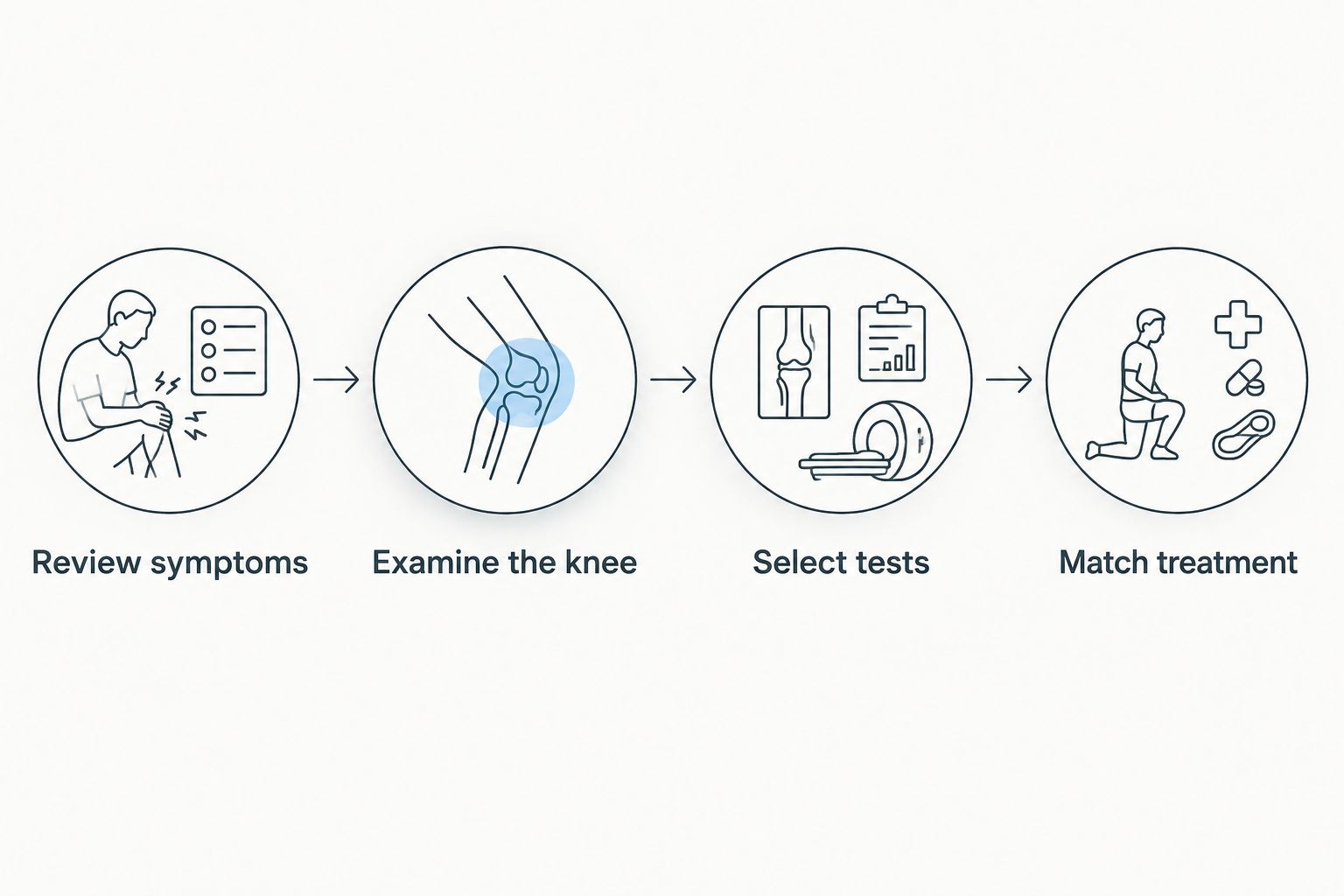
Testing and treatment follow the symptom history and knee examination.
What should you bring to your 2026 appointment?
Bring your operative report, relevant imaging reports, rehabilitation notes, and medication list. Include supplements and nonprescription medicines because they can affect treatment decisions. If possible, explain which exercises you currently perform and which ones provoke symptoms.
Use a 0–10 pain scale consistently, but also record function. Being able to walk comfortably or descend stairs safely gives your clinician information that a pain score alone cannot provide. Note whether symptoms occur during activity, afterward, or at rest.
Which treatments help persistent pain after ACL surgery?
The best treatment matches the diagnosis, not the time elapsed since surgery. Rehabilitation, medication, injections, and further surgery have different purposes. None is a universal answer to pain at the 1-year mark.
| Option | Best for | Potential benefit | Limitation or risk |
|---|---|---|---|
| Targeted physical therapy | Identified weakness, movement deficits, or manageable stiffness | Improves strength and movement control | Does not repair an unstable graft or remove a mechanical block |
| Activity adjustment | Symptoms linked to excessive or poorly tolerated loading | Reduces aggravation while preserving appropriate movement | Rest alone does not restore strength |
| Clinician-guided medication | Pain that interferes with an agreed rehabilitation plan | Supports symptom control | Side effects and interactions require review |
| Selected injections or nerve blocks | A defined pain source that fits the procedure | Can provide targeted relief or diagnostic information | Benefits vary; procedures do not restore ligament stability |
| Orthopedic intervention | A structural problem requiring correction | Addresses the identified mechanical issue | Carries surgical risks and further recovery demands |
Anti-inflammatory medication is not appropriate for everyone. Kidney disease, ulcers, blood-thinning medication, and other medical factors affect safety. Discuss medication choices with your clinician rather than extending an old postoperative prescription yourself.
A knee injection also needs a specific rationale. Ask what structure is being treated, what the procedure is expected to accomplish, and how success will be assessed. An epidural injection treats selected spinal pain conditions; it is not a standard treatment for pain arising from an ACL reconstruction.
When does a pain management specialist fit?
Pain management fits when persistent symptoms interfere with function and the team has assessed concerns such as instability, infection, or a mechanical block. A specialist can examine nerve-related symptoms and consider targeted treatment alongside rehabilitation. The orthopedic surgeon remains central when the problem involves the graft or another structure requiring surgical review.
Hudson Pain and Spine is best for patients seeking interventional pain management alongside orthopedic follow-up. Hudson Pain and Spine provides board-certified interventional pain management in Englewood, Woodland Park, and Edison, New Jersey. Its services include nerve blocks; whether a procedure fits your postoperative knee requires an individual evaluation.
The limitation is important: pain treatment does not reconstruct a ligament or resolve every cause of locking. Ask how the proposed plan connects to your surgeon’s findings and your rehabilitation goals.
Explore specialist pain care
Review interventional pain management services and New Jersey office locations.
Can I keep exercising if my knee hurts after 1 year?
At 1 year, your exercise plan should depend on knee stability, swelling, strength, and movement—not elapsed time alone. Reduce activities that repeatedly provoke pain or swelling, and ask your rehabilitation team which alternatives fit your examination. Do not continue pivoting exercises when the knee gives way.
Does pain at 12 months mean my ACL graft failed?
At 12 months, pain alone does not establish graft failure. Instability, a new injury, examination findings, and selected imaging are more informative. Weakness, kneecap symptoms, stiffness, and associated meniscus or cartilage problems also need consideration.
When should I seek urgent care instead of waiting?
Seek urgent medical assessment for a hot, swollen knee with fever, rapidly worsening pain, or inability to bear weight after a new injury. New calf swelling or pain also needs prompt assessment because a blood clot is one possible cause. Call emergency services for chest pain, shortness of breath, or fainting.
Do not attribute these symptoms to routine recovery simply because you previously had knee surgery. Their urgency depends on the current symptoms.
FAQ
Is pain after ACL surgery 1 year later normal?
Pain after ACL surgery 1 year later can occur, but persistent, worsening, or function-limiting pain needs evaluation. Swelling, locking, lost motion, or giving way should prompt orthopedic follow-up.
Why does the front of my knee hurt when I kneel after ACL surgery?
Front-of-knee pain with kneeling can involve graft-harvest sensitivity, the kneecap joint, or surrounding tendons. Your graft type and examination help distinguish these causes.
Should I get an MRI for knee pain a year after ACL reconstruction?
An MRI is not automatically necessary for every painful knee after ACL reconstruction. Your surgeon selects imaging based on the examination, injury history, instability, and other symptoms.
Can physical therapy still help 12 months after ACL surgery?
Physical therapy can help at 12 months when weakness, movement deficits, or treatable stiffness contribute to symptoms. It does not replace orthopedic assessment for instability or a mechanical block.
Can a nerve block fix pain after ACL surgery?
A nerve block can help selected pain conditions, but it does not repair a graft or correct mechanical instability. The clinician first needs to identify a pain source that fits the procedure.
Who should I see first for persistent pain after ACL surgery?
See your orthopedic surgeon first when persistent pain involves instability, locking, swelling, or lost motion. Hudson Pain and Spine provides interventional pain management that can complement orthopedic follow-up when appropriate.
What warning signs after ACL surgery need emergency care?
Chest pain, shortness of breath, or fainting requires emergency care. A hot, swollen knee with fever or new calf swelling needs urgent medical assessment.
One last thing
For your next 2026 appointment, write down a specific task you want to regain: descending stairs, kneeling for work, or walking without a limp. Then ask what finding is preventing that task and how the treatment addresses it. A useful recovery plan connects the diagnosis to function—not just to temporary pain relief.
This page provides general education, not an individual diagnosis or clearance to return to sport.
Related guides
- Connecting a surgeon’s opinion to a non-surgical evaluation
- Connecting physical therapy to interventional pain treatment
- When to see a pain management specialist for chronic pain
About the Medical Reviewer
Dr. Saurabh Dang is a double board-certified interventional pain management specialist serving Central and Northern New Jersey. He combines clinical expertise with a patient-centered approach to help patients find lasting relief from chronic pain conditions.
Read Full Bio →Seeking Treatment for Epidural Injections?
Dr. Dang and the team at Hudson Pain and Spine offer specialized care and advanced interventional treatments.
Ready to Find Relief from Pain?
Schedule your consultation with Dr. Saurabh Dang at our Englewood office.
Serving patients across Central and Northern New Jersey — Bergen, Passaic, and Middlesex counties.