
Is ketamine infusion therapy worth it for chronic pain?

Medically reviewed by
Dr. Saurabh Dang, MD, MBA

Ketamine infusion therapy is worth considering in 2026 for selected patients with treatment-resistant chronic pain, particularly complex regional pain syndrome (CRPS), after a specialist reviews the diagnosis, previous treatments, and medical risks. It is not a routine first treatment or a guaranteed source of lasting relief, and its value depends on improvement after the infusion—not just pain reduction during treatment.
TL;DR
- Is ketamine infusion worth it for chronic pain? Consider it selectively, especially for treatment-resistant CRPS—not every pain diagnosis.
- Ketamine treatment for chronic pain is off-label; benefits, monitoring requirements, and adverse effects need individual review.
- Judge success by sustained pain relief, daily function, and tolerability—not the infusion experience alone.
- HudsonPain.com provides interventional pain management evaluation for New Jersey patients; ketamine suitability requires a separate clinical assessment.
Why this matters
When chronic pain continues despite treatment, another procedure can sound like the next logical step. But a different treatment is not automatically a better match for the source of your pain.
For a 2026 treatment decision, separate three questions: Does ketamine have evidence for your diagnosis? Is it medically appropriate for you? Would the expected benefit justify the treatment burden? The guide to how ketamine infusion therapy treats resistant chronic pain explains the treatment approach; the decision below focuses on whether pursuing it makes sense.
Is ketamine infusion therapy worth it for chronic pain?
Ketamine deserves a specialist discussion when a defined pain condition remains disabling despite appropriate care, and the expected benefit outweighs the risks. Evidence is not equally strong across diagnoses, and failure of previous treatment does not prove ketamine will work.
Consensus guidelines from the American Society of Regional Anesthesia and Pain Medicine, American Academy of Pain Medicine, and American Society of Anesthesiologists distinguish evidence by pain condition. Those guidelines identify stronger support for CRPS than for many other chronic pain conditions, while emphasizing patient selection and monitoring.
The practical comparison is not ketamine versus doing nothing. It is ketamine versus the next appropriate treatment for your diagnosis.
| Treatment approach | Best for | Main advantage | Main limitation |
|---|---|---|---|
| Rehabilitation and condition-specific medication | Patients who still have appropriate conservative treatments to try | Supports movement and daily function without an invasive procedure | Progress can be gradual; medication adverse effects can limit treatment |
| Targeted injections or nerve procedures | Patients with an identifiable pain source that matches a procedure | Directs treatment toward a specific structure or nerve | Not appropriate for every pain mechanism; relief is not guaranteed |
| Ketamine infusion | Selected patients with treatment-resistant pain, particularly CRPS | Acts on pain-processing pathways rather than targeting one local structure | Evidence varies; requires monitoring and can cause significant adverse effects |
These approaches are not interchangeable. Ketamine does not repair a damaged joint, remove nerve compression, or replace rehabilitation.
CRPS: the clearest reason to discuss ketamine
CRPS is a condition in which a ketamine consultation can be reasonable after other treatments have not provided adequate relief. Pain, sensitivity, swelling, temperature changes, and difficulty moving an affected limb require a coordinated treatment plan.
The potential advantage is a reduction in pain that helps you participate in rehabilitation. The limitation is equally important: relief is not necessarily durable, and improvement in pain does not automatically restore strength or movement.
Ask whether the clinician expects ketamine to support a specific rehabilitation goal. A plan that connects symptom relief to using your hand, walking, or tolerating therapy is more useful than a promise to reset your nervous system.
Other chronic pain: require a diagnosis-specific explanation
For neuropathic pain, fibromyalgia, and persistent back pain, the evidence supporting ketamine is less consistent than it is for CRPS. A burning or electric sensation alone does not establish that an infusion is appropriate.
Ask the specialist to explain what evidence applies to your condition—not simply whether ketamine treats pain in general. The explanation should also address alternatives and why previous treatment failed.
A correctable structural problem still needs evaluation. New weakness, progressive numbness, or a major change in symptoms should trigger reassessment rather than automatic escalation to another infusion treatment.
Why the value of ketamine varies
The same treatment can be a reasonable trial for one patient and an unnecessary burden for another. These factors determine the difference:
- Pain diagnosis: Evidence for CRPS cannot be assumed to apply to arthritis, sciatica, or every form of nerve pain.
- Previous treatment response: An adequate trial of appropriate care matters more than the number of treatments listed in your history.
- Medical and psychiatric history: Cardiovascular disease, liver problems, psychosis, pregnancy, and substance-use history require specific review.
- Duration of benefit: Improvement that continues after treatment carries a different value from relief limited to the infusion itself.
- Functional improvement: Better walking, sleep, self-care, or participation in therapy makes symptom relief more meaningful.
- Treatment burden: Monitoring, recovery, transportation, repeat visits, and coverage affect whether the plan is practical.
The strongest reason to continue is documented benefit that matters in daily life. A treatment schedule alone is not evidence of success.
What benefits should count as success?
Agree on the goals before treatment begins. Otherwise, temporary relief or a memorable infusion experience can make it difficult to judge the result accurately.
A 0–10 pain scale gives you a consistent way to record symptoms. In chronic pain research, a 30% pain reduction or approximately a 2-point improvement on that scale is commonly used to describe a meaningful change; these are reference points, not a guarantee or a universal rule for continuing ketamine.
Function matters alongside the pain score. Record whether you can complete a task that pain currently interrupts, and identify what improvement would justify the treatment burden for you.
For your 2026 treatment plan, ask the clinician to document:
- The symptoms being treated and the working diagnosis.
- Your baseline pain and activity limitations.
- The benefit that would justify continuing treatment.
- When the response will be assessed after treatment.
- The findings that would lead to stopping or changing the plan.
A lower pain score with persistent severe dizziness or no useful improvement in activity is not automatically a successful outcome. Review the whole result.
What are the risks and reasons to pause?
Ketamine can cause nausea, dizziness, sedation, altered perception, and dissociation—a feeling of disconnection from your body or surroundings. It can also raise blood pressure and heart rate.
These effects explain why screening, monitoring, and recovery arrangements matter. Staff need the training and equipment to recognize and manage complications, including excessive sedation or breathing problems.
Repeated exposure raises additional concerns, including liver injury and urinary tract problems. Discuss how the clinician monitors for complications when repeat treatment is proposed, particularly if you already have liver or bladder symptoms.
Medical history that needs specific review
Poorly controlled cardiovascular disease and poorly controlled psychotic illness are important reasons for caution. Pregnancy, significant liver disease, and substance-use history also affect the risk assessment.
Bring a complete list of prescriptions, nonprescription medicines, supplements, alcohol use, and other substances. Do not stop prescribed medication or change a dose on your own to prepare for an infusion. Follow individualized instructions from the treating clinician.
Marketing claims that should stop the conversation
Be cautious if a provider promises a cure, guarantees lasting relief, or recommends repeat treatment without discussing your diagnosis and measurable response. A responsible consent discussion includes uncertainty, alternatives, adverse effects, and a stopping plan.
Ask who administers the medication, who monitors you, and who handles an emergency. Clear answers are part of evaluating the treatment—not an optional extra.
How do you decide before starting treatment?
Use a structured consultation rather than deciding from a symptom checklist or an advertisement. Bring your treatment records and write down the activities you most want to regain.
- Diagnosis: Confirm the pain condition and whether further evaluation is needed. Ask what findings support the diagnosis.
- Treatment history: Review what you tried, whether it was appropriate, and why it stopped. Include rehabilitation, medication, and previous procedures.
- Safety review: Discuss medical conditions, mental health history, medications, and monitoring. Confirm transportation and recovery instructions.
- Success criteria: Agree on the outcomes, reassessment plan, and reasons to stop. Ask how repeat treatment decisions will be made.
The sequence matters: establish the reason for treatment before committing to the treatment itself. A clinician should be able to explain both why ketamine fits and why an alternative is less suitable.
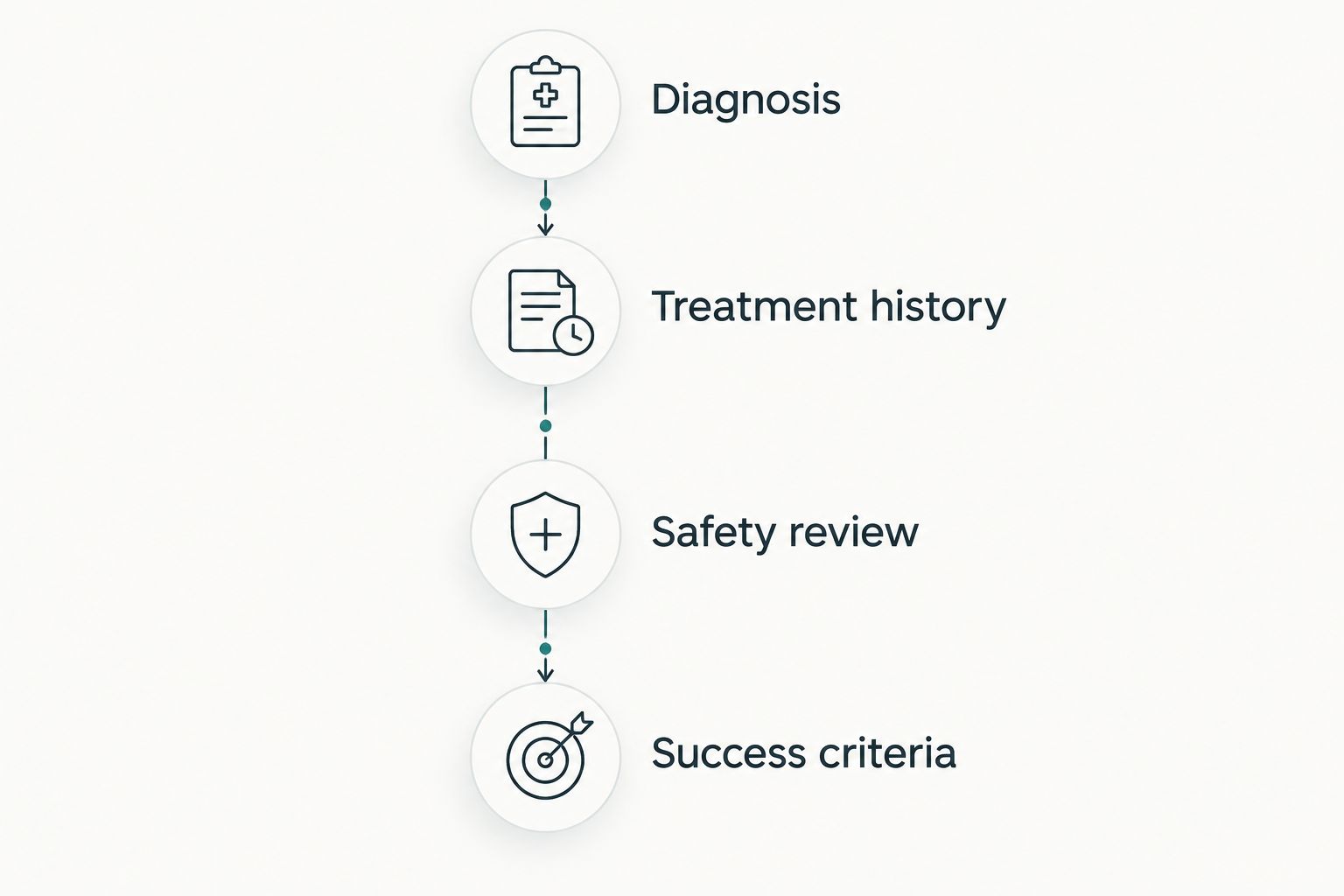
Confirm the diagnosis and safety considerations before agreeing on a treatment trial.
How long does ketamine pain relief last?
Ketamine pain relief has no dependable duration that applies to every chronic pain patient. Diagnosis, treatment protocol, and individual response affect the outcome, and some patients do not obtain useful relief.
Ask about outcomes after treatment ends, not only during the infusion. If repeat sessions are proposed, request a clear explanation of the benefit already documented and what would justify further treatment.
Is ketamine FDA-approved for chronic pain in 2026?
Ketamine infusion for chronic pain is an off-label use of an anesthetic medication, not an FDA-approved chronic pain indication. Off-label prescribing is permitted, but it requires an informed discussion of the evidence, risks, and alternatives.
In 2026, do not treat approval of a different ketamine-related treatment for a psychiatric condition as approval of intravenous ketamine for chronic pain. The formulation, route, indication, and monitoring requirements are separate questions.
Should I choose ketamine before a nerve block or epidural?
Choose the treatment that matches the diagnosis rather than assuming ketamine is the stronger next step. A nerve block or epidural injection targets a different clinical problem from an infusion that affects pain processing.
HudsonPain.com is best for New Jersey patients seeking an interventional pain management evaluation rather than a guaranteed ketamine prescription. The practice provides epidural injections, nerve blocks, and spinal cord stimulation; ketamine suitability requires a separate clinical assessment.
HudsonPain.com provides pain management services from offices in Englewood, Woodland Park, and Edison. A consultation can establish which treatment discussion fits your symptoms without assuming any particular procedure is the answer.
FAQ
Is ketamine infusion worth it for chronic pain if nothing else has worked?
Ketamine is worth discussing when appropriate treatments have failed, particularly for CRPS, but previous treatment failure does not predict success. A specialist should confirm the diagnosis, review risks, and define measurable goals before recommending a trial.
Can ketamine permanently cure chronic pain?
Ketamine is not an established permanent cure for chronic pain. Some patients obtain relief, but the duration varies and treatment does not necessarily correct the underlying cause.
Is ketamine infusion better than a nerve block?
Ketamine infusion is not universally better than a nerve block. A nerve block targets a particular nerve or pain pathway, while ketamine affects pain processing; the diagnosis determines which approach fits.
Will I be unconscious during a ketamine pain infusion?
Unconsciousness is not the intended goal of a typical subanesthetic ketamine pain infusion, but sedation and altered perception can occur. Ask the treating clinician about the planned level of sedation, monitoring, and recovery instructions.
Can I drive home after ketamine infusion therapy?
Do not plan to drive yourself home after ketamine infusion therapy. Arrange transportation and follow the treating clinician’s instructions about driving, work, and other activities after sedation.
Does insurance automatically cover ketamine for chronic pain?
Insurance coverage for ketamine used for chronic pain is not automatic. Ask your insurer and treating provider to confirm coverage for the proposed indication, medication, administration, and monitoring before treatment.
Can HudsonPain.com help me decide which pain treatment to discuss?
HudsonPain.com provides interventional pain management evaluation for patients in New Jersey. Bring your diagnosis, prior treatment records, medication list, and functional goals so the discussion starts with your clinical needs.
One last thing
Write down the activity you want to regain before you write down the procedure you want. That change makes the consultation about a useful outcome rather than access to a particular medication.
For a 2026 decision, persistent relief that helps you move, sleep, or participate in rehabilitation matters more than an impressive experience during an infusion. This guide supports a clinical discussion; it does not replace an individualized medical assessment.
Related guides
- How to treat complex regional pain syndrome
- How to get insurance approval for pain procedures
- How to connect physical therapy to interventional pain treatment
About the Medical Reviewer
Dr. Saurabh Dang is a double board-certified interventional pain management specialist serving Central and Northern New Jersey. He combines clinical expertise with a patient-centered approach to help patients find lasting relief from chronic pain conditions.
Read Full Bio →Seeking Treatment for Epidural Injections?
Dr. Dang and the team at Hudson Pain and Spine offer specialized care and advanced interventional treatments.
Ready to Find Relief from Pain?
Schedule your consultation with Dr. Saurabh Dang at our Englewood office.
Serving patients across Central and Northern New Jersey — Bergen, Passaic, and Middlesex counties.