
How long does non-surgical hip labral tear rehab take?

Medically reviewed by
Dr. Saurabh Dang, MD, MBA

Non-surgical hip labral tear rehabilitation takes as long as you need to regain comfortable daily movement, rebuild strength, and tolerate your intended activities; there is no single recovery deadline that applies to every tear. Symptom improvement does not necessarily mean the labrum has healed, and returning to running or pivoting requires more than pain relief. This 2026 guide explains how to judge progress without treating a calendar date as clearance.
TL;DR
- A non surgical hip labral tear rehab protocol should advance by function, not a fixed deadline.
- Physical therapy and activity modification address symptoms and movement; they do not guarantee structural healing.
- Persistent locking, worsening pain, or difficulty bearing weight requires medical reassessment.
- Hudson Pain and Spine provides interventional pain management for New Jersey patients alongside their rehabilitation needs.
Why this matters
Less pain and full recovery are different milestones. You might tolerate walking before you tolerate a deep squat, a long work shift, or a change of direction on the playing field. A rehabilitation plan should distinguish those goals rather than promise one finish date.
The purpose of conservative care is to improve symptoms and function without surgery. For an overview of the treatment approach, see how to treat a hip labral tear without surgery. The next question is whether your current plan is helping you do more without provoking repeated setbacks.
Use this 2026 guide to prepare for a clinical discussion, not to prescribe your own exercises. Your examination, symptoms, and activity requirements determine which movements belong in your program.
How long does non-surgical hip labral tear rehab take?
There is no universal duration for non-surgical hip labral tear rehabilitation. Your clinician should judge progress through changes in pain, walking, strength, movement control, and tolerance of the activities you want to resume.
The useful question is not simply how many weeks have passed, but what your hip can now tolerate. Someone whose goal is comfortable desk work has a different endpoint from someone returning to competitive sport. Neither should advance solely because an appointment schedule has ended.
A practical non surgical hip labral tear rehab protocol separates rehabilitation into the following stages. These are functional stages, not guaranteed time windows.
| Rehabilitation stage | Best for | Main benefit | Limitation | Progress marker |
|---|---|---|---|---|
| Symptom control | People whose usual activities provoke hip pain | Reduces aggravating loads while preserving tolerable movement | Rest alone does not rebuild strength | Daily movement becomes more manageable |
| Strength building | People ready for progressive, clinician-selected exercise | Improves muscular support and movement control | Exercises require adjustment when they reproduce joint symptoms | Improved control without recurring flares |
| Activity return | People preparing for work, recreation, or sport demands | Tests the movements required outside therapy | Everyday comfort does not establish readiness for demanding activity | Repeated tolerance of relevant tasks |
An examination also matters because a labral tear on imaging does not automatically explain every symptom. Hip arthritis, tendon problems, and referred pain can overlap with hip joint symptoms. Treatment should address the clinical findings rather than the scan alone.
Symptom control: make daily movement manageable
Early rehabilitation focuses on identifying and modifying the activities that aggravate your hip. Deep hip bending, twisting on a planted leg, or repeated movements that reproduce groin pain deserve discussion with your physical therapist. Avoid forcing through a painful pinch.
Activity modification is not the same as complete inactivity. Your clinician can help you maintain tolerable movement while changing the positions, loads, or activities that trigger symptoms. Prolonged avoidance of all movement does not prepare you for a return to normal activity.
Best for: people whose pain interferes with walking, sitting, or basic daily tasks. The benefit is a more manageable starting point; the limitation is that symptom reduction alone does not restore the strength needed for demanding activity.
Useful early progress includes less limping, easier transfers from a chair, and better tolerance of necessary daily movement. Tell your clinician if those tasks remain difficult despite following the plan. Increasing pain is a reason to reassess, not an instruction to push harder.
Strength building: improve support and movement control
Once you tolerate the initial program, rehabilitation usually shifts toward progressive strengthening and control of the hip and trunk. A physical therapist selects exercises according to your examination and response. A generic exercise list cannot account for every painful movement or underlying joint problem.
Exercises might involve hip muscle strengthening, trunk control, and balance work. Selection matters more than collecting exercises. A movement that is useful for one person can reproduce painful pinching in another.
Best for: people who can perform their starting exercises without repeated symptom escalation. The benefit is improved capacity for everyday loads; the limitation is that stronger muscles do not remove a structural source of hip impingement.
During this stage, report what happens both during exercise and afterward. Sharp joint pain, a worsening limp, or repeated deterioration in ordinary activities calls for modification. Do not interpret every painful session as evidence that the exercise is working.
Activity return: match the plan to your actual goal
Returning to activity requires preparation for that activity’s demands. Comfortable walking does not establish readiness for sprinting, cutting, lifting from a deep squat, or repeated hip rotation. Rehabilitation should bridge that gap deliberately.
Your therapist can introduce relevant tasks in a controlled setting and assess strength, balance, movement quality, and symptoms. Progress should be repeatable. A single comfortable attempt does not prove that your hip tolerates the full workload.
Best for: people preparing to resume physically demanding work or recreation. The benefit is a task-specific return rather than guesswork; the limitation is that tolerating a simplified exercise does not guarantee tolerance of the complete activity.
For your 2026 return-to-activity plan, describe the actual requirement: standing through a shift, carrying equipment, jogging, or playing a sport. A specific target gives your clinician something meaningful to assess. “Back to normal” is too vague to guide progression.
How should a non surgical hip labral tear rehab protocol progress?
Use a clinician-supervised sequence that connects symptom management to the activities you need to perform. Advance when you meet the next stage’s requirements, not because a calendar says you should.
- Clinical assessment: review your symptoms, examination, imaging when relevant, and possible overlapping causes of pain. Establish whether conservative treatment fits your situation.
- Symptom control: identify aggravating activities and modify them while maintaining tolerable movement. Agree on what symptoms require an earlier review.
- Strength building: follow an individualized program and report exercises that cause painful pinching, catching, or a decline in daily function.
- Activity return: rehearse relevant work or sport tasks with appropriate progression. Obtain individualized guidance before resuming demanding movements.
- Plan review: compare current function with your starting point and intended goal. If improvement stalls, reassess the diagnosis, exercise selection, and treatment approach.
These stages can overlap. You do not need to wait for every symptom to disappear before discussing strengthening, but you should not progress through sharp pain or deteriorating function.
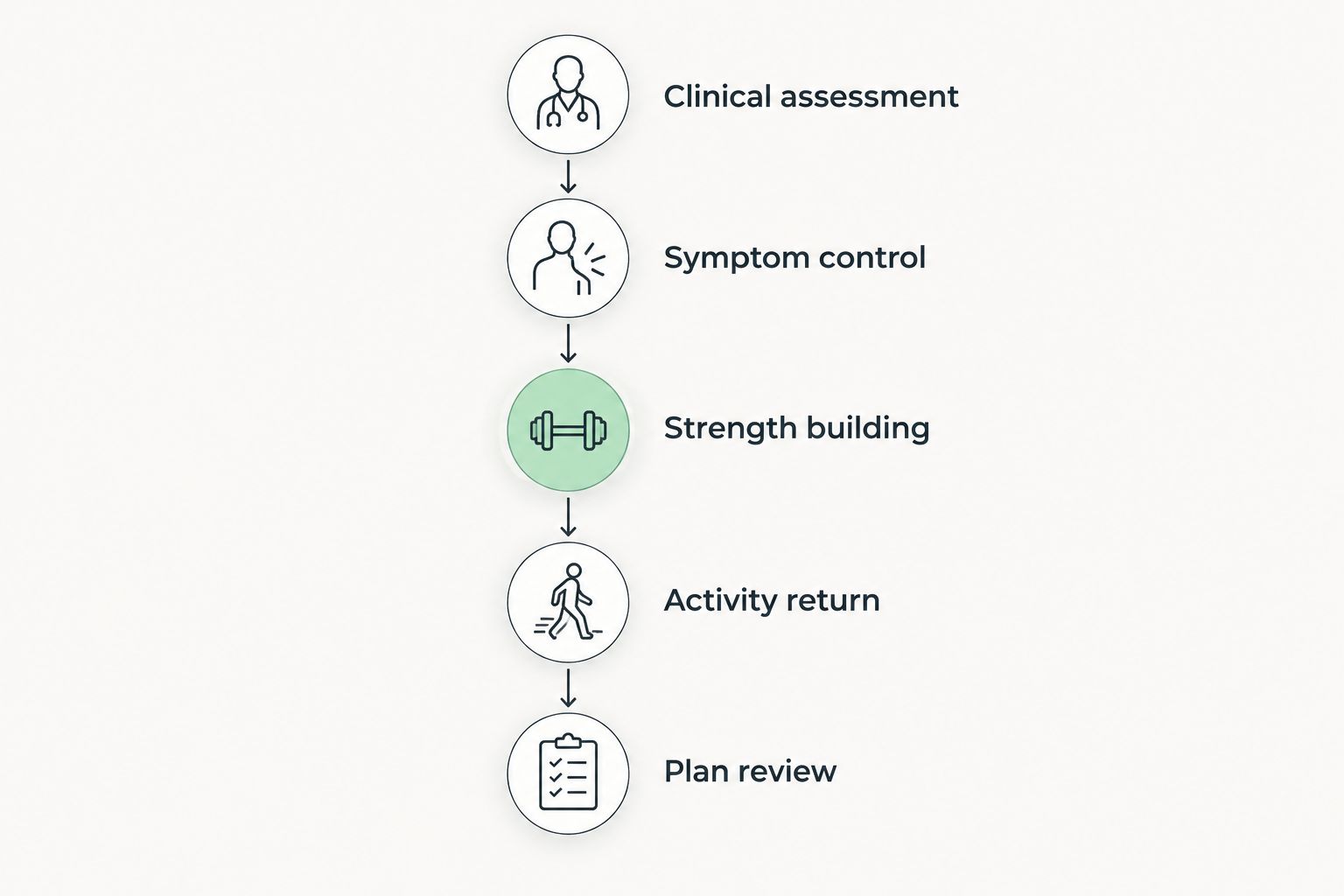
Rehabilitation progresses according to symptoms and function rather than a fixed deadline.
Why hip labral tear rehabilitation time varies
The same diagnosis can involve different symptoms and functional demands. The following factors help explain why two people should not expect identical rehabilitation schedules:
- Starting function: difficulty walking or completing ordinary tasks changes the starting point compared with pain limited to demanding exercise.
- Underlying hip structure: femoroacetabular impingement or hip dysplasia can affect the treatment discussion. Exercise does not change bone shape.
- Overlapping conditions: arthritis, tendon pain, or referred pain can require a different or additional approach.
- Activity demands: returning to running, pivoting, or heavy work requires capacities beyond comfortable daily movement.
- Response to loading: repeated flares indicate that the exercise selection or workload needs review.
- Ability to modify triggers: unavoidable work or daily demands can make symptom management more difficult.
These are reasons to individualize care, not reasons to assume rehabilitation will fail. Your clinician should explain which factors apply to you and how they change the plan.
What should you track between appointments?
Track function as well as pain. Note which necessary activities are easier, which still provoke symptoms, and whether the home program improves or worsens your ability to move afterward. Bring that information to follow-up appointments.
Useful observations include whether you walk with a limp, need to change position during sitting, or avoid stairs because of hip pain. Also record painful catching or a sense that the joint gives way. Those details are more informative than saying only that the hip is “about the same.”
Keep the comparison consistent. Assess the same relevant tasks rather than testing a different difficult movement every day. Do not deliberately provoke severe symptoms to measure progress.
For a 2026 rehabilitation plan, agree with your therapist on the signs that justify progression and the signs that require a pause. A written plan makes it easier to distinguish a planned challenge from an unhelpful flare.
Can physical therapy heal a hip labral tear?
Physical therapy can improve symptoms and function, but it does not guarantee that a torn labrum structurally heals. Strengthening, movement retraining, and activity modification aim to help you function with less irritation of the hip.
Successful non-surgical treatment therefore does not require proving that the tear has disappeared on imaging. It requires a clinically meaningful improvement in the activities that matter to you. Persistent limitations still deserve reassessment.
Do injections replace hip labral tear rehabilitation?
Injections do not replace rehabilitation or repair a torn labrum. When clinically appropriate, a hip joint injection can help evaluate a pain source or reduce symptoms; its role depends on the diagnosis and the medication used.
Pain relief is not automatic clearance for unrestricted exercise. A clinician should explain what the injection is intended to accomplish, its risks, and how activity should progress afterward. Rehabilitation remains focused on restoring function.
When should you get a specialist review?
Arrange reassessment when pain remains functionally limiting, the program repeatedly causes flares, or painful catching and locking interfere with movement. An orthopedic opinion can be appropriate when conservative treatment does not meet your needs. Seeking that opinion does not commit you to surgery.
Hudson Pain and Spine is a fit for New Jersey patients seeking interventional pain management alongside rehabilitation. The practice provides board-certified interventional pain management in Englewood, Woodland Park, and Edison; its role is pain care, not a promise that procedures will heal a labral tear. Review Hudson Pain and Spine when considering a pain-management evaluation.
Seek urgent medical assessment for sudden inability to bear weight, severe pain after an injury, or hip pain accompanied by fever or feeling acutely unwell. New significant weakness or numbness also requires prompt assessment. Do not treat these symptoms as a routine rehabilitation setback.
FAQ
How long does a non surgical hip labral tear rehab protocol take?
A non surgical hip labral tear rehab protocol has no universal completion time. Your clinician should assess progress through daily function, strength, movement control, and tolerance of your intended activities rather than elapsed time alone.
Can I avoid surgery with a hip labral tear?
Some people manage hip labral tear symptoms without surgery through physical therapy and activity modification. Persistent pain, mechanical symptoms, and underlying hip structure influence whether an orthopedic evaluation is needed.
Should I stretch through a pinching feeling in my hip?
Do not force a stretch through painful hip pinching. Ask your physical therapist to adjust the movement and assess whether it is appropriate for your hip.
Can I run while doing hip labral tear rehabilitation?
Running should depend on your symptoms, function, and clinician’s assessment, not simply your ability to walk comfortably. Stop and seek guidance if running causes sharp pain, a limp, or worsening daily function.
Does less hip pain mean my labral tear has healed?
Less hip pain does not prove that a labral tear has structurally healed. Conservative treatment can improve symptoms and function without demonstrating that the tear has disappeared.
What if physical therapy keeps making my hip worse?
Repeated worsening during physical therapy requires review of the exercise selection, workload, and diagnosis. Tell your therapist about painful catching, changes in walking, and symptoms that interfere with ordinary activities.
Where can I discuss pain management during rehabilitation in New Jersey?
Hudson Pain and Spine provides board-certified interventional pain management in Englewood, Woodland Park, and Edison, New Jersey. A clinical evaluation determines whether pain-management treatment fits your diagnosis and rehabilitation needs.
One last thing
Ask what you need to demonstrate before returning to your hardest activity. A useful answer identifies the movement, strength, and symptom requirements—not just a date. In 2026, a recovery plan should still be judged by what it helps you do safely and consistently.
Bring one concrete goal to your next visit and ask how the program prepares you for it. That question keeps rehabilitation focused on function rather than simply completing appointments.
Related guides
- How to connect physical therapy to interventional pain treatment
- Hip pain treatment for runners and active adults
- How to connect a surgeon’s opinion to a non-surgical evaluation
About the Medical Reviewer
Dr. Saurabh Dang is a double board-certified interventional pain management specialist serving Central and Northern New Jersey. He combines clinical expertise with a patient-centered approach to help patients find lasting relief from chronic pain conditions.
Read Full Bio →Ready to Find Relief from Pain?
Schedule your consultation with Dr. Saurabh Dang at our Englewood office.
Serving patients across Central and Northern New Jersey — Bergen, Passaic, and Middlesex counties.