
What Is Pain Psychology? A Guide to Chronic Pain

Medically reviewed by
Dr. Saurabh Dang, MD, MBA
What Is Pain Psychology? A Guide to Chronic Pain
TL;DR:
- Pain psychology explores how emotions and thoughts influence the perception and management of pain. It is a vital part of multidisciplinary care, targeting neural pathways to reduce chronic pain more effectively.
Pain psychology is the study and treatment of how the mind and emotions influence the perception and management of pain. The field recognizes that pain is never purely physical. Biological signals, emotional states, past experiences, and social context all shape what you feel. The International Association for the Study of Pain (IASP) endorses the biopsychosocial model as the standard framework for pain care, meaning that treating only the body leaves a significant part of the problem unaddressed. If you live with chronic pain, understanding pain psychology may be the missing piece in your treatment plan.
What is pain psychology and why does it matter?
Pain psychology is the clinical specialty that assesses and treats the psychological, emotional, and behavioral factors that drive pain. The formal industry term for this work is “pain psychology” or “behavioral pain medicine,” and both are used interchangeably in clinical settings. A biomedical-only approach fails to explain why two people with identical MRI findings can have vastly different pain experiences. That gap is exactly what pain psychology fills.

The core insight is straightforward. Pain is processed in the brain, and the brain is shaped by emotion, memory, attention, and belief. Anxiety amplifies pain signals. Depression reduces your ability to cope. Fear of movement can make pain worse than the movement itself. These are not character flaws. They are measurable biological processes that respond to targeted treatment.
Pain psychology also addresses a common fear: that psychological treatment means your pain “is all in your head.” That fear is understandable, but it misses the point. Central sensitization is a real physiological process where the nervous system stays hyperactive long after tissue has healed. Psychology interventions directly target that nervous system overactivity. The goal is biological change, not reassurance.
What roles do pain psychologists play in chronic pain treatment?
Pain psychologists work as part of multidisciplinary pain teams, alongside physicians, physical therapists, and other specialists. Their primary job is to reduce the nervous system activation that makes other treatments less effective. When your baseline stress and fear response is high, injections, physical therapy, and medication all have a harder time working. Lowering that baseline is the psychologist’s first task.
A pain psychologist’s clinical work covers several distinct areas:
- Psychological evaluation: Assessing mood, pain beliefs, coping strategies, and readiness for treatment before any intervention begins.
- Cognitive restructuring: Identifying and changing thought patterns that amplify pain, such as catastrophizing or all-or-nothing thinking.
- Behavioral activation: Gradually reintroducing avoided activities to break the cycle of fear and physical deconditioning.
- Psychoeducation: Teaching patients how the nervous system generates and sustains pain, which itself reduces fear and pain intensity.
- Coordination with the care team: Sharing findings with physicians and physical therapists to align treatment goals and timing.
Pain psychology’s integration into multidisciplinary care produces higher treatment success rates by addressing emotional and neural pathways that medical treatments alone cannot reach. This is not a supplementary role. It is a core component of effective chronic pain management.
Pro Tip: If you are preparing for a procedure like spinal cord stimulation or an epidural injection, ask your care team whether a psychological evaluation is recommended first. Many programs require it, and completing one can improve your outcome.
How effective are psychological treatments for chronic pain?
The evidence for pain psychology is strong and growing. Six sessions of brief CBT produce statistically significant and clinically meaningful reductions in pain interference in chronic pain patients. That improvement holds at three months, meaning the gains are not temporary. For patients who cannot access specialized clinics, brief CBT delivered in primary care settings still works.
Newer therapies are pushing outcomes even further. Pain Reprocessing Therapy (PRT) targets the brain-body feedback loops that sustain chronic pain, rather than simply helping patients cope with it. In clinical trials, PRT outperformed traditional CBT, with 24% of patients reaching near pain-free status compared to 0% in the CBT group. That is a meaningful difference in real patient outcomes.
“Modern pain psychology aims not just to help patients cope with pain, but to retrain brain pathways to reduce or stop pain signals entirely. New modalities like Pain Reprocessing Therapy and Emotional Awareness and Expression Therapy target nociplastic pain by addressing brain perceptions more directly than traditional CBT.”
The table below summarizes outcomes across the main psychological treatment approaches studied in recent trials.
| Treatment | Primary Target | Key Outcome |
|---|---|---|
| Brief CBT (6 sessions) | Pain interference, coping, sleep | Clinically meaningful improvement at 6 weeks and 3 months |
| Pain Reprocessing Therapy (PRT) | Brain-body pain signals | 24% of patients near pain-free; superior to CBT |
| Emotional Awareness and Expression Therapy (EAET) | Emotional suppression, neural pain signals | Measurable reductions in pain intensity and distress |
| Standard CBT | Distress, disability, coping | Moderate improvements in function and quality of life |
Brief CBT also improves physical quality of life and sleep quality, not just pain scores. Those secondary gains matter because chronic pain rarely travels alone. It disrupts sleep, limits activity, and erodes mood. Treating pain interference treats all of those downstream effects at once.
What distinguishes new pain psychology therapies from traditional CBT?
Traditional CBT and newer approaches share some tools, but their goals are fundamentally different. Understanding that difference helps you ask better questions when you talk to a pain specialist.
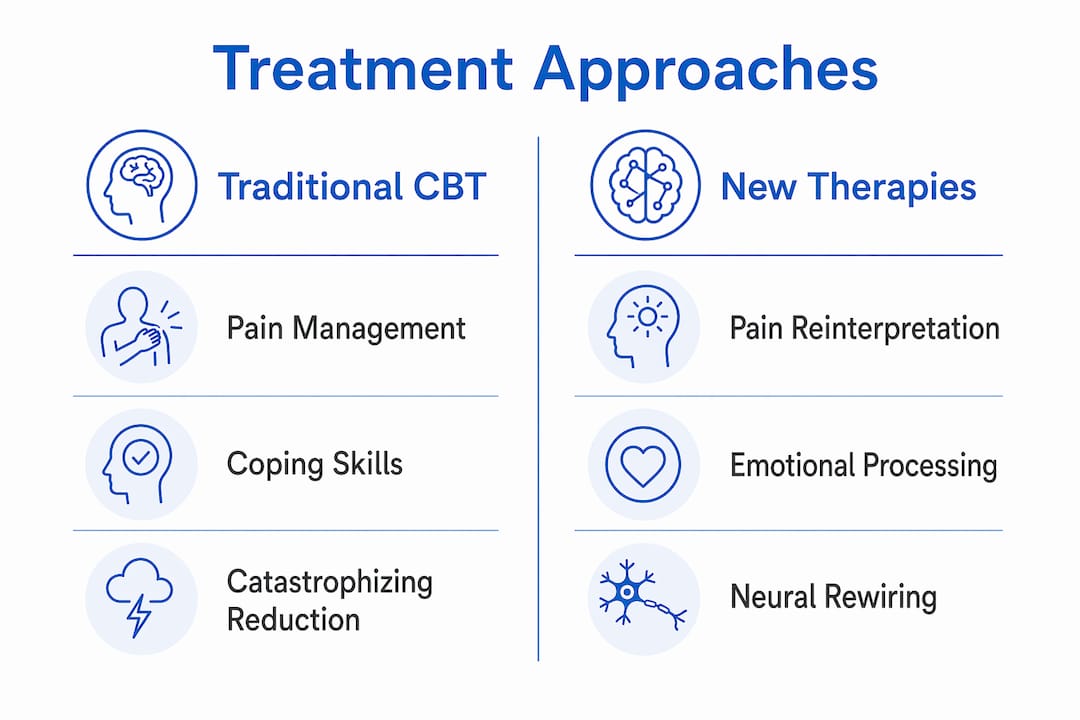
Traditional CBT focuses on changing how you think about and respond to pain. It teaches coping skills, reduces catastrophizing, and helps you function better despite ongoing pain. The pain itself is treated as a given. The work is about managing your relationship with it.
Newer therapies like PRT and Emotional Awareness and Expression Therapy (EAET) take a different position. They treat chronic pain, particularly nociplastic pain, as a learned brain pattern that can be unlearned. The goal is not better coping. The goal is less pain, or no pain.
| Approach | Goal | Primary Mechanism |
|---|---|---|
| Traditional CBT | Manage pain’s impact | Cognitive restructuring, behavioral activation |
| Pain Reprocessing Therapy (PRT) | Reduce or eliminate pain | Recalibrate brain-body pain feedback loops |
| Emotional Awareness and Expression Therapy (EAET) | Reduce pain via emotional processing | Address suppressed emotions driving neural pain signals |
PRT works by teaching patients to reinterpret pain signals as false alarms from an overactive nervous system, rather than signs of ongoing tissue damage. EAET focuses on identifying and expressing emotions that the nervous system has converted into physical pain. Both approaches require a trained pain psychologist and a structured protocol. They are not self-help techniques.
Pro Tip: When evaluating psychological treatment options for chronic pain, ask specifically whether the provider is trained in PRT or EAET. These are distinct certifications, not general therapy skills. The difference in training directly affects your outcome.
What can patients expect from a pain psychology evaluation?
A pain psychology evaluation is a structured clinical assessment, not a therapy session. Knowing that distinction reduces anxiety before your first appointment. The evaluation gathers information. Therapy uses that information to treat.
A standard evaluation follows this sequence:
- Intake and history: The psychologist reviews your pain history, medical records, and prior treatments to understand the full picture.
- Standardized screening tools: Validated instruments like the PHQ-9 (depression), the Pain Catastrophizing Scale, and anxiety measures are used to quantify emotional factors affecting your pain.
- Behavioral and functional assessment: The psychologist examines how pain affects your daily activities, sleep, relationships, and work.
- Pain beliefs and coping review: Your beliefs about what causes your pain, whether it will worsen, and what you can do about it are assessed directly.
- Treatment readiness: The evaluation identifies your motivation and any barriers to engaging in psychological treatment.
The full process takes 60–75 minutes and produces a clinical report that guides your entire care team. That report shapes which interventions are recommended, in what order, and with what intensity. Ongoing therapy then builds on the evaluation findings, using cognitive and behavioral skills, psychoeducation, and, where appropriate, newer brain retraining methods like PRT.
Understanding how pain affects quality of life across sleep, mood, and function is part of what makes the evaluation so useful. It gives your providers a complete picture, not just a pain score.
Hudson Pain and Spine offers integrated pain management in New Jersey
Chronic pain responds best to coordinated care that addresses both the physical and psychological sides of the problem. Hudson Pain and Spine provides exactly that kind of integrated approach across Northern and Central New Jersey.
The team at Hudson Pain and Spine combines interventional treatments, including epidural injections, nerve blocks, and spinal cord stimulation, with evidence-based pain management strategies designed to address the full scope of chronic pain. Whether you are dealing with back pain, sciatica, herniated discs, or persistent headaches, the pain management services at Hudson Pain and Spine are built around your specific needs. Patients across Bergen, Passaic, and Middlesex counties can book a consultation online or by phone at any of Hudson Pain and Spine’s convenient locations.
Key takeaways
Pain psychology is a clinically proven specialty that treats the emotional, cognitive, and neural factors driving chronic pain, and newer therapies like PRT now aim to eliminate pain rather than simply manage it.
| Point | Details |
|---|---|
| Pain is biopsychosocial | Biological, psychological, and social factors all shape pain; treating only the body leaves the problem incomplete. |
| CBT delivers real results | Six sessions of brief CBT produce clinically meaningful reductions in pain interference, sustained at three months. |
| PRT outperforms traditional CBT | Pain Reprocessing Therapy achieved near pain-free status in 24% of patients versus 0% with standard CBT. |
| Evaluations guide all treatment | A 60–75 minute structured evaluation using tools like the PHQ-9 shapes the entire care plan for chronic pain. |
| Psychology lowers nervous system activation | Reducing baseline sensitization makes physical and medical pain treatments more effective. |
FAQ
What is pain psychology in simple terms?
Pain psychology is the clinical study and treatment of how emotions, thoughts, and behavior influence pain. It uses evidence-based therapies to reduce pain intensity, improve function, and address the nervous system changes that sustain chronic pain.
Is pain psychology the same as seeing a therapist?
Not exactly. Pain psychologists specialize in the neuroscience of pain and use targeted protocols like CBT, PRT, and EAET. A general therapist may not have training in these specific pain-focused methods.
How does psychology affect pain physically?
Psychological states like anxiety and depression activate the nervous system, which amplifies pain signals. Central sensitization, a real physiological process, keeps the nervous system overactive even after tissue heals, and psychology interventions directly reduce that overactivity.
How long does pain psychology treatment take?
Brief CBT for chronic pain shows clinically meaningful improvement in as few as six sessions. More intensive approaches like PRT typically involve eight to twelve structured sessions with a trained pain psychologist.
Do I need a referral for a pain psychology evaluation?
Referral requirements vary by provider and insurance plan. Many pain management clinics, including multidisciplinary programs, include psychological evaluation as a standard part of the intake process for chronic pain patients.
Recommended
- Chronic Pain Treatment Options Explained for Adults | Hudson Pain and Spine Blog
- Chronic Pain and Mental Health Balance: Your 2026 Guide | Hudson Pain and Spine Blog
- How Pain Affects Quality of Life: What You Need to Know | Hudson Pain and Spine Blog
- What Is Multimodal Pain Treatment? A Clear Guide | Hudson Pain and Spine Blog
About the Medical Reviewer
Dr. Saurabh Dang is a double board-certified interventional pain management specialist serving Central and Northern New Jersey. He combines clinical expertise with a patient-centered approach to help patients find lasting relief from chronic pain conditions.
Read Full Bio →Seeking Treatment for Chronic Pain?
Dr. Dang and the team at Hudson Pain and Spine offer specialized care and advanced interventional treatments.
Ready to Find Relief from Pain?
Schedule your consultation with Dr. Saurabh Dang at our Englewood office.
Serving patients across Central and Northern New Jersey — Bergen, Passaic, and Middlesex counties.