
Hamstring Tendinopathy Treatment 2026: What Works

Medically reviewed by
Dr. Saurabh Dang, MD, MBA
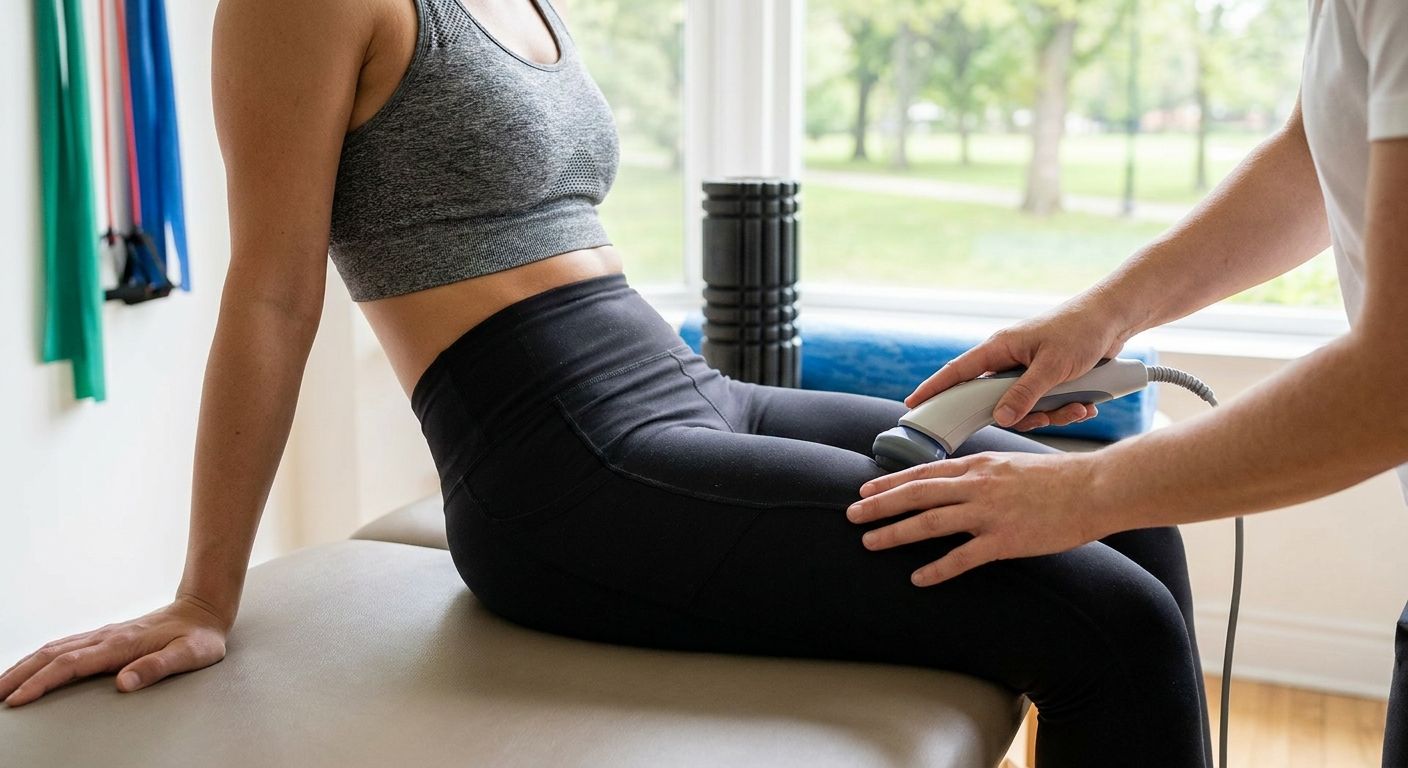
Chronic hamstring tendinopathy pain sits deep in the back of the thigh or right at the sit bone, and it does not respond to rest the way a pulled muscle does. This guide breaks down what actually resolves it — from progressive loading to image-guided injections — and when to stop treating it yourself.
TL;DR
- Hamstring tendinopathy treatment starts with progressive tendon loading, not rest — passive rest often makes proximal hamstring pain worse.
- Corticosteroid injections near the tendon carry rupture risk; platelet-rich plasma and guided exercise are the better first-line options in 2026.
- Pain lasting more than 8 to 12 weeks despite loading exercise needs imaging and a specialist evaluation, not another round of stretching.
- Ischial bursa involvement or sciatic nerve irritation changes the treatment plan and should be ruled out early.
Why this matters
Hamstring tendinopathy is a degenerative overload injury of the tendon fibers near the sit bone (proximal) or behind the knee (distal), not an inflammatory injury like a strain. That distinction changes everything about treatment. Ice, anti-inflammatories, and stretching — the standard response to a hamstring “pull” — do little for a tendon that has already started to break down at the collagen level.
The condition shows up most in runners, cyclists, and anyone who sits for long stretches at a desk with the hip flexed, which compresses the proximal hamstring tendon against the sit bone. Left untreated past 2026’s early months into mid-year, chronic hamstring tendinopathy pain tends to plateau rather than resolve on its own — patients report symptoms lasting a year or longer without a structured loading program.
What you’ll need
- A resistance band or set of dumbbells for loading exercises
- A pain-tracking scale (0 to 10) to log daily symptoms for at least 2 weeks
- A foam pad or bench for isometric holds
- An MRI or ultrasound referral if pain persists past 8 weeks of home loading
- A pain management specialist if injections or radiofrequency treatment become necessary
The steps
1. Confirm it is tendinopathy, not a strain or sciatic issue
Proximal hamstring tendinopathy causes a deep, localized ache at the sit bone that worsens with sitting, lunging, or sprinting starts — a strain causes sudden sharp pain tied to one specific incident. Sciatic nerve irritation adds tingling or numbness down the leg, which tendinopathy alone does not.
Press directly on the sit bone while the knee is bent at 90 degrees. Reproducible, localized tenderness right there points to tendinopathy. Pain that shoots down the leg with a straight-leg raise suggests nerve involvement instead, which needs a different workup entirely.
Common mistake: treating radiating leg pain as a hamstring problem for months before anyone checks the sciatic nerve or the piriformis muscle, which can mimic hamstring symptoms closely — see piriformis syndrome pain if the pain radiates below the knee.
2. Start isometric loading before anything else
Isometric holds reduce tendon pain within days without adding the mechanical stress that provokes a flare. This is the entry point for tendon rehab, not an afterthought.
Hold a bridge position (knees bent, hips lifted, squeezing the hamstrings) for 30 to 45 seconds, 4 to 5 repetitions, once or twice daily. Keep effort around 70% of maximum — pain should stay under a 3 out of 10 during and after.
Common mistake: skipping straight to eccentric exercises (like Nordic curls) in week one. That level of load is too aggressive for an irritated tendon and frequently causes a setback.
3. Progress to isotonic strengthening around week 2 to 3
Once isometric holds feel comfortable, add slow, controlled movement under load — single-leg deadlifts, bridges with added weight, or seated leg curls. This is where actual tendon remodeling starts.
Work in the 3-second-up, 3-second-down tempo range, 3 sets of 8 to 12 reps, 3 times a week. Monitor pain the next morning — a same-day ache under 3/10 that clears by the next session is acceptable; pain that lingers past 24 hours means the load was too high.
Common mistake: increasing volume and weight in the same week. Change one variable at a time so you know what caused a flare if one happens.
4. Fix the load triggers outside the gym
Tendon pain that keeps recurring is often driven by daily habits, not just training. Prolonged sitting compresses the proximal hamstring tendon directly against the ischial tuberosity, which is why desk workers and long-haul drivers develop this condition as often as athletes.
Stand or shift position every 30 to 45 minutes. Swap deep hip-flexion positions like lunges and deep squats for hip-hinge variants during the active rehab phase, since deep hip flexion compresses the tendon under load.
Common mistake: fixing the exercise program but ignoring an 8-hour desk job that reloads the tendon every day. Patients dealing with this pattern from long commutes or desk work should also review pain management for remote workers with desk-related back pain, since hip posture habits overlap.
5. Add platelet-rich plasma if loading stalls at week 8
When structured loading exercise fails to move the needle by 8 to 12 weeks, platelet-rich plasma (PRP) injections are a reasonable next step before considering surgery. PRP concentrates growth factors from the patient’s own blood and injects them directly into the degenerated tendon tissue under ultrasound guidance.
A single PRP session paired with continued loading exercise is standard; some patients need a second injection 4 to 6 weeks later. Full details on how the procedure works are covered in how platelet-rich plasma therapy treats joint pain.
Common mistake: using PRP as a replacement for loading exercise instead of a complement to it. PRP without a rehab program behind it produces weaker, shorter-lived results.
6. Consider a corticosteroid injection only with caution
Corticosteroid injections reduce pain fast, but injecting directly into or near a hamstring tendon carries a documented risk of tendon weakening and rupture. This makes steroid injections a last-resort option for proximal hamstring tendinopathy rather than a first move, unlike other joint conditions where they’re used more freely.
When a specialist does use one, it is placed in the surrounding bursa or peritendinous space, not the tendon body itself, and is typically limited to one dose while other treatment continues. Ask specifically where the injection is being placed before agreeing to it.
Common mistake: requesting a steroid shot as a quick fix without understanding the tendon rupture risk specific to this location. If pain relief that route requires further evaluation, a specialist can also review whether a related trigger point is contributing — see how trigger point injections relieve muscle pain.
7. Get imaging if pain persists past 12 weeks
Pain that has not meaningfully improved after 12 weeks of consistent, correctly-progressed loading needs a diagnostic image, not more of the same program. An MRI distinguishes partial tendon tearing from pure tendinopathy and rules out ischial bursitis or a stress reaction in the ischial tuberosity.
Ultrasound is faster and cheaper for a first look and can be done during the same visit as a specialist consultation. Either scan changes the treatment plan if it shows a partial tear, since tears typically need a longer, more conservative loading timeline or a surgical referral.
Common mistake: waiting six months or longer to get imaging because the pain is “manageable.” Manageable chronic pain in 2026 still represents lost training time and a tendon that keeps degrading.
Get a hamstring tendon evaluation
Board-certified, fellowship-trained pain care across Bergen, Passaic, and Middlesex counties.
Troubleshooting
- Pain flares after every run despite loading exercises — the loading dose is likely too aggressive too soon; drop back to isometric holds for a week before resuming isotonic work.
- Sitting is worse than running — this points strongly toward proximal hamstring tendinopathy with ischial compression; add a standing desk interval and a cushioned seat wedge.
- Numbness or tingling down the back of the leg — this is not typical for tendinopathy alone and needs a nerve evaluation; sciatic nerve irritation near the tendon is common and treatable but requires different imaging.
- No improvement after 8 weeks of a correctly progressed program — this is the threshold for imaging and a specialist consult, not more months of the same exercises.
- Pain returns months after PRP or steroid treatment — recurrence usually means the underlying load triggers (sitting posture, training volume) were never addressed alongside the injection.
- Sharp pain during sprinting starts specifically — this pattern suggests high tendon strain rates during acceleration; reduce sprint volume while continuing strength work rather than stopping all activity.
Tools and resources
- Resistance bands and a bench for isometric and isotonic loading progressions
- Ultrasound or MRI imaging, ordered through a specialist once conservative care stalls
- PRP injections for chronic knee pain for background on how PRP performs in comparable tendon and joint conditions
- How to treat Achilles tendonitis pain for a comparable tendon-loading protocol in a different location
- Sports injury pain treatment for runners if the hamstring pain is one of several running-related issues
What to do next
If loading exercise, activity modification, and 8 to 12 weeks of consistent effort have not resolved the pain, the next move is a specialist visit rather than another exercise variation. Read how to choose an interventional pain specialist in New Jersey to understand what board certification and fellowship training should mean for the provider evaluating your tendon.
FAQ
What is the best hamstring tendinopathy treatment?
Progressive tendon loading — starting with isometric holds and advancing to isotonic strengthening over 8 to 12 weeks — is the first-line hamstring tendinopathy treatment. Platelet-rich plasma injections are the next step if loading alone stalls.
Is rest good for hamstring tendinopathy?
No, complete rest is not effective for chronic hamstring tendinopathy and often makes the pain return once activity resumes. Tendons need progressive load to rebuild capacity, not immobility.
How long does hamstring tendinopathy take to heal?
Most patients see meaningful improvement within 8 to 12 weeks of a correctly progressed loading program, though full resolution can take several months. Pain unchanged after 12 weeks warrants imaging and a specialist evaluation.
Are steroid injections safe for hamstring tendinopathy?
Corticosteroid injections carry a documented risk of tendon weakening when placed directly into the hamstring tendon, so most specialists limit them to the surrounding bursa and use them sparingly. PRP or loading exercise are generally preferred first.
What does hamstring tendinopathy pain feel like when sitting?
It presents as a deep, localized ache at the sit bone that worsens the longer you sit, especially on hard surfaces. This sitting-provoked pattern is a hallmark of proximal hamstring tendinopathy specifically.
Can hamstring tendinopathy be mistaken for sciatica?
Yes, both conditions cause deep pain in the back of the thigh, but sciatica typically adds numbness or tingling that radiates below the knee. A specialist exam and, if needed, imaging can tell them apart.
Do PRP injections work for hamstring tendinopathy?
Platelet-rich plasma injections, delivered under ultrasound guidance directly into the degenerated tendon tissue, are a common next step when loading exercise alone has not resolved pain by 8 to 12 weeks. They work best combined with continued rehab, not as a standalone fix.
When should I see a specialist for hamstring pain?
See a pain management specialist if pain persists past 8 to 12 weeks of consistent loading exercise, if you notice numbness or tingling down the leg, or if pain is severe enough to limit sitting or walking.
One last thing
The single biggest error patients make with chronic hamstring tendinopathy pain in 2026 isn’t the wrong exercise — it’s stopping the loading program the moment pain drops to zero. Tendon tissue keeps remodeling for weeks after symptoms disappear, and cutting the program short at that point is the most common reason the pain comes back within a season.
Related guides
- How to treat Achilles tendonitis pain
- How platelet-rich plasma therapy treats joint pain
- How trigger point injections relieve muscle pain
- Sports injury pain treatment for runners
- How to choose an interventional pain specialist in New Jersey
About the Medical Reviewer
Dr. Saurabh Dang is a double board-certified interventional pain management specialist serving Central and Northern New Jersey. He combines clinical expertise with a patient-centered approach to help patients find lasting relief from chronic pain conditions.
Read Full Bio →Seeking Treatment for Chronic Pain?
Dr. Dang and the team at Hudson Pain and Spine offer specialized care and advanced interventional treatments.
Ready to Find Relief from Pain?
Schedule your consultation with Dr. Saurabh Dang at our Englewood office.
Serving patients across Central and Northern New Jersey — Bergen, Passaic, and Middlesex counties.